Andorre-la-Vieille
Andorra
--:--
Andorra 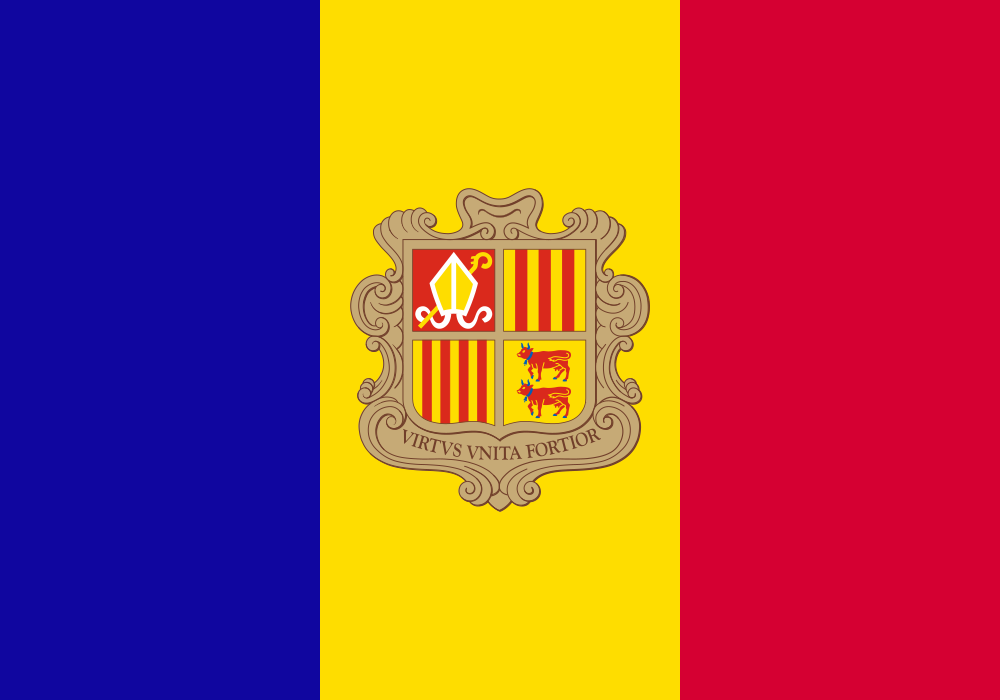
Andorra's time zone, Europe/Andorra, was officially recognized in the IANA database in 1993, reflecting its adoption of CET to align with co-princes France and Spain, despite the country's medieval origins as a co-principality dating back to 1278. This temporal harmony supports its role as a neutral haven, where clocks tick in unison with neighbors during events like the annual La Mercè festival on September 24, timed precisely to Catalan traditions.
Nestled in the Pyrenees mountains between France and Spain, Andorra is a tiny European principality known for its stunning alpine landscapes, tax-free shopping, and vibrant cultural heritage. With a population of around 80,000, this landlocked country operates on a single time zone, making it straightforward for travelers and businesses to coordinate schedules. The capital, Andorre-la-Vieille, embodies the nation's efficient rhythm, where the time zone aligns closely with neighboring European nations, facilitating seamless cross-border interactions.
Andorra adheres to Central European Time (CET), designated by the IANA time zone identifier Europe/Andorra, with a standard UTC offset of +1 hour. This places the entire country, including the bustling capital of Andorre-la-Vieille, firmly in sync with much of Western Europe, ensuring consistent timing for events, flights, and communications across its compact 468 square kilometers. As a microstate without its own extensive rail or aviation networks, Andorra relies on the time standards of its larger neighbors, France and Spain, both of which also follow CET, minimizing any disruptions for visitors arriving via bus from Barcelona or Toulouse.
Daylight saving time (DST) is observed in Andorra, marked as "oui" in official records, aligning with the European Union's directives despite the country's non-membership. Clocks spring forward by one hour on the last Sunday of March—typically around 2:00 AM local time—to become Central European Summer Time (CEST) at UTC+2. This adjustment lasts until the last Sunday of October, when clocks fall back to CET at the same 2:00 AM (which becomes 1:00 AM after the shift). These switchover dates promote energy savings during longer summer days and harmonize with international summer schedules, affecting everything from ski resort operations in winter to hiking trails in summer.
Regarding time differences with London, Andorra is generally one hour ahead year-round due to the UK's separate observance of Greenwich Mean Time (GMT) and British Summer Time (BST). In winter (from late October to late March), Andorra's CET (UTC+1) is one hour ahead of London's GMT (UTC+0), meaning a 9:00 AM meeting in Andorre-la-Vieille corresponds to 8:00 AM in the UK capital. During summer DST (late March to late October), Andorra's CEST (UTC+2) remains one hour ahead of London's BST (UTC+1), so the same 9:00 AM in Andorra aligns with 8:00 AM in London. This consistent one-hour gap simplifies planning for British tourists, who form a significant portion of Andorra's visitors, especially for winter sports or summer escapes. For those tracking the ISO code AD in global tools, this setup ensures Andorra's time is easily accessible via standard world clock apps, underscoring its integration into Europe's temporal framework without the complications of multiple zones.
Life in Andorra pulses with a Mediterranean-influenced cadence, blending Catalan traditions from Spain with French practicality, all adapted to the high-altitude Pyrenean setting. Typical meal times reflect this hybrid: breakfast is light and early, around 7:00–8:00 AM, often featuring coffee and pastries in local bakeries. Lunch, the main meal, occurs between 1:00 PM and 3:00 PM, with families and workers gathering for hearty dishes like escudella stew or trinxat cabbage, followed by a relaxed afternoon pause reminiscent of a siesta, though less formal than in Spain. Dinner is late, starting at 9:00 PM or later, emphasizing social dining in cozy mountain inns, where conversations linger under the stars.
Office and administrative hours generally run from 9:00 AM to 5:00 PM or 6:00 PM, Monday through Friday, but with a pronounced lunch break from 1:00 PM to 3:00 PM, during which many services pause. Government offices in Andorre-la-Vieille, handling everything from residency permits to tax queries, adhere to this schedule, closing promptly at day's end. Shops, a cornerstone of Andorra's economy due to its duty-free status, open around 9:30 AM and close by 8:00 PM, often with a midday siesta break in smaller locales; larger retail hubs in the capital extend to 10:00 PM. Sundays serve as the weekly rest day, with most businesses shuttered except for select tourist spots, allowing residents to recharge amid the mountains—perhaps attending mass or hiking.
Local specifics add flavor to this rhythm: the annual Fira de la Candèlora festival in February, timed to the Christian calendar, features candlelit processions starting at dusk, blending ritual with community bonding. Nightlife in Andorre-la-Vieille revs up after 10:00 PM, with bars and clubs in areas like Meritxell Avenue drawing crowds for live music until 2:00 AM or later, especially on weekends. In contrast, rural parishes wind down earlier, honoring the natural cycle. Sunrise and sunset times vary dramatically due to Andorra's latitude around 42°N; at the summer solstice (June 21), the sun rises about 6:15 AM and sets near 9:30 PM, extending daylight for outdoor pursuits, while the winter solstice (December 21) sees dawn at 8:20 AM and dusk by 5:00 PM, cozying up evenings around fireplaces. This seasonal shift influences everything from ski season peaks in December to vibrant summer markets, embedding the rhythm deeply in Andorra's alpine identity.