San José
Costa Rica
--:--
Costa Rica 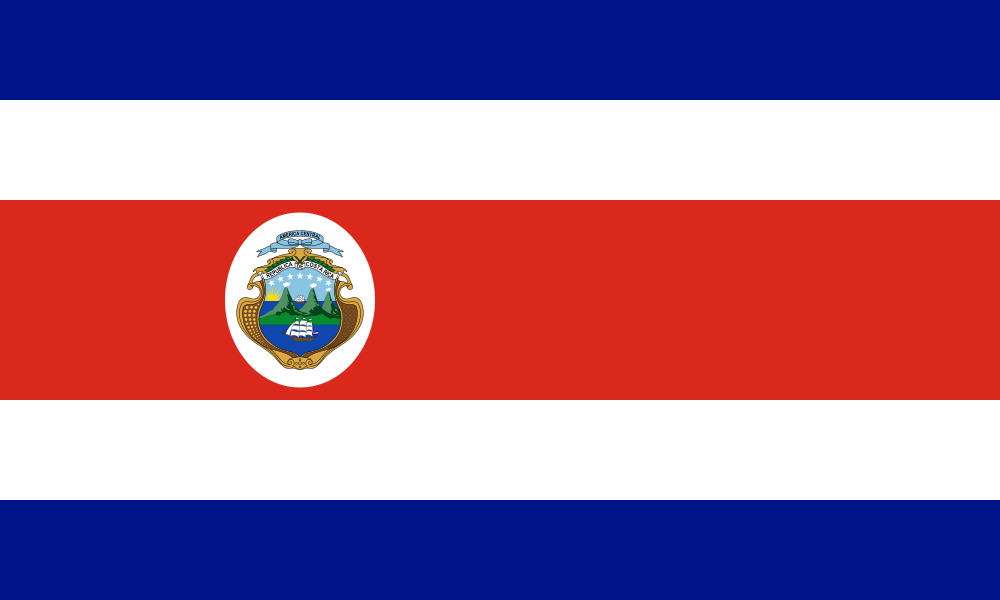
Costa Rica's decision to forgo daylight saving time since 1950 stems from its equatorial location, where seasonal daylight changes are negligible—unlike in Europe, this keeps the nation's clocks in sync with its consistent tropical sunrises, supporting efficient coffee production cycles that export over 80,000 tons annually without time disruptions.
Costa Rica, a vibrant nation in North America with a population of around 5.1 million, is renowned for its lush rainforests, pristine beaches, and commitment to environmental conservation. The country, whose ISO code is CR, operates on a single time zone, making it straightforward for travelers and businesses to coordinate schedules. Its capital, San José, embodies the nation's "Pura Vida" philosophy of pure life, where time flows with a relaxed yet efficient rhythm.
Costa Rica adheres to a single time zone across its entire territory, identified by the IANA time zone America/Costa_Rica, with a standard UTC offset of -6 hours. This consistency simplifies daily life and international interactions for the country's 5.1 million residents, from the bustling streets of San José to remote coastal villages. San José, the political and cultural heart of Costa Rica, follows this exact zone, ensuring that clocks in the capital align seamlessly with the rest of the nation—no regional variations complicate travel or communication here.
Unlike many North American neighbors, Costa Rica does not observe daylight saving time (DST), a policy in place since the country abolished it in 1950 after brief trials in the early 20th century. This decision reflects a practical approach suited to its tropical climate, where daylight hours remain relatively stable year-round due to its proximity to the equator. Without DST switchovers, there are no spring-forward or fall-back dates to remember; clocks stay fixed at UTC-6 throughout the seasons, avoiding the disruptions that affect places like the United States or Europe.
For those connecting with Costa Rica from afar, understanding the time difference with major cities is key. In winter (November to March), when London operates on Greenwich Mean Time (GMT, UTC+0), Costa Rica is six hours behind—meaning 9 a.m. in San José corresponds to 3 p.m. in the UK capital. During London's summer months (late March to late October), when British Summer Time (BST, UTC+1) is in effect, the gap widens to seven hours, so midday in Costa Rica aligns with late evening in London. This stable offset makes planning calls or flights predictable, especially for eco-tourists eyeing Costa Rica's biodiversity hotspots or business professionals dealing with its growing tech and coffee export sectors. Overall, the absence of DST underscores Costa Rica's emphasis on natural rhythms over artificial adjustments, fostering a sense of continuity in a country where time zones number just one.
Life in Costa Rica pulses to the beat of "Pura Vida," a laid-back yet purposeful cadence that integrates work, leisure, and nature. Typical meal times reflect this balance: breakfast, often gallo pinto (rice and beans) with fresh fruit, is enjoyed between 6 a.m. and 8 a.m., fueling the day ahead. Lunch, the largest meal and a social highlight, runs from noon to 2 p.m., with many offices closing briefly for casado—a hearty plate of rice, beans, meat, and plantains. Dinner follows lighter, around 6 p.m. to 8 p.m., allowing evenings for family gatherings or unwinding under the stars.
Office and administrative hours generally span 8 a.m. to 5 p.m., Monday through Friday, though the tropical heat often prompts siestas or flexible breaks in rural areas. Shops and markets buzz from 9 a.m. to 6 p.m., with larger stores in San José extending to 8 p.m.; banks operate 9 a.m. to 4 p.m. Sundays serve as the primary weekly rest day, when many businesses shutter, and locals prioritize church, beach outings, or hiking in national parks—over 25% of Costa Rica's land is protected, influencing this nature-centric downtime. Nightlife thrives in urban pockets like San José's Barrio Amón, where bars and salsa clubs come alive after 9 p.m., but the overall rhythm winds down early, respecting the early sunrises.
Sunrise and sunset times add to this equatorial harmony. At the summer solstice (around June 21), dawn breaks near 5:20 a.m. in San José, with sunset around 6:05 p.m., providing about 12 hours and 45 minutes of daylight. Winter solstice (December 21) sees sunrise at roughly 5:45 a.m. and sunset by 5:25 p.m., yielding similar balanced hours with minimal variation—unlike temperate zones, Costa Rica's daylight stays consistent at 11.5 to 12.5 hours annually. This stability shapes rituals like morning coffee harvests in the Central Valley or evening eco-tours spotting sloths and toucans, embedding time with the land's biodiversity. Whether navigating government offices for residency paperwork or joining a weekend rodeo (festejos típicos), Costa Ricans weave efficiency with relaxation, making the daily rhythm as inviting as the country's famed volcanoes and cloud forests.