Madrid
Spain
--:--
Madrid 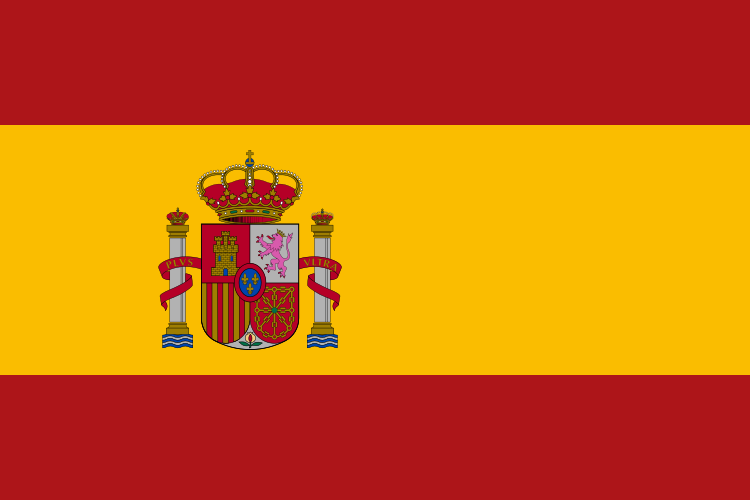
Plus Ultra
In 1940, during World War II, Francisco Franco's regime advanced Spain's clocks by one hour to align with Nazi Germany's time zone, a decision that persists today—making Spaniards among Europe's latest risers despite their longitude suggesting alignment with the UK. This shift, intended for wartime coordination, has cemented the nation's reputation for extended evenings and vibrant nightlife.
L'Espagne utilise CET (UTC+1), malgré sa position géographique occidentale.
Spain, officially the Kingdom of Spain, is a vibrant European nation on the Iberian Peninsula with a population of approximately 47 million people. As a key player in the European Union, its capital Madrid serves as the political and cultural heart, while the ISO code ES identifies it internationally. Spain operates across two primary time zones, reflecting its diverse geography from the mainland to the Atlantic Canary Islands, and it observes daylight saving time to harmonize with continental Europe. This temporal structure influences the country's famous late-night lifestyle, blending Mediterranean leisure with modern efficiency.
Spain's time organization spans two official IANA time zones, accommodating its mainland territory and overseas islands. The majority of the country, including the Iberian Peninsula, the Balearic Islands in the Mediterranean, and the North African enclaves of Ceuta and Melilla, follows the Europe/Madrid zone. This corresponds to Central European Time (CET), which is UTC+1 during standard time. In winter, cities like Madrid, Barcelona, Seville, and Valencia all align under this zone, ensuring synchronized operations across bustling urban centers and rural regions. For instance, Madrid, home to the Prado Museum and Royal Palace, experiences the same clock time as the coastal vibrancy of Barcelona's Sagrada Família.
The Canary Islands, an autonomous community off Africa's northwest coast, operate on a separate zone: Atlantic/Canary, which uses Western European Time (WET) at UTC+0 in standard periods. Major cities here, such as Las Palmas de Gran Canaria and Santa Cruz de Tenerife, reflect this offset, creating a one-hour difference from the mainland. This division stems from geographic and historical logic: the Canary Islands' position in the Atlantic, closer to Morocco than to Madrid, justifies the UTC+0 alignment to match solar time more closely and facilitate trade with Africa and the Americas. Politically, Spain maintains this setup to preserve the islands' unique identity while integrating them into the national framework. The choice avoids a single-zone imposition, which would misalign natural daylight in the Canaries—sunrise there would occur nearly an hour later if synced to CET. This dual-zone system supports Spain's diverse economy, from tourism in the sunny south to finance in Madrid, ensuring practical time management for the 47 million residents and millions of annual visitors exploring Europe's second-most visited country.
Spain observes daylight saving time (DST), aligning with most of the European Union to promote energy efficiency and extended evening daylight. The switch occurs twice a year: clocks spring forward by one hour on the last Sunday of March at 2:00 a.m. local time, shifting from CET (UTC+1) to Central European Summer Time (CEST, UTC+2). The reversal happens on the last Sunday of October at 3:00 a.m. CEST, falling back to CET. This practice, rooted in post-World War I energy conservation efforts, was standardized across Europe in the 1980s and helps Spain maximize sunlight for outdoor activities during the longer summer days.
The primary reasons include reducing electricity use for lighting and aligning business hours with brighter evenings, which boosts tourism and leisure in a sun-soaked climate. Practical consequences are noticeable in daily life: summer months extend usable daylight until 10 p.m. or later, fueling Spain's renowned late dinners and vibrant street festivals. However, the biannual changes can disrupt sleep patterns, especially for shift workers or parents, and have sparked debates in the EU about abolishing DST due to health impacts. For travelers, it's essential to adjust devices accordingly—apps like World Clock simplify this. In the Canary Islands, the same DST rules apply to their WET/WEST zones, maintaining the one-hour gap with the mainland year-round. Overall, these shifts enhance Spain's rhythmic balance between work and play, though some regions like the cooler north feel the extended evenings less acutely than the Mediterranean coast.
Spain's national rhythm is famously leisurely yet productive, shaped by its Mediterranean climate and cultural emphasis on social connections over strict schedules. Meals punctuate the day with a relaxed pace: breakfast (desayuno) is light around 8-9 a.m., often just coffee and toast, before work begins. Lunch (comida), the largest meal, typically falls between 2:00 p.m. and 3:30 p.m., featuring paella or tapas with family or colleagues—many offices close for this two-hour break, allowing a short siesta (nap) in hotter regions like Andalusia, though it's less common in urban Madrid. Dinner (cena) starts late, from 9:00 p.m. to 11:00 p.m., extending into lively conversations at tapas bars, reflecting a philosophy of savoring life rather than rushing.
Office hours generally run from 9:00 a.m. to 6:00 p.m. or 7:00 p.m., with a midday pause, differing from the non-stop Anglo-Saxon model. Shops and businesses often follow a split schedule: open 9:30 a.m. to 2:00 p.m., then reopen 4:30 p.m. to 8:00 p.m., accommodating the afternoon heat and siesta tradition. In major cities like Barcelona and Madrid, this rhythm fuels a dynamic nightlife—bars and clubs don't peak until midnight, with discos open until dawn on weekends. Documented local specifics include the "hora española," or Spanish time, where events start 15-30 minutes late, emphasizing flexibility. Festivals like La Tomatina or San Fermín align with this flow, turning evenings into communal celebrations. For the 47 million Spaniards, this structure fosters work-life balance, with generous vacation time (up to 30 days annually) and a cultural aversion to early bedtimes, making Spain a haven for night owls and travelers seeking authentic European vivacity.
Navigating time differences is key for connecting with Spain, a popular destination for UK and US travelers. Year-round, Spain's mainland (CET/CEST) is consistently one hour ahead of London (GMT/BST), as both observe DST simultaneously—meaning a 3:00 p.m. meeting in Madrid is 2:00 p.m. in the UK, simplifying scheduling without seasonal adjustments. Compared to New York (EST/EDT, UTC-5/-4), the offset is six hours: winter CET is six hours ahead of EST (e.g., noon in NYC is 6:00 p.m. in Madrid), and summer CEST maintains the six-hour gap over EDT. For Tokyo (JST, UTC+9, no DST), mainland Spain lags eight hours in winter (Tokyo midnight is Madrid 4:00 p.m. previous day) and seven hours in summer, ideal for evening calls from Japan aligning with Spanish mornings.
From the UK, the minimal one-hour difference allows flexible calling windows—anytime from 9:00 a.m. London time works for Spanish business hours, or evenings for casual chats without disrupting dinners. US callers from New York should target 8:00 a.m. to 4:00 p.m. EST to hit Spain's 2:00 p.m. to 10:00 p.m., avoiding very late nights; mornings in the US (e.g., 7:00 a.m. EST) catch early Spanish risers. For the Canary Islands, add one hour back to these offsets (e.g., five hours ahead of New York). Jet-lag recommendations for eastbound travelers from the US include gradual adjustment: advance sleep by an hour daily pre-flight and stay hydrated, as the six-hour shift can cause fatigue—exposure to morning light in Madrid helps reset circadian rhythms. Westbound from Europe, light exercise and avoiding caffeine eases the return. Apps like Time Buddy or Google Calendar's world clock feature prevent mishaps, ensuring seamless coordination for business trips to Barcelona or vacations in Seville, where understanding these nuances enhances the experience in this time-forward nation.
Spain primarily uses Central European Time (CET, UTC+1) for its mainland and the Balearic Islands, with the Canary Islands on Western European Time (WET, UTC+0). The capital Madrid follows CET, the same as cities like Barcelona and Valencia. During daylight saving time from late March to late October, these shift to CEST (UTC+2) and WEST (UTC+1), respectively.
Spain is always one hour ahead of London year-round, as both countries observe daylight saving time on the same dates. In winter, CET is UTC+1 while London is GMT (UTC+0); in summer, CEST (UTC+2) aligns with BST (UTC+1), maintaining the one-hour gap. This consistency makes planning calls or travel straightforward without seasonal surprises.
From the UK, call anytime during standard business hours (9:00 a.m. to 6:00 p.m. London time) to match Spain's schedule, given the one-hour difference—ideal for evenings too, as Spaniards dine late. From the US East Coast, aim for 8:00 a.m. to 3:00 p.m. EST to hit Spain's 2:00 p.m. to 8:00 p.m., avoiding overnight disruptions. For travel, spring (April-June) or fall (September-October) offer mild weather and fewer crowds, aligning with post-DST energy.
Spain's daily rhythm features late lunches around 2:00-3:00 p.m. and dinners from 9:00 p.m., with shops often closing midday for siesta. The Alhambra in Granada, a UNESCO site, opens daily from 8:30 a.m. to 8:00 p.m. in summer (varying seasonally), but tickets sell out fast—book online for morning slots to beat crowds and heat. This reflects the unhurried pace, where afternoons are for rest and evenings for socializing.
Spain's two time zones—Europe/Madrid for the mainland and Atlantic/Canary for the islands—stem from geography, with the Canaries' Atlantic location warranting UTC+0 to match solar noon better. A notable local specificity is the "hora española," where social events or meetings often start 15-30 minutes late, prioritizing relationships over punctuality in this warm, convivial culture.