Asunción
Paraguay
--:--
Asuncion 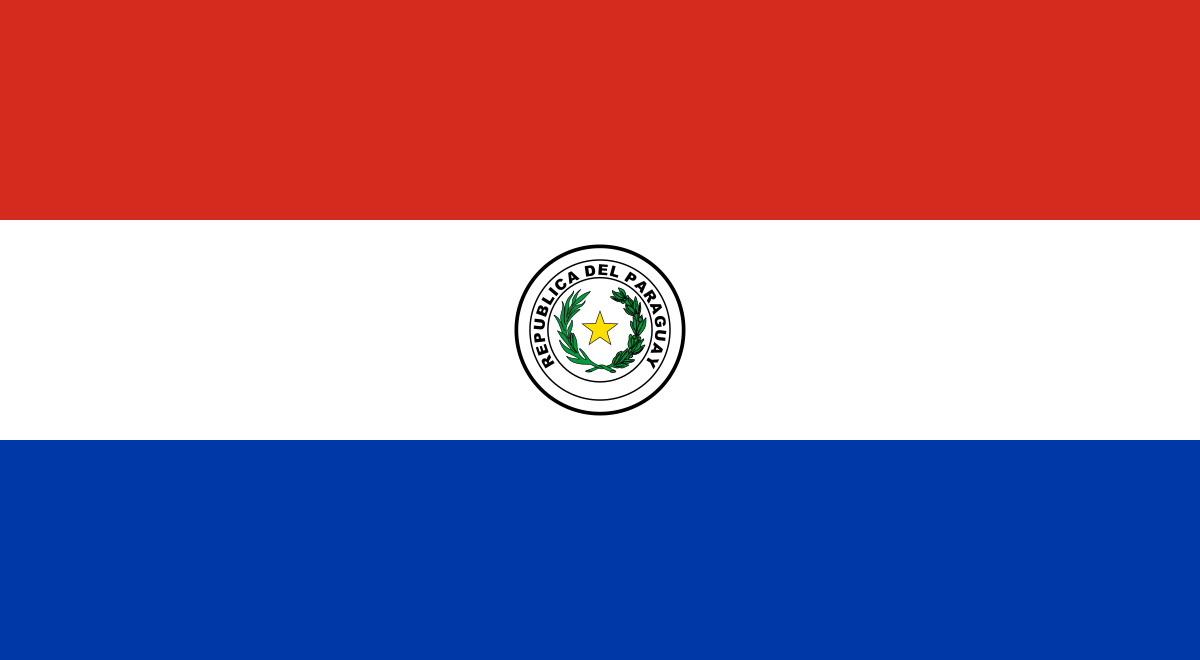
Paraguay's observance of daylight saving time dates back to 1960, but it was notably suspended from 2009 to 2016 due to public confusion and minimal energy savings, resuming only after parliamentary debate—highlighting the country's pragmatic approach to temporal adjustments. In Asunción, the historic Torre del Reloj (Clock Tower) at the port chimes hourly, a colonial-era marker that has synchronized the city's rhythm since the 19th century.
Nestled in the heart of South America, Paraguay is a landlocked nation known for its rich Guarani heritage, stunning natural landscapes like the Pantanal wetlands, and a population of around 7 million people. The country's international name is Paraguay, with the ISO code PY, and its capital, Asunción, serves as the bustling political and cultural hub. Paraguay operates on a single time zone, making it straightforward for travelers and businesses to coordinate schedules across its 406,752 square kilometers.
Paraguay adheres to a single time zone, officially designated as America/Asuncion in the IANA time zone database. This zone follows Paraguay Time (PYT) with a standard UTC offset of -4 hours, placing it four hours behind Coordinated Universal Time during non-daylight saving periods. Asunción, the vibrant capital on the Paraguay River, shares this exact time zone, ensuring uniformity for the entire country—from the urban energy of Ciudad del Este to the serene rural expanses in the Chaco region.
Daylight saving time (DST) is observed in Paraguay, marked as "oui" in international notations, which shifts clocks forward by one hour to Paraguay Summer Time (PYST) at UTC-3. The transition begins at midnight on the first Sunday of October, when clocks are advanced, and ends at midnight on the fourth Sunday of March, when they are set back. This practice, reintroduced in 2017 after a hiatus, aims to extend evening daylight during the warmer months and aligns with agricultural and energy-saving needs in this subtropical climate. For instance, in 2023, DST started on October 1 and concluded on March 24.
When comparing to London, which uses Greenwich Mean Time (GMT, UTC+0) in winter and British Summer Time (BST, UTC+1) from late March to late October, the time difference varies seasonally. During Paraguay's standard time (April to September), it is typically 4 hours behind London in winter (when London is on GMT) and 5 hours behind during London's summer (BST). In Paraguay's DST period (October to March), the gap narrows to 3 hours behind London in midwinter (GMT) but remains 4 hours behind during overlapping summer periods (BST). This makes scheduling calls or flights from the UK relatively predictable, though tools like world clocks are recommended for precise overlaps. Overall, Paraguay's time zone simplifies regional coordination in South America, where neighbors like Brazil and Argentina may have multiple zones, but its DST observance adds a layer of adjustment for international dealings.
Life in Paraguay pulses with a blend of indigenous Guarani traditions and Spanish colonial influences, creating a relaxed yet vibrant daily rhythm that emphasizes family, community, and the natural flow of the day. Meals anchor the schedule: breakfast (desayuno) is light and early, often around 7-8 a.m., featuring chipa (a cheesy bread) or mate tea shared communally. Lunch (almuerzo), the largest meal, typically occurs between 12 p.m. and 2 p.m., with staples like sopa paraguaya (cornbread) or grilled meats, followed by a short rest—though the traditional siesta is less rigid here than in neighboring countries, many offices pause briefly for this midday break. Dinner (cena) is late, starting around 8-10 p.m., often lighter and social, extending into evening gatherings.
Office and administrative hours generally run from 7 or 8 a.m. to 5 p.m., Monday through Friday, with government buildings like those in Asunción closing for lunch. Shops and markets, such as the iconic Mercado 4 in the capital, open around 8 a.m. and stay bustling until 8 or 9 p.m., catering to the evening shopping culture. Banks and services adhere to 8:30 a.m.-3 p.m. weekdays, reflecting a practical approach in this economy driven by agriculture and services. Sundays serve as the primary weekly rest day, with most businesses closed and families prioritizing church, tereré (cold mate) sessions, or outings to the Paraná River—embodying the Paraguayan value of "tranquilo" (calm) pacing.
Nightlife adds flair, especially in Asunción, where bars and clubs like those in the Villa Morra district come alive after 10 p.m. on weekends, fueled by polka-infused music and late-night asados (barbecues). Local specifics include the ritual of mate drinking at any hour, symbolizing hospitality, and festivals like Carnival in February, which disrupt routines with all-night celebrations. Sunrise and sunset times in Asunción vary seasonally: on the summer solstice (around December 21), the sun rises about 5:35 a.m. and sets near 7:40 p.m., offering long days for outdoor activities; in winter (June 21), it's roughly 7:05 a.m. to 5:35 p.m., shortening the active hours but highlighting cozy indoor traditions. This rhythm fosters a balanced life, where time feels flexible yet tied to the land's cycles, appealing to visitors seeking an authentic South American experience.