Montevideo
Uruguay
--:--
Montevideo 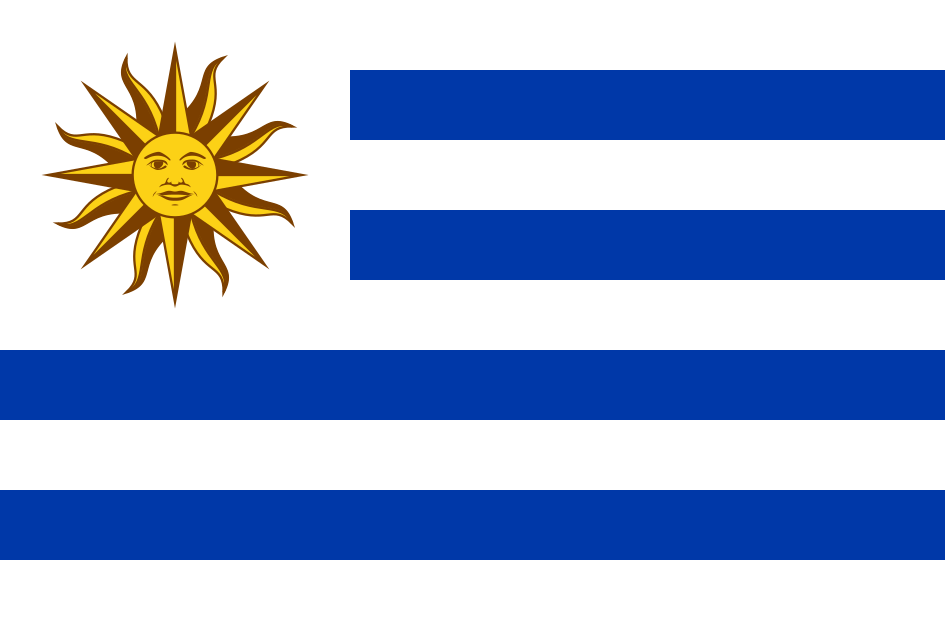
Uruguay was one of the first countries in South America to adopt standard time zones in 1927, aligning with UTC-3 to facilitate trade with Europe, a legacy that persists today without DST interruptions. This early adoption helped Montevideo become a key port for synchronized shipping schedules in the early 20th century.
Uruguay, a small yet vibrant nation in South America with a population of around 3.5 million, is bordered by Brazil, Argentina, and the Atlantic Ocean. Its capital, Montevideo, serves as the cultural and economic hub, embodying the country's laid-back yet progressive spirit. Uruguay operates on a single time zone, Uruguay Time (UYT), which keeps the entire country synchronized without the complications of multiple zones or seasonal shifts.
Uruguay maintains a straightforward approach to timekeeping with just one time zone across its territory, making it easy for travelers and businesses to adjust. The official time zone is America/Montevideo in IANA notation, with a fixed UTC offset of -3 hours year-round. This means that whether you're in the bustling streets of Montevideo or the serene beaches of Punta del Este, the clock reads the same, reflecting Uruguay's compact geography and unified national rhythm.
Montevideo, the capital and largest city, fully adheres to this zone, where local time is consistently three hours behind Coordinated Universal Time (UTC-3). For international coordination, this offset simplifies planning but requires awareness of global variations. Notably, Uruguay does not observe Daylight Saving Time (DST), a policy in place since 2015 when the country abolished the practice to avoid disruptions to daily life and agriculture. Prior to that, Uruguay had experimented with DST, typically starting in the first Sunday of October and ending in the third Sunday of March, but the decision to discontinue it has stabilized schedules and reduced confusion for residents and visitors alike.
When comparing to London, the time difference highlights Uruguay's position in the Western Hemisphere. In winter (November to March in the Southern Hemisphere, aligning with London's summer), Uruguay is four hours behind London due to the UK's observance of British Summer Time (BST, UTC+1). During London's winter (October to March, UTC+0), the gap narrows to three hours behind. This consistent setup without DST in Uruguay ensures predictable differences: for example, when it's noon in Montevideo, it's 3 p.m. in London during UK winter and 4 p.m. during UK summer. Such reliability aids in scheduling calls or flights, especially for those connecting South America with Europe. Overall, Uruguay's single, unchanging time zone promotes efficiency in a region often fragmented by varying offsets, from UTC-2 in parts of Brazil to UTC-4 in Argentina during DST periods. This stability underscores Uruguay's modern, pragmatic approach to time management, benefiting its ISO code UY economy focused on exports like beef and soybeans.
Life in Uruguay flows with a relaxed yet structured pace, influenced by its Mediterranean-like climate and strong European heritage from Italian and Spanish immigrants. Meals anchor the day, starting with a light breakfast around 7-9 a.m., often featuring mate—a traditional herbal tea sipped communally throughout the day as a social ritual rather than a formal meal. Lunch, the largest meal, typically occurs between 12 p.m. and 2 p.m., with families and colleagues gathering for asado (barbecue) or pasta dishes; this mid-day break can extend office hours slightly, though a full siesta is uncommon in urban areas like Montevideo.
Office and administrative hours generally run from 9 a.m. to 5 p.m., Monday through Friday, with banks and government offices opening around 10 a.m. and closing by 4 p.m. Shops and businesses follow suit, often from 9 a.m. to 7 p.m., but many close for lunch between 1 p.m. and 3 p.m., especially in smaller towns. In Montevideo, the pace quickens with a vibrant after-work culture; dinner is late, starting at 8-10 p.m., allowing time for evening strolls along the Rambla waterfront. Nightlife thrives post-10 p.m., with tango clubs, bars, and candombe drum sessions pulsing into the early hours, particularly on weekends. Sunday serves as the primary day of rest, when most shops shutter and families prioritize relaxation or beach outings, embodying the Uruguayan value of "tranquilidad" (tranquility).
Seasonal daylight variations add nuance to this rhythm. At the summer solstice in December, sunrise in Montevideo occurs around 5:25 a.m., with sunset near 8:35 p.m., extending evenings for outdoor activities like soccer matches or parrilladas. In contrast, the winter solstice in June brings sunrise at about 7:50 a.m. and sunset by 5:50 p.m., prompting earlier indoor gatherings and cozy mate sessions. These patterns influence everything from agricultural work in the countryside—where farmers rise with the dawn—to urban festivals like Carnival in February, when the long days fuel all-night celebrations. Uruguay's daily cadence, free from DST disruptions, fosters a balanced lifestyle that harmonizes work, leisure, and community ties.
The overall seo_text integrates keywords like "time in Uruguay," "Uruguay time zone," and "daily rhythm in Uruguay" naturally to optimize for searches on travel, business, and cultural planning. With its single time zone and no DST, Uruguay offers seamless synchronization for global visitors, while its meal times and late dinners reflect a warm, unhurried South American vibe.