Kaboul
Afghanistan
--:--
Kabul 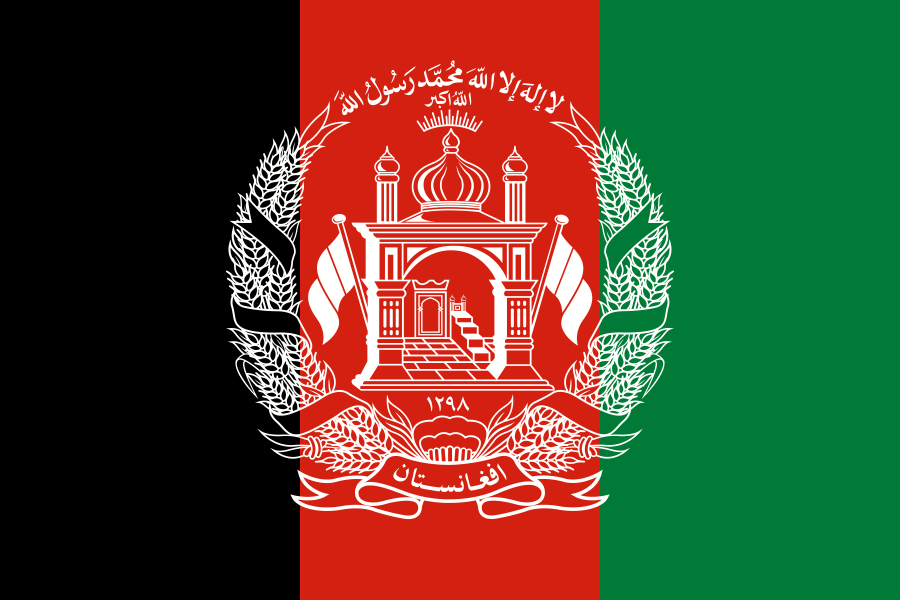
Afghanistan's unique UTC+4:30 offset, established in 1917, makes it one of only a handful of countries worldwide using a half-hour deviation, originally aligned to the mean solar time of Kabul at 69 degrees east longitude. This quirky timing has persisted through political upheavals, distinguishing Afghan clocks from neighbors like Pakistan (UTC+5) and Iran (UTC+3:30).
Afghanistan, a landlocked nation in South Asia with a population of around 40 million, is known for its rugged mountains, rich history, and resilient culture. The country operates on a single time zone, Afghanistan Standard Time (AFT), which simplifies coordination across its diverse regions. This unified time system reflects the nation's efforts to maintain national cohesion amid its varied geography, influencing everything from daily prayers to business hours in the capital, Kabul. Understanding Afghanistan's time organization provides insight into the rhythmic flow of life, where Islamic traditions and modern challenges shape the pace of the day.
Afghanistan adheres to a single time zone, making it one of the simpler countries in Asia for time management. The official IANA time zone identifier is Asia/Kabul, corresponding to Afghanistan Standard Time (AFT) with a UTC offset of +4:30. This half-hour deviation from standard UTC hours is unusual but practical for the region's longitudinal position, which centers around 65–70 degrees east—aligning roughly with UTC+4 but adjusted for local solar time.
The capital, Kabul, located in the eastern part of the country at approximately 69 degrees east longitude, serves as the primary reference point for this zone. Other major cities, including Herat in the west (62 degrees east), Kandahar in the south (65 degrees east), and Mazar-i-Sharif in the north (67 degrees east), all follow Asia/Kabul without variation. This single-zone approach spans Afghanistan's 652,000 square kilometers, from the Hindu Kush mountains to the arid deserts, despite the country stretching over about 30 degrees of longitude. Politically, this unification dates back to the early 20th century under King Amanullah Khan, who standardized time to foster administrative efficiency and national identity. Geographically, while western areas like Herat experience sunrise slightly earlier (around 20–30 minutes ahead of Kabul in winter), the single zone avoids the fragmentation seen in larger neighbors like Russia or China. This setup supports seamless operations for government offices, transportation, and trade, particularly along the historic Silk Road routes. For travelers or businesses dealing with Afghanistan's ISO code AF, recognizing this +4:30 offset is crucial to avoid scheduling mishaps. In a country where mobile networks and internet access are improving, tools like world clocks set to Asia/Kabul ensure accurate timing for calls or virtual meetings. Overall, this streamlined time zone underscores Afghanistan's commitment to simplicity in a complex geopolitical landscape, aiding everything from aid deliveries to cultural exchanges across its urban centers.
Afghanistan does not observe Daylight Saving Time (DST), maintaining Afghanistan Standard Time (AFT) at UTC+4:30 year-round. This policy has been consistent since the country's time standardization in 1917, with no historical switchovers to adjust for seasonal light changes. The decision stems from several factors: Afghanistan's predominantly agrarian and pastoral economy, where farmers and herders rely on consistent solar cues rather than clock adjustments; the Islamic lunar calendar's influence, which prioritizes religious observances over artificial time shifts; and practical challenges in a rugged terrain with limited infrastructure for widespread clock changes.
Without DST, there's no spring-forward or fall-back, eliminating the biannual disruptions common in Europe or North America. This stability benefits daily life, as prayer times (salat) follow the sun's position via the Hijri calendar, and fixed clocks align reliably with these. However, it means longer evenings in summer without the extra hour of daylight, potentially affecting energy use in cities like Kabul where electricity shortages are frequent. For international dealings, the unchanging offset simplifies planning—no need to track DST transitions in Afghanistan itself. Travelers appreciate this predictability, though it can lead to minor mismatches with DST-observing countries. In essence, the absence of DST reinforces Afghanistan's cultural and practical focus on natural rhythms over imposed changes, promoting a steady national tempo amid seasonal extremes from harsh winters to hot summers.
In Afghanistan, the daily rhythm is deeply intertwined with Islamic traditions, family-oriented customs, and the demands of a developing economy, creating a pace that starts early and winds down with the sunset. Breakfast, often simple fare like naan bread, tea, and yogurt, is typically eaten around 6–7 a.m., shortly after the dawn prayer (Fajr), especially in rural areas where the call to prayer echoes from mosques. Lunch, the main meal featuring rice pilaf (kabuli pulao), kebabs, or stews, occurs between 1–2 p.m., aligning with the midday Zuhr prayer and providing a break from work or studies. Dinner is later, around 8–9 p.m. or even after the Isha prayer, emphasizing communal gatherings in homes, as street food culture is subdued due to security concerns.
Office hours in government and private sectors generally run from 8 a.m. to 4:30 p.m., Monday through Thursday, with a half-day on Friday for Jumu'ah prayers—reflecting the workweek's adjustment to the Islamic calendar. Shops and markets, vibrant in Kabul's bustling bazaars like the Chicken Street market, open as early as 7 a.m. and close around 7–8 p.m., pausing briefly for prayers five times a day. In larger cities, some businesses extend hours during Ramadan, when the fast from dawn to dusk shifts the entire schedule later. Nightlife is modest and centered in Kabul or Herat, with teahouses (chaikhanas) serving as social hubs until 10 p.m., offering qawwali music or informal chats rather than Western-style clubs—though upscale restaurants in safer districts may stay open later for locals and expats.
Local specifics highlight resilience: In mountainous regions like Bamiyan, days follow seasonal herding patterns, with longer summer evenings for community events. Urban youth in Kabul increasingly blend traditional timings with digital influences, using apps for prayer alerts. Overall, this rhythm fosters a sense of continuity, where time in Afghanistan revolves around faith, family, and adaptation to challenges like power outages, creating a uniquely grounded lifestyle.
Afghanistan's UTC+4:30 offset positions it ahead of major Western cities, facilitating certain communication windows but requiring awareness for travelers. Compared to London, which uses Greenwich Mean Time (GMT, UTC+0) in winter and British Summer Time (BST, UTC+1) from late March to late October, Afghanistan is 4 hours and 30 minutes ahead in winter and 3 hours and 30 minutes ahead during London's summer DST. For New York, on Eastern Standard Time (EST, UTC-5) in winter and Eastern Daylight Time (EDT, UTC-4) in summer, the difference is 9 hours and 30 minutes ahead in winter (Afghanistan morning aligns with New York evening) and 8 hours and 30 minutes in summer. Paris, on Central European Time (CET, UTC+1) winter and CEST (UTC+2) summer, sees Afghanistan 3 hours and 30 minutes ahead in winter and 2 hours and 30 minutes in summer—useful for European business ties.
For calls from the UK, the best window is early morning London time (7–9 a.m. GMT), corresponding to late afternoon in Kabul (11:30 a.m.–1:30 p.m. AFT), when offices are active before evening prayers. From the US East Coast, aim for late afternoon New York time (3–5 p.m. EST), hitting early evening in Afghanistan (7:30–9:30 p.m. AFT), ideal for personal chats post-dinner. Avoid Fridays after noon UK/US time, as it's the Afghan weekend start. Use apps like World Time Buddy for precise scheduling, considering Afghanistan's single unchanging zone.
Jet-lag tips for travelers: Flying from London (about 7 hours) or New York (13–15 hours via Dubai or Istanbul) eastward, expect 1–2 days of adjustment to the +4:30 shift—combat it by advancing sleep schedules pre-flight and staying hydrated amid dry Afghan air. From the US, split the journey with a stopover to ease the 9+ hour gap; upon arrival in Kabul International Airport, align with local prayer times for natural cues. Business visitors should plan arrivals mid-week to sync with office rhythms, while tourists benefit from summer visits when longer days aid acclimation despite no DST.
Afghanistan operates in the Asia/Kabul time zone, which is UTC+4:30 year-round. This single zone covers the entire country, including Kabul, with no variations for regions. For the exact current time, check a reliable world clock tool set to Asia/Kabul.
Afghanistan does not observe Daylight Saving Time, sticking to UTC+4:30 consistently. The offset with London is +4:30 hours in winter (GMT) and +3:30 hours during British Summer Time. This stability simplifies planning without seasonal adjustments.
From the UK, call between 7–10 a.m. London time for 11:30 a.m.–2:30 p.m. in Afghanistan, catching business hours. From the US East Coast, 4–7 p.m. New York time aligns with 8:30–11:30 p.m. Kabul time for evenings. For travel, spring (April–June) or autumn (September–October) offer mild weather and fewer crowds, easing jet lag adjustment.
Offices in Kabul generally open at 8 a.m. and close by 4:30 p.m., Monday to Thursday, with Friday half-days ending around 12:30 p.m. for prayers. Major sites like the National Museum operate 9 a.m.–5 p.m., but always confirm as hours can shift for holidays or security.
The Hijri lunar calendar influences daily life by setting prayer times to solar positions and holidays like Eid, which shift annually against the Gregorian calendar. This creates a layered time sense, where fixed clocks blend with variable religious rhythms for events and fasting periods.