Phnom Penh
Cambodia
--:--
Phnom Penh 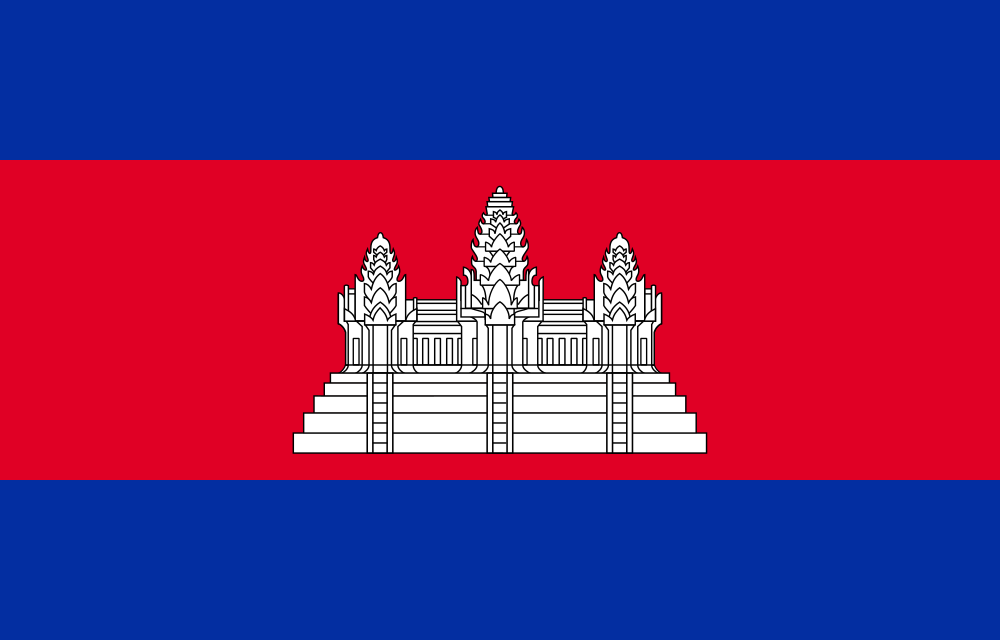
Cambodia's Khmer calendar, a lunisolar system dating back over 1,000 years, counts years from 78 CE and dictates the timing of major holidays like the Water Festival (Bon Om Touk) in November, which celebrates the Mekong River's reversal with boat races and full-moon illuminations. This calendar ensures that traditional events remain tied to natural cycles, even as the Gregorian system handles global business.
Cambodia, a vibrant Southeast Asian nation officially known as the Kingdom of Cambodia, captivates visitors with its ancient temples, lush landscapes, and rich cultural heritage. Home to approximately 17 million people, this ISO KH-coded country spans the Indochinese Peninsula, with Phnom Penh as its bustling capital. Cambodia operates on a single time zone, Indochina Time (ICT), which simplifies travel and daily coordination across its diverse regions. This unified time system reflects the country's compact geography and aligns with neighboring nations, fostering a national rhythm that blends traditional Khmer lifestyles with modern urban pulses.
Cambodia maintains a straightforward time zone structure with just one official zone, making it one of the simpler countries for international travelers to navigate. The sole time zone is Asia/Phnom_Penh, based on the IANA (Internet Assigned Numbers Authority) designation, which observes Indochina Time at UTC+7 year-round. This offset places Cambodia seven hours ahead of Coordinated Universal Time (UTC), ensuring consistency from the coastal regions in the south to the mountainous north. Phnom Penh, the political and economic heart of the country, fully embodies this zone, where government offices, markets, and the iconic Royal Palace all synchronize to Asia/Phnom_Penh. Other key cities like Siem Reap—gateway to the majestic Angkor Wat complex—and Battambang, known for its colonial architecture and bamboo trains, also adhere strictly to this single zone. Even remote areas, such as the Cardamom Mountains or the Mekong River delta towns like Kratie, follow the same timing without deviations.
This unified approach stems from Cambodia's relatively small land area of about 181,000 square kilometers, which doesn't warrant multiple zones like larger neighbors such as China or Russia. Politically, it promotes national cohesion in a country recovering from historical turmoil, allowing seamless communication for the 17 million residents spread across 25 provinces. Geographically, Cambodia's position in mainland Southeast Asia justifies alignment with the Indochina Time bloc, shared by Thailand, Vietnam, and Laos, facilitating regional trade and tourism. For instance, a flight from Bangkok to Phnom Penh involves no time adjustment, easing cross-border business. This setup also supports the tourism industry, which draws over 6 million visitors annually, as global booking systems and apps like World Clock effortlessly display "Cambodia time" without confusion. In practice, the Asia/Phnom_Penh zone ensures that events like the annual Water Festival in Phnom Penh or temple visits in Siem Reap start on schedule, regardless of location. Overall, this single-zone policy underscores Cambodia's emphasis on simplicity and harmony, mirroring its Buddhist-influenced culture where punctuality blends with flexible social norms.
Cambodia does not observe Daylight Saving Time (DST), maintaining its UTC+7 offset throughout the year without any clock adjustments. This decision aligns with most tropical countries in Southeast Asia, where the consistent daylight hours—averaging 12 hours from sunrise to sunset—eliminate the need for seasonal shifts. Introduced in various temperate regions to conserve energy during summer, DST has little relevance in Cambodia's equatorial climate, where temperatures hover between 25°C and 35°C year-round, and sunlight patterns remain stable. The government has never implemented DST, even during colonial influences or post-independence eras, prioritizing stability over potential minor energy savings that wouldn't significantly impact the nation's agriculture-based economy.
The absence of DST brings practical benefits, such as predictable scheduling for businesses and daily life, avoiding the twice-yearly disruptions that can confuse travelers or shift workers. For locals, it means unchanging routines: farmers in rural provinces like Kampot rise with the dawn at around 5:30 AM, unaffected by artificial time changes. Internationally, it simplifies coordination; a virtual meeting set for 9 AM in Phnom Penh remains fixed, regardless of seasons in DST-observing countries. However, visitors from Europe or North America might initially overlook this, leading to minor scheduling hiccups during peak travel months like November to February, when cooler weather draws crowds to sites like Angkor. In essence, Cambodia's no-DST policy enhances its appeal as a reliable destination, where time flows steadily amid the rhythm of monsoon rains or dry-season festivals.
Cambodia's daily rhythm pulses with a mix of traditional Khmer customs and contemporary urban energy, shaped by its tropical climate and Buddhist heritage. Mornings often start early, around 5-6 AM, with street markets in Phnom Penh or Siem Reap buzzing as vendors prepare fresh noodle soups like kuy teav for breakfast, typically eaten between 6-8 AM. Lunch, the main meal, falls around noon to 1 PM, featuring rice-based dishes such as lok lak or fish amok, often shared family-style in homes or roadside eateries. Dinner is lighter and later, from 6-8 PM, though in rural areas, it might wrap up by 7 PM to align with early bedtimes.
Office hours in the capital and larger cities generally run from 8 AM to 5 PM, Monday through Friday, with a possible siesta-like break during the midday heat, especially in government buildings or NGOs. Private businesses, including banks and tech startups, mirror this but may extend to 6 PM in tourist hubs. Shops and markets, however, operate more flexibly: central markets like Phsar Thmei in Phnom Penh open from 6 AM to 8 PM, while smaller stalls might close by 6 PM outside peak seasons. In coastal Sihanoukville, beachside vendors adapt to tourist flows, staying open until 10 PM.
Nightlife adds vibrancy, particularly in major cities. Phnom Penh's riverside bars and clubs along Sisowath Quay thrum from 8 PM onward, with spots like the Heart of Darkness nightclub drawing crowds until 2 AM or later on weekends. Siem Reap's Pub Street offers a tamer scene, with live music and cocktails from 7 PM to midnight, catering to temple-weary explorers. Local specifics include the influence of Theravada Buddhism, prompting many to avoid late nights on holy days or during festivals like Pchum Ben in October, when families prioritize ancestral rituals over socializing. Workweeks can feel shorter in rural areas, where agricultural cycles—planting rice in the wet season (May-October)—dictate pauses, and monks' alms rounds at dawn set a serene tone. This blend creates a laid-back yet purposeful pace, where "Cambodia time" often means a relaxed approach to schedules, emphasizing relationships over rigid clocks.
Navigating time differences is key for connecting with Cambodia, which sits at UTC+7 and never shifts for DST. Compared to London, which uses Greenwich Mean Time (GMT, UTC+0) in winter and British Summer Time (BST, UTC+1) from late March to late October, Cambodia is 7 hours ahead in winter and 6 hours ahead during London's summer. For New York, operating on Eastern Standard Time (EST, UTC-5) in winter and Eastern Daylight Time (EDT, UTC-4) from March to November, the gap is a substantial 12 hours ahead in winter and 11 hours in summer—meaning midday in New York aligns with early morning the next day in Phnom Penh. Tokyo, at Japan Standard Time (JST, UTC+9) year-round, is just 2 hours ahead of Cambodia, a minor difference that supports easy regional calls.
For those in the UK calling family or business contacts in Cambodia, the best windows are early mornings: a 7-9 AM London start corresponds to 2-4 PM in Phnom Penh, ideal for afternoon meetings without encroaching on evenings. Avoid late UK nights, as 10 PM London time hits 5 AM the next day in Cambodia, when most are asleep. From the US East Coast, aim for 8-10 AM New York time, which lands at 8-10 PM in Cambodia—perfect for casual chats or wrapping up workdays. West Coast callers should target 5-7 AM Pacific Time for similar evening overlaps.
Jet-lag tips are crucial for travelers: flying east from London (about 12 hours) or New York (up to 20 hours with layovers) often causes fatigue from the advance. To mitigate, adjust sleep gradually pre-flight—shift bedtime earlier by an hour daily—and stay hydrated amid Cambodia's humidity. Upon arrival, embrace the local rhythm: hit Angkor Wat at sunrise to sync with early risers, and nap briefly if needed, but avoid caffeine after noon. Apps like Time Buddy or world clocks on smartphones help track "time in Cambodia" seamlessly. For business trips, schedule arrivals mid-week to acclimate before key events, ensuring you're attuned to Phnom Penh's 8 AM starts. These strategies turn potential disorientation into smooth immersion in Cambodia's timeless allure.
Cambodia operates in the Indochina Time zone (ICT), designated as Asia/Phnom_Penh in IANA standards, which is UTC+7. This single time zone covers the entire country, including the capital Phnom Penh and cities like Siem Reap. There are no variations or sub-zones, making it straightforward for visitors and remote workers.
Cambodia is 7 hours ahead of London during UK winter (GMT) and 6 hours ahead during British Summer Time (BST). Cambodia does not observe Daylight Saving Time, so its UTC+7 offset remains constant year-round. This stability simplifies planning compared to London's seasonal changes.
From the UK, the optimal calling window is 7-10 AM London time, which corresponds to 2-5 PM in Cambodia, aligning with afternoon availability. For the US East Coast, dial between 8-11 AM EST/EDT, hitting 8-11 PM Cambodian time for evening convenience. These slots minimize disruptions to sleep or work routines on either side.
In Phnom Penh, offices and banks typically open from 8 AM to 5 PM, Monday to Friday, with a short lunch break around noon. Markets and shops run longer, from 6 AM to 8 PM, reflecting the city's lively street-food scene and early starts. The rhythm slows in the evening heat, with nightlife picking up around 8 PM.
Cambodia follows the Gregorian calendar for official and international purposes but integrates the ancient Khmer lunisolar calendar for cultural events. This results in festivals like Khmer New Year falling in mid-April, based on lunar cycles rather than fixed dates. It adds a layer of seasonal timing to daily life, blending modern clocks with traditional observances.