Johannesburg
South Africa
--:--
Johannesburg 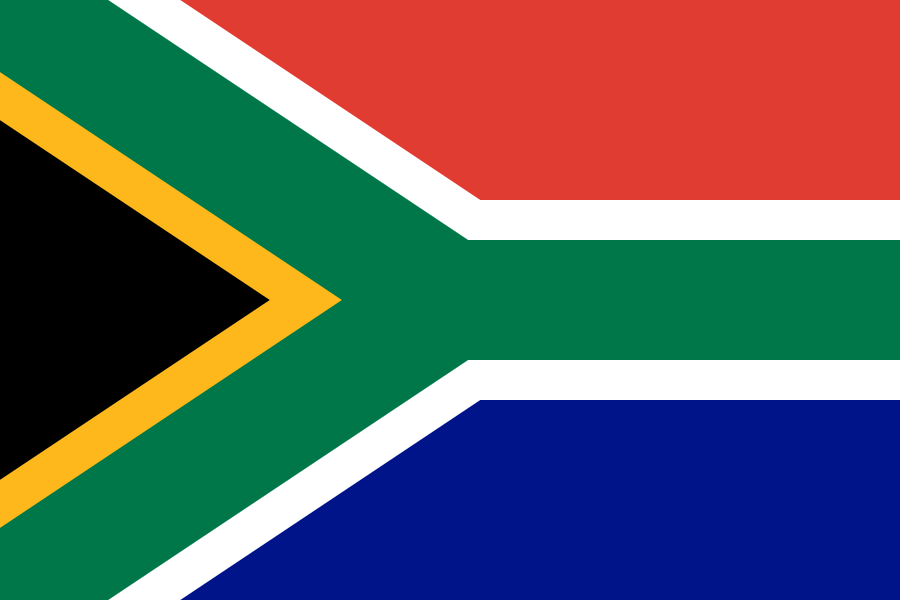
L'unité dans la diversité
South Africa's single time zone was formalized in 1903 to standardize railway schedules across former Boer republics and British colonies, preventing delays that once plagued gold rush shipments from Johannesburg mines. This unification helped transform the nation into Africa's rail hub, with the Blue Train luxury service still running on precise SAST timings today.
L'Afrique du Sud utilise SAST (UTC+2) toute l'année.
South Africa, officially the Republic of South Africa, is a vibrant nation located at the southern tip of the African continent, bordered by the Atlantic and Indian Oceans. With a population of approximately 60 million people and Pretoria as its administrative capital, it spans diverse landscapes from the arid Kalahari Desert to lush coastal regions. The country operates on a single time zone, South Africa Standard Time (SAST), which simplifies coordination across its vast territory of over 1.2 million square kilometers. This unified system reflects South Africa's commitment to national cohesion in a post-apartheid era. In this article, we explore the structure of time in South Africa, including its time zone details, daily rhythms influenced by its multicultural society, historical context, and practical advice for travelers and business professionals. Whether you're planning a safari in Kruger National Park or scheduling a meeting with Johannesburg executives, understanding South Africa's temporal framework ensures seamless engagement with this dynamic economy.
South Africa maintains a straightforward time zone structure with just one official IANA time zone covering the entire country: Africa/Johannesburg. This zone adheres to South Africa Standard Time (SAST), fixed at UTC+2 year-round, without any observance of daylight saving time. The decision for a single time zone stems from both political and geographic considerations; politically, it promotes unity across the nation's nine provinces, which include linguistically and culturally diverse regions like the Zulu-dominated KwaZulu-Natal and the Afrikaans-speaking Western Cape. Geographically, South Africa's longitude ranges from about 16°E to 33°E, placing much of its territory east of the Greenwich meridian, which naturally aligns with a +2 hour offset from Coordinated Universal Time (UTC). This positioning makes it two hours ahead of Greenwich Mean Time (GMT) and positions South Africa as a key temporal bridge in southern Africa, where neighboring countries like Namibia (UTC+2 but with DST in some areas) and Botswana (UTC+2) often synchronize closely for trade and travel.
The adoption of this single-zone policy dates back to the early 20th century, when the Union of South Africa standardized time to facilitate railway operations and economic integration following colonial divisions. Unlike larger continents like North America with multiple zones, South Africa's relatively compact east-west span—about 1,600 kilometers—avoids the fragmentation seen in countries like Russia. The IANA identifier Africa/Johannesburg is used globally in computing and travel apps to denote this zone, ensuring accurate timestamps for events from Cape Town's Table Mountain hikes to Durban's port activities. This uniformity supports South Africa's role as Africa's most industrialized nation, with its time zone facilitating efficient connections to global markets in Europe and Asia. For visitors, this means no need to adjust watches when traveling internally, whether flying from Johannesburg's OR Tambo International Airport to Port Elizabeth or driving the scenic Garden Route.
All regions of South Africa, including its mainland provinces and the autonomous territory of Walvis Bay (returned from Namibia in 1994 but aligned with SAST), fall under the single Africa/Johannesburg time zone at UTC+2. The administrative capital, Pretoria, in Gauteng Province, operates strictly on SAST, where government offices like the Union Buildings hum with activity during standard business hours. Nearby, Johannesburg, the economic powerhouse and largest city with over 5 million residents, shares the same zone, synchronizing its bustling Stock Exchange and vibrant Soweto townships without deviation. Coastal hubs like Cape Town in the Western Cape and Durban in KwaZulu-Natal also adhere to this uniform timing; Cape Town's V&A Waterfront sees synchronized ferry departures, while Durban's Golden Mile beaches align with the same clock for lifeguard shifts.
Even remote areas, such as the mining towns of the Northern Cape or the wildlife reserves in Limpopo, follow SAST to maintain national coordination for services like electricity grids managed by Eskom. South Africa has no overseas territories or islands with differing zones; Prince Edward Islands in the sub-Antarctic are uninhabited research sites but notionally tied to SAST for scientific logging. This lack of edge cases simplifies logistics for the country's 11 official languages and multicultural fabric, from Xhosa communities in the Eastern Cape to Indian-influenced neighborhoods in Durban. For edge scenarios, Antarctic bases like SANAE IV on the continent's ice shelf use UTC+2 to match South African operations, ensuring seamless supply chains from Cape Town harbors. Overall, this single-zone approach minimizes confusion for the 60 million inhabitants and millions of annual tourists exploring sites like Robben Island or the Drakensberg Mountains.
South Africa does not observe daylight saving time (DST), maintaining South Africa Standard Time (SAST) at UTC+2 throughout the year, including no clock changes in spring or fall. This policy has been in place since 1944, when the government discontinued DST experiments that began during World War I to conserve energy. The decision was driven by South Africa's subtropical latitude—mostly between 22°S and 35°S—where daylight hours vary minimally compared to higher latitudes, reducing the perceived benefits of shifting clocks. Politically, the uniform time supports agricultural schedules in rural areas and industrial efficiency in urban centers, avoiding the disruptions of biannual adjustments. Current debates occasionally resurface, particularly from business sectors eyeing alignment with DST-observing partners like the European Union, but no changes have been implemented as of 2023.
The absence of DST has practical implications for international interactions; flights from Johannesburg to London depart on fixed schedules without seasonal offsets, aiding airlines like South African Airways in planning. Communications with DST zones, such as the US, remain consistent, preventing errors in video calls or stock trades on the Johannesburg Stock Exchange (JSE). For businesses, this stability fosters reliable partnerships, though it means South African offices start two hours after London in winter. Locally, it aligns with the country's sunny climate, where summer evenings in December stretch to 9 PM without artificial extensions, benefiting outdoor events like the Cape Town Minstrel Carnival. Travelers appreciate the predictability, as hotel check-ins and tour bookings in places like Kruger National Park follow unchanging times, enhancing safety and enjoyment.
South Africa's daily rhythm blends European work ethics with African communal traditions, shaped by its 11 official languages and multicultural heritage. Breakfast is typically light and early, around 7-8 AM, featuring porridge (pap) or toast with coffee in urban homes, contrasting the heartier UK fry-ups or US pancakes but similar in timing to both. Lunch, often between 12-2 PM, is a substantial meal in rural areas—think braai (barbecue) meats or bunny chow in Durban—while city workers grab quick sandwiches, differing from the later, lighter US lunches. Dinner winds down the day from 7-9 PM, with families gathering for potjiekos stews or seafood in coastal towns, earlier than late Spanish suppers but later than early US family meals.
Office hours generally run from 8 AM to 5 PM, Monday to Friday, with a one-hour lunch break, mirroring UK patterns but with flexibility in creative industries like Cape Town's film sector. Shops and markets open around 9 AM, closing by 6 PM, though 24/7 convenience stores like Spar in Johannesburg cater to night owls. Administrative offices, such as Pretoria's Home Affairs, operate 8 AM-4 PM, with queues forming early. Nightlife pulses vibrantly in major cities; Johannesburg's Maboneng Precinct buzzes with clubs until 2 AM, while Cape Town's Long Street offers all-night bars, reflecting a post-apartheid embrace of round-the-clock energy. Local specifics include no formal siesta, but afternoon tea breaks in Afrikaans communities echo British influences, and weekend markets in Soweto extend into evenings. In a nation where load-shedding (power outages) can disrupt schedules, many adapt with solar backups, maintaining a resilient rhythm that balances productivity and leisure.
South Africa's fixed UTC+2 position creates consistent offsets with global hubs, unaffected by its own lack of DST. Compared to London (GMT/UTC+0 in winter, UTC+1 in summer), South Africa is two hours ahead in winter and one hour ahead during British Summer Time (March to October). This means a 9 AM London meeting aligns with 11 AM in Pretoria, ideal for morning overlaps. With New York (Eastern Time, UTC-5 winter/UTC-4 summer DST), the gap is seven hours in winter and six in summer; thus, a 5 PM New York close finds Johannesburg at midnight, but early US calls (8 AM EST) hit 3 PM SAST for productive afternoons.
Paris (Central European Time, UTC+1 winter/UTC+2 summer) is one hour behind South Africa year-round, enabling seamless EU-Africa trade links, like 10 AM Paris equating to 11 AM Johannesburg. Tokyo (Japan Standard Time, UTC+9) trails by seven hours, so Tokyo's evening winds down as South Africa's day begins, suiting tech collaborations. Sydney (Australian Eastern Time, UTC+10 winter/UTC+11 summer) is eight or nine hours ahead, making real-time chats challenging but overnight syncing possible—Sydney's 9 AM might be South Africa's 1 AM. For English speakers, visualize it as: when it's noon in London, it's 2 PM in Cape Town; 5 AM in New York means 1 PM Durban time. These fixed differences, without South African DST, simplify planning for investors eyeing the JSE or tourists booking safaris, ensuring no surprises across hemispheres.
South Africa's time zone history reflects its colonial past and path to unity. In the late 19th century, disparate regions used local solar times, but the 1892 adoption of a standard meridian at 30°E (near Pretoria) by the Zuid-Afrikaansche Republiek began synchronization for railways. The 1903 formation of the Union standardized UTC+1:30, shifting to UTC+2 in 1945 post-World War II to align with economic partners, a change cemented without DST after wartime trials ended in 1944 due to farming disruptions. No traditional local calendar supplants the Gregorian system, though indigenous groups like the San people historically tracked seasons via lunar cycles for hunting.
Notable events include the 1994 post-apartheid era, when time uniformity symbolized national reconciliation, avoiding zonal divides that echoed racial segregations. Culturally, time ties to rituals like the Zulu Reed Dance in August-September, timed to the spring equinox for fertility celebrations, or the Afrikaans Braai Day on September 24, honoring Heritage Day with communal feasts under lengthening days. Solar festivals, such as the Namaqualand flower bloom in September, draw crowds attuned to the sun's rhythm, blending European clockwork with African seasonal wisdom. These elements underscore how time in South Africa weaves colonial precision with indigenous harmony, evident in modern observances like New Year's Eve fireworks over Table Bay.
For those calling from London, the optimal window is 8 AM-4 PM GMT, translating to 10 AM-6 PM SAST, catching Pretoria professionals mid-day without encroaching on evenings. From New York, aim for 2-10 PM EST (9 AM-5 PM SAST in winter), aligning US afternoons with South African mornings to discuss deals over coffee. Jet-lag advice for eastward travelers from Europe: arrive in Johannesburg and embrace the two-hour advance by scheduling light activities like Addo Elephant Park visits on day one, using melatonin for sleep adjustment; westward from Asia, combat fatigue with early sun exposure in Cape Town.
Financial markets like the JSE operate 9 AM-5 PM SAST (7 AM-3 PM GMT), opening shortly after London for cross-trading, while main administrations in Pretoria handle queries 8 AM-4 PM. For international meetings, confirm no DST mismatches—South Africa's fixed clock avoids US fall-back pitfalls, but double-check partner zones via tools like World Time Buddy. Precautions include setting devices to Africa/Johannesburg upon landing at OR Tambo, and for summer visits (December-February), note extended daylight for evening game drives. Business travelers should respect "African time" flexibility in informal settings, padding schedules by 15-30 minutes, while strict punctuality rules corporate interactions in Durban's ports.
The main time zone in South Africa is South Africa Standard Time (SAST), identified as Africa/Johannesburg in the IANA database. It operates at a fixed offset of UTC+2 year-round, covering the entire country from Pretoria to Cape Town. This single zone ensures uniformity for all residents and visitors.
South Africa has only one time zone, SAST at UTC+2. It is two hours ahead of London in winter (GMT) and one hour ahead during British Summer Time from late March to late October. This consistency simplifies scheduling without seasonal adjustments.
South Africa does not observe daylight saving time, having discontinued it in 1944 after earlier trials. Clocks remain on UTC+2 throughout the year, with no switchover dates. This policy avoids disruptions, though occasional debates consider reintroduction for energy savings.
The best time to call from the UK is between 8 AM and 4 PM GMT, which corresponds to 10 AM to 6 PM SAST. This overlaps with standard business hours in Johannesburg and Pretoria, ensuring recipients are available. Avoid evenings UK time to respect South African dinner routines around 7 PM.
In Pretoria, office and administrative hours run from 8 AM to 5 PM, Monday to Friday, with shops opening around 9 AM and closing by 6 PM. Lunch breaks occur 12-1 PM, and nightlife in nearby areas starts after 8 PM. Government sites like the Union Buildings align with these timings for public access.
The best time to visit is during the dry winter months of May to September, when days are mild (20-25°C) and wildlife viewing in Kruger peaks, with sunsets around 6 PM SAST for golden-hour photos. Summer (November-February) brings heat but vibrant festivals like Cape Town's December events, with longer evenings until 9 PM. Avoid peak rainy season for coastal trips.
South Africa and Namibia both use UTC+2 as their standard time, with Namibia occasionally considering DST but currently aligned year-round like South Africa. This makes cross-border travel from Johannesburg to Windhoek seamless, with no time change. However, Namibia's half-degree west position is politically unified with SAST for trade.