Alger
Algeria
--:--
Algiers 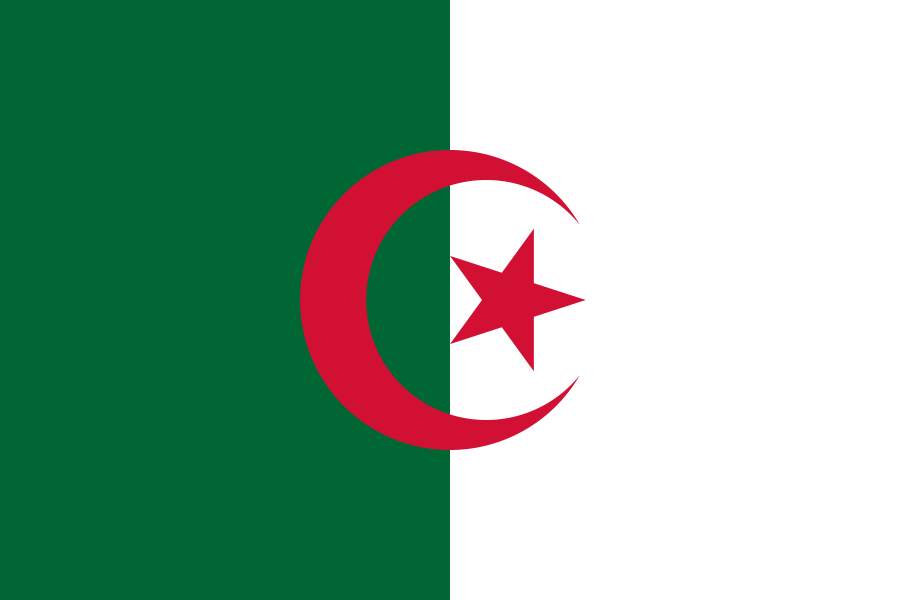
Par le peuple et pour le peuple
Algeria adopted its current UTC+1 time zone in 1911 under French colonial administration to align with neighboring European territories, but post-independence in 1962, it briefly considered multiple zones before opting for unity to symbolize national cohesion across its diverse regions. This decision persists today, making Algeria one of the few large African countries with a single time zone despite spanning multiple longitudes.
L'Algérie utilise CET (UTC+1) toute l'année.
Algeria, the largest country in Africa by land area, stretches from the Mediterranean coast to the vast Sahara Desert, encompassing a diverse landscape that shapes its vibrant culture and daily life. With a population of approximately 45 million people, this North African nation, officially known as the People's Democratic Republic of Algeria (ISO code: DZ), maintains a unified time zone system that reflects its centralized governance and geographic cohesion. The capital, Alger (Algiers), serves as the political and economic heart, where the rhythm of life pulses with a blend of modern urban energy and traditional Berber and Arab influences. Algeria's single time zone, set at UTC+1 year-round without daylight saving time, ensures consistency across its expansive territory, allowing seamless coordination for business, travel, and social activities from the bustling streets of Oran to the remote oases of the south.
Algeria operates under a single time zone, designated as Africa/Algiers in the official IANA (Internet Assigned Numbers Authority) database, with a fixed offset of UTC+1. This zone, also known as Central European Time (CET) without the seasonal adjustments, covers the entire country from its northern coastal regions to the southern borders with Niger and Mali. The decision to use one time zone stems from both geographic and political logic: Algeria's elongated shape, spanning about 2,400 kilometers from north to south, could theoretically justify multiple zones, but historical unification under French colonial rule and post-independence centralization in 1962 prioritized national unity. This approach simplifies administration, transportation, and communication in a country where vast distances separate urban centers from rural areas.
In the capital, Alger, located on the Mediterranean shore, the Africa/Algiers zone means local time aligns closely with solar noon, though the country's position slightly east of Greenwich influences slight variations in daylight patterns. Major cities like Oran in the west, Constantine in the east, and Annaba near the Tunisian border all follow this same UTC+1 standard, ensuring that a meeting scheduled in Alger at 9 AM occurs simultaneously in Tamanrasset, a southern desert hub over 2,000 kilometers away. This uniformity supports Algeria's oil and gas industry, which dominates the economy and relies on synchronized operations across remote Saharan fields. For travelers, the single zone eliminates the need for time adjustments within the country, making itineraries from the Casbah of Alger to the Roman ruins of Timgad straightforward. Politically, maintaining one zone reinforces national identity in a diverse nation with Arab, Berber, and French linguistic influences, avoiding the fragmentation seen in larger countries like Russia or the United States. Overall, Africa/Algiers provides a stable temporal framework that mirrors Algeria's resilient spirit, adapting to its Mediterranean climate in the north and arid extremes in the south without complicating daily coordination.
Algeria does not observe daylight saving time (DST), maintaining its UTC+1 offset throughout the year without any clock changes. This policy has been in place since 2009, when the government abolished DST to promote stability and avoid the disruptions associated with biannual adjustments. Historically, Algeria experimented with DST during the French colonial era and briefly post-independence, but these were discontinued due to economic costs, public confusion, and minimal benefits in a country where energy conservation isn't significantly impacted by extended evening daylight. The decision aligns with many African nations, prioritizing consistency over seasonal shifts, especially in a region influenced by Islamic traditions where prayer times are calculated based on solar positions rather than civil clock changes.
The absence of DST has practical consequences that enhance predictability in daily life. Businesses, schools, and government offices operate on fixed schedules year-round, reducing errors in scheduling and boosting productivity in sectors like agriculture and manufacturing. For instance, farmers in the fertile Tell Atlas region can plan harvests without worrying about shifting work hours, while international trade with Europe benefits from unchanging offsets. Travelers appreciate the lack of confusion, as flight times and hotel check-ins remain constant regardless of season. However, in summer months, when days are longer, the fixed clock means evenings start feeling later, encouraging outdoor activities like souk shopping until dusk. This steady approach fosters a sense of reliability in Algeria's rhythm, contrasting with DST-observing neighbors like Tunisia, and supports the nation's focus on economic development without temporal interruptions.
Algeria's daily rhythm blends Mediterranean leisure with Islamic cultural norms, creating a pace that varies by region but emphasizes family, faith, and community. Breakfast, often a light affair of bread, cheese, olives, and strong coffee, is typically enjoyed early, around 7-8 AM, before the morning heat intensifies in summer. Lunch, the main meal, occurs between 1 PM and 3 PM, featuring hearty dishes like couscous with lamb or merguez sausage, followed by a short rest or siesta in hotter areas, reflecting influences from neighboring Arab countries. Dinner is a social event, starting as late as 8-9 PM or later, with families gathering for tagines or grilled fish, extending into lively conversations that underscore the importance of communal bonds.
Office hours generally run from 8:30 AM to 5 PM, Monday through Friday, though government and private sectors may close early on Fridays for Jummah prayers, a key Islamic observance. In Alger and Oran, banks and businesses often pause midday for lunch, reopening until 6 PM, while shops in traditional markets like the souks of Constantine stay open later, sometimes until 8 PM, catering to after-work crowds. The workweek's structure, with weekends on Saturday and Sunday, allows for relaxed pacing, but during Ramadan, the holy month of fasting, schedules shift dramatically: offices might open later (9 AM-4 PM) and evenings buzz with iftar feasts breaking the fast at sunset. Nightlife in major cities pulses with energy yet remains conservative; Alger's coastal promenade comes alive with cafes serving mint tea until midnight, and modern clubs in upscale neighborhoods play raï music—a UNESCO-recognized Algerian genre—drawing young crowds until 2 AM. In contrast, southern cities like Ghardaïa observe earlier bedtimes due to desert isolation. These patterns highlight local specifics, such as the five daily prayers (salat) that punctuate the day, influencing everything from business meetings to public transport, fostering a harmonious balance between productivity and spiritual life in this culturally rich nation.
Algeria's fixed UTC+1 time zone creates straightforward yet seasonally variable differences with global cities, aiding travelers and remote workers. Compared to London, which follows GMT (UTC+0) in winter and BST (UTC+1) during summer DST from late March to late October, Algeria is one hour ahead in winter months (e.g., January: Alger 1 PM when London is noon). In summer, the offset drops to zero, aligning perfectly—ideal for seamless video calls between 9 AM and 5 PM local time in both places. With New York, on Eastern Standard Time (UTC-5) in winter and EDT (UTC-4) in summer, the difference is larger: Algeria leads by 6 hours in winter (e.g., New York 9 AM is Alger 3 PM) and 5 hours in summer. For Tokyo, always on Japan Standard Time (UTC+9), Algeria trails by 8 hours year-round, meaning a 10 AM call from Alger reaches Tokyo at 6 PM.
Practical tips for calling from the UK or US emphasize these windows to avoid awkward timings. From London, winter calls work best between 10 AM and 4 PM UK time (11 AM-5 PM Alger), while summer alignment allows full business-day overlap—perfect for professionals in finance or tourism. US callers from New York should aim for their mornings (8-11 AM EST/EDT), landing in Alger's early afternoon (2-5 PM), minimizing disruptions during Algerian lunch hours. For businesses, tools like world clocks on smartphones ensure accuracy, and scheduling apps accounting for London's DST prevent mishaps.
Jet-lag recommendations for travelers focus on Algeria's proximity to Europe: flights from London (about 2.5 hours) or Paris (2 hours, where Alger is level year-round on CET) often require minimal adjustment, but eastbound from New York (7-8 hours) can cause mild fatigue. To combat this, stay hydrated during the flight, expose yourself to natural light upon arrival in sunny Alger, and align meals with local times—opt for an early lunch to reset your internal clock. Short naps under two hours help, but avoid caffeine post-arrival. For longer stays venturing south, the consistent time zone eases transitions, letting you immerse in Algeria's rhythms without temporal stress, whether exploring the Sahara or negotiating in vibrant souks.
Algeria uses the Africa/Algiers time zone, which is UTC+1 year-round. This single zone applies nationwide, including in the capital Alger and cities like Oran and Tamanrasset. There are no daylight saving changes, so the local time remains consistent throughout the seasons.
Algeria does not observe daylight saving time, sticking to UTC+1 without adjustments. The offset with London varies: in winter, Algeria is 1 hour ahead of GMT (UTC+0), but during London's summer BST (UTC+1), the times align exactly. This makes coordination straightforward for year-round interactions.
The best time to call from the UK is during overlapping business hours: 9 AM to 5 PM London time in summer (same in Alger) or 10 AM to 4 PM in winter to catch Alger's 11 AM to 5 PM. From the US East Coast, aim for 8-11 AM New York time, which is 2-5 PM in Alger. For travel, spring (April-May) or fall (September-October) offer mild weather (20-25°C in Alger) and fewer crowds, minimizing jet lag from Europe while aligning with vibrant festivals.
Daily life in Algeria starts early with breakfast around 7-8 AM, lunch from 1-3 PM, and dinner after 8 PM, influenced by prayer times and family gatherings. Major sites like the Casbah of Alger (a UNESCO site) are open daily from 9 AM to 5 PM, though some close Fridays midday for prayers; the Roman ruins at Djemila follow similar hours, 8 AM-6 PM in summer. Shops in souks often run until 8 PM, but expect shorter days during Ramadan.
During Ramadan, Algeria's schedules adapt to fasting from dawn to sunset, with offices opening later (around 9 AM-4 PM) and evenings lively with iftar meals starting at sunset (around 6-8 PM varying by season). Prayer times become central, pausing daily activities five times a day, and non-Muslims should respect quieter work paces. This holy month, observed on the lunar calendar, shifts annually, lasting 29-30 days and fostering community spirit nationwide.