Riyad
Saudi Arabia
--:--
Riyadh 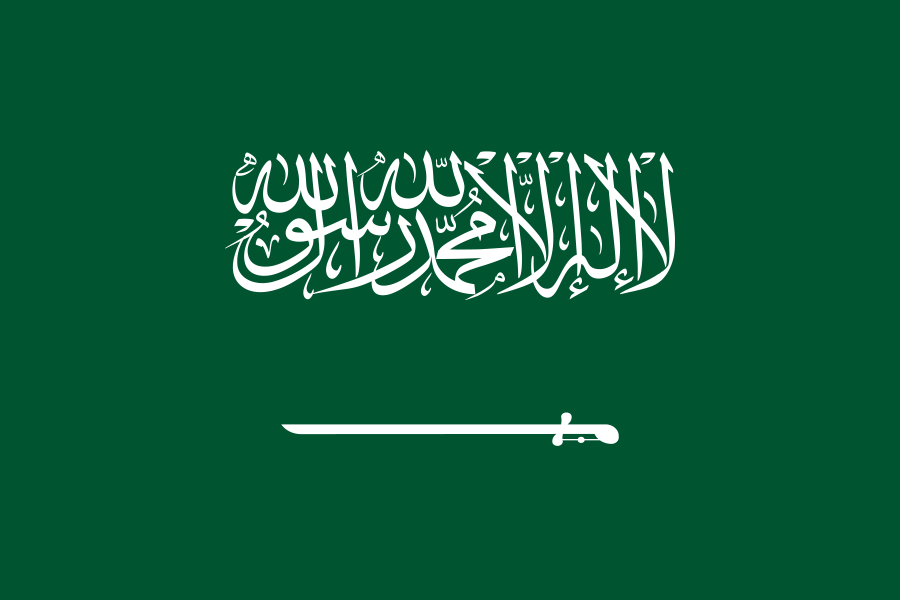
Il n'y a de dieu que Dieu
In 1968, Saudi Arabia officially standardized its time zone to UTC+3, replacing varied local solar times that once caused up to an hour's discrepancy between eastern oil fields and western holy cities. This change was crucial for coordinating the burgeoning petroleum industry with global markets, as documented in royal decrees from King Faisal's era.
L'Arabie saoudite utilise AST (UTC+3) toute l'année.
Saudi Arabia, officially the Kingdom of Saudi Arabia, stands as a pivotal nation in the Middle East, encompassing vast deserts, ancient historical sites, and modern megacities across the Arabian Peninsula. With a population of approximately 35 million people and Riyadh as its bustling capital, the country spans about 2.15 million square kilometers, making it the largest on the peninsula. Time in Saudi Arabia is unified under a single time zone, Arabia Standard Time (AST), which operates at UTC+3 year-round without any daylight saving adjustments, reflecting the nation's commitment to a consistent schedule amid its arid climate and Islamic cultural framework. This straightforward time organization simplifies coordination for travelers, businesses, and pilgrims visiting holy sites like Mecca and Medina. In this article, we'll explore Saudi Arabia's time zone details, daily rhythms influenced by prayer times and work culture, historical context, and practical tips for engaging with this dynamic kingdom. Whether you're planning a business trip to Riyadh or a spiritual journey to Jeddah, understanding the national rhythm will help you sync seamlessly with local life.
Saudi Arabia maintains a single official time zone across its entire territory, covered by the IANA identifier Asia/Riyadh, which corresponds to Arabia Standard Time (AST) at a fixed UTC+3 offset. This unified approach was adopted to foster national cohesion in a country that stretches from the Red Sea in the west to the Persian Gulf in the east, spanning diverse regions including the Najd highlands, the Rub' al-Khali desert, and coastal areas. Politically, the decision for one zone stems from the centralized governance under the Al Saud monarchy, established in 1932, which prioritizes simplicity for administration, oil industry operations, and religious observances that require synchronized timing nationwide. Geographically, while the kingdom lies between longitudes 34°E and 56°E—positioned about three hours ahead of the Greenwich meridian—the single zone avoids the fragmentation seen in larger nations like Russia or the United States, despite the country's east-west expanse exceeding 1,200 kilometers.
In the broader Middle East context, Saudi Arabia's UTC+3 aligns it with neighbors like Kuwait, Bahrain, and Qatar, facilitating regional trade and Gulf Cooperation Council (GCC) collaborations. This positioning places it three hours ahead of Central European Time (CET) and eight hours ahead of Eastern Standard Time (EST) in the U.S., making it a key bridge between Asian and European markets. The absence of sub-zones ensures that from the western Hijaz mountains near Mecca to the eastern oil fields of Dhahran, all clocks tick in unison, supporting the kingdom's Vision 2030 economic diversification efforts. For international visitors, this means no need to adjust watches mid-country, though the intense summer heat can subtly influence perceived time flow during peak daylight hours.
Riyadh, the capital and political heart of Saudi Arabia, operates strictly on Arabia Standard Time (AST, UTC+3), where government offices, the King Khalid International Airport, and iconic landmarks like the Kingdom Centre Tower all adhere to this zone. As home to over 7 million residents, Riyadh exemplifies the nation's unified timing, with daily life revolving around this standard from dawn prayers at Fajr to evening gatherings. Other major cities follow suit without deviation, reinforcing the single-zone policy. Jeddah, the commercial gateway on the Red Sea with a population exceeding 4 million, shares AST, as do the holy cities of Mecca and Medina, which attract millions of pilgrims annually for Hajj and Umrah—events that demand precise, nationwide synchronization for safety and logistics.
In the east, Dammam and the Aramco oil hub in Dhahran also use UTC+3, aligning industrial shifts with global energy markets. Even remote areas like the Empty Quarter desert outposts or the southern border town of Najran maintain this time, with no edge cases such as overseas territories or derogating zones, given Saudi Arabia's contiguous mainland focus. The ISO code SA universally applies, and the national flag 🇸🇦 flies over clocks set to AST in every province. This uniformity extends to the Asir region's highland villages and Tabuk's northern frontiers, eliminating any intra-country time discrepancies that could complicate travel or communication.
Saudi Arabia does not observe Daylight Saving Time (DST), maintaining Arabia Standard Time (AST) at UTC+3 throughout the year without any clock adjustments. This policy has been in place since 1963, when the kingdom abolished an earlier brief experiment with DST that ran from 1940 to 1950 and again in 1951, citing minimal benefits in energy savings and significant disruptions to daily routines. Politically, the decision aligns with Islamic traditions that emphasize fixed prayer times based on solar positions, which DST would complicate, especially in a nation where the five daily Salah prayers structure much of social and work life. At latitudes around 24°N, the country's subtropical position means daylight hours vary seasonally—longer in summer (up to 14 hours) and shorter in winter—but the government prioritizes stability over artificial shifts, amid ongoing debates in the region about climate-driven energy efficiency.
Practically, this no-DST stance simplifies international flights, with airlines like Saudia scheduling arrivals and departures on unchanging local time, reducing confusion for transiting passengers from DST-observing countries. Businesses benefit from predictable trading hours, particularly in Riyadh's financial district, where stock market operations on the Tadawul align seamlessly with global partners. However, for communications, it means expatriates and visitors must account for fixed offsets, avoiding surprises during winter months when European or North American DST ends. Overall, the consistent clock fosters a sense of reliability in a kingdom transforming through modernization while honoring cultural constants.
The daily rhythm in Saudi Arabia is deeply intertwined with Islamic practices, where the five daily prayers—Fajr (dawn), Dhuhr (noon), Asr (afternoon), Maghrib (sunset), and Isha (night)—punctuate the day, often pausing work and commerce for 10-15 minutes each. Breakfast is typically light and early, around 6-7 AM before Fajr in winter or slightly later in summer, featuring dates, bread, and coffee; lunch, the main meal, occurs between 1-3 PM after Dhuhr, with family gatherings over rice, lamb, or kabsa. Unlike the earlier UK or US schedules, dinners are later, starting post-Maghrib around 7-9 PM, extending into social hours with tea and conversation, reflecting a cultural emphasis on communal evening bonds rather than rushed meals.
Office hours generally run from 8 AM to 5 PM Sunday through Thursday, with the weekend on Friday-Saturday to align with Jumu'ah prayers; many private firms now offer flexible 9 AM-6 PM shifts to accommodate traffic in Riyadh or Jeddah. Shops and markets, like the vibrant Souq Al-Zal in Mecca, open around 9-10 AM and close by 10 PM, though malls such as Riyadh Gallery operate until midnight or later, blending tradition with 24/7 convenience in urban areas. Administrative services, including passport offices, follow 7:30 AM-2:30 PM timings, often with prayer breaks. Nightlife thrives modestly in major cities—Jeddah's Corniche offers seaside cafes open till 2 AM, while Riyadh's evolving scene includes family-friendly entertainment zones—but public life winds down earlier than in Western hubs, prioritizing rest amid the heat. No formal siesta exists, but afternoon lulls during peak summer temperatures (over 40°C) encourage indoor activities, and late dinners underscore a rhythm that values spiritual reflection over constant hustle.
Saudi Arabia's fixed UTC+3 offset creates straightforward time differences with global capitals, unaffected by its own lack of DST. Compared to London, which runs on Greenwich Mean Time (GMT, UTC+0) in winter and British Summer Time (BST, UTC+1) from late March to late October, Saudi Arabia is three hours ahead in winter and two hours ahead during London's summer—meaning a 9 AM Riyadh meeting is 6 AM in London off-season or 7 AM during BST. With New York on Eastern Standard Time (EST, UTC-5) in winter and Eastern Daylight Time (EDT, UTC-4) from March to November, the gap is eight hours in winter (e.g., noon in Riyadh is 4 AM EST) and seven hours during New York's DST.
For Paris (Central European Time, CET UTC+1 winter, CEST UTC+2 summer), Saudi Arabia leads by two hours in winter and one in summer. Tokyo's Japan Standard Time (JST, UTC+9, no DST) places it six hours ahead of Riyadh, ideal for evening calls from the kingdom. Sydney, on Australian Eastern Standard Time (AEST, UTC+10) in winter and AEDT (UTC+11) in summer, trails Riyadh by seven hours off-season and six during its DST, though Australia's periods differ from the Northern Hemisphere. Here's a quick mental table for an English-speaking reader: Riyadh at noon is 9 AM in Paris (winter), 5 AM in New York (winter), 3 AM in London (winter), 6 PM in Tokyo, and 10 PM previous day in Sydney (winter). These fixed Saudi timings make it a reliable hub for bridging East-West schedules, especially in energy and finance sectors.
Saudi Arabia's time zone history reflects its evolution from tribal confederacies to a modern state. Prior to 1925, local solar times based on regional meridians prevailed, but unification under King Abdulaziz led to the adoption of UTC+3 in the 1930s, formalized in 1968 with the IANA Asia/Riyadh standard to support growing oil exports and pilgrimage logistics. A notable event was the 1950s DST trials, abandoned in 1963 due to public resistance and religious concerns over shifting prayer timings. The kingdom's official calendar duality adds cultural depth: the Gregorian calendar handles civil and international affairs, while the Hijri (Islamic lunar) calendar governs religious events, causing dates like Ramadan to shift annually by 10-12 days against solar time.
This temporal layering influences traditions such as the seasonal Hajj pilgrimage, fixed to the 12th of Dhu al-Hijjah in the Hijri calendar, drawing over 2 million to Mecca on precise lunar-solar alignments. Another specificity is the solar festival of Eid al-Fitr, marking Ramadan's end with communal feasts timed to the new moon sighting, blending astronomical observation with national broadcasts from Riyadh. These practices underscore how time in Saudi Arabia weaves faith, history, and modernity, distinct from purely secular Western systems.
For calling from London, aim for 10 AM-6 PM Riyadh time (7-3 PM London winter, 8 AM-4 PM during BST), catching the workday post-morning prayers; from New York, target 8 AM-4 PM Riyadh (midnight-8 AM EST winter, 1-9 AM EDT), best for early risers to align with Saudi office hours. Jet-lag wise, westward travelers from Europe face minimal disruption due to the short offset, but eastward from the US should prioritize hydration and light exposure upon arrival in Riyadh's intense sun—adjust by advancing sleep schedules a day prior. Financial trading on Tadawul runs 10 AM-3 PM AST Sunday-Thursday, overlapping London's 7-10 AM GMT for cross-market plays, while main administrations like the Ministry of Foreign Affairs operate 8 AM-4 PM, ideal for virtual meetings mid-morning Saudi time.
Since no DST applies, skip clock worries for international gatherings, but confirm partners' seasonal shifts—e.g., avoid U.S. spring-forward clashes. For Hajj season, book flights outside peak lunar months to dodge crowds, and use apps like Muslim Pro for prayer-based scheduling. These tips ensure smooth integration into Saudi Arabia's rhythmic flow, enhancing productivity and cultural respect.
The main time zone in Saudi Arabia is Arabia Standard Time (AST), which is UTC+3 and covers the entire country year-round. This single zone, identified as Asia/Riyadh in IANA standards, ensures uniformity from Riyadh to Jeddah. No other zones apply, simplifying travel and business across the kingdom.
Saudi Arabia has just one time zone, Arabia Standard Time (AST) at UTC+3. It is three hours ahead of London in winter (GMT) and two hours ahead during British Summer Time (BST). This fixed difference supports consistent scheduling for UK-Saudi interactions.
Saudi Arabia does not observe Daylight Saving Time, maintaining UTC+3 without any seasonal changes. Historical trials in the 1940s and 1950s were discontinued in 1963 due to cultural and practical reasons. As a result, there are no switchover dates, providing stability for international communications.
The best time to call from the UK is between 8 AM and 4 PM your time, which aligns with 11 AM to 7 PM in Riyadh during winter, catching the core workday. During BST, shift to 9 AM-5 PM UK time for similar overlap. Avoid Fridays, the holy day, when business slows.
In Riyadh, typical office hours are from 8 AM to 5 PM Sunday through Thursday, with short breaks for prayers. Government entities may start at 7:30 AM and end by 2:30 PM, while private businesses in sectors like finance often extend to 6 PM. The Friday-Saturday weekend respects Islamic traditions.
The best time to visit is from November to March, when milder temperatures (20-30°C) align with standard daily rhythms, allowing comfortable exploration of sites like the Al-Masjid an-Nabawi in Medina from morning till evening. Avoid summer peaks (June-August) due to extreme heat that shortens outdoor activities. For Hajj, time trips around the lunar calendar's Dhu al-Hijjah for spiritual immersion.
Saudi Arabia's UTC+3 (AST) matches the United Arab Emirates' Gulf Standard Time (GST), also UTC+4? Wait, no—UAE is UTC+4, one hour ahead of Saudi Arabia. This difference affects cross-border travel, like from Dubai to Riyadh, requiring a clock adjustment despite shared cultural ties.