Bagdad
Iraq
--:--
Baghdad 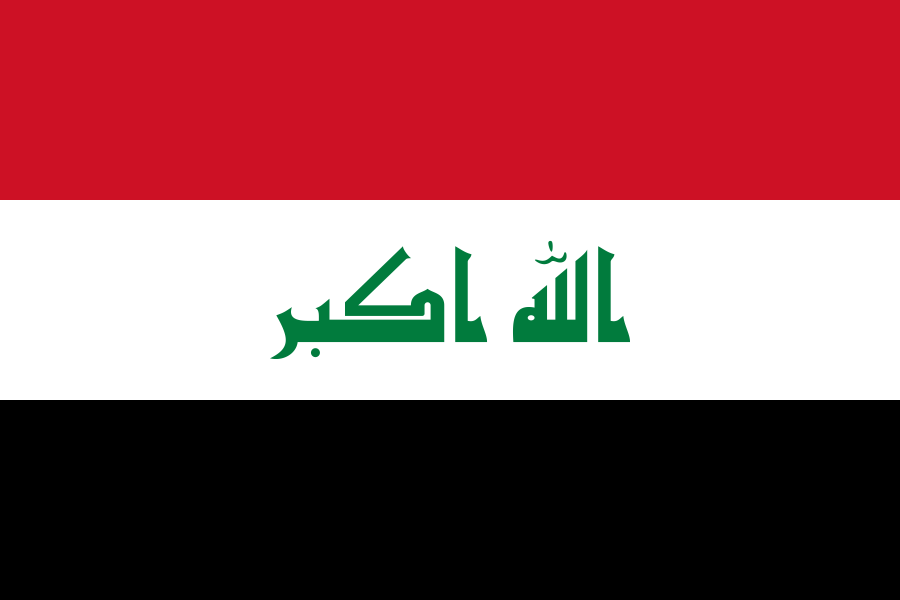
Iraq's ancient Mesopotamian civilization, centered in cities like Babylon, developed one of the world's earliest sundials around 1500 BCE to track time using shadows, influencing later astronomical timekeeping. This innovation from the cradle of civilization highlights how the region has long shaped our understanding of dividing the day.
Nestled in the heart of the Middle East, Iraq is a nation rich in history and cultural diversity, home to approximately 41 million people across its vast deserts, fertile river valleys, and ancient ruins. As a country in the Middle East continent with the ISO code IQ, Iraq maintains a single time zone that simplifies daily life and international coordination for its capital, Baghdad, and beyond. This unified time structure reflects Iraq's compact geography and political unity, ensuring that the rhythm of life—from bustling markets in Basra to serene evenings in Erbil—pulses to the steady beat of Arabia Standard Time. Understanding the time in Iraq is essential for travelers, business professionals, and anyone connecting with this resilient country, where time intertwines with traditions shaped by millennia of civilization.
Iraq operates under a single time zone, making it one of the simpler nations for time management in the Middle East. The official IANA time zone identifier is Asia/Baghdad, which corresponds to Arabia Standard Time (AST) with a fixed UTC offset of +3 hours. This means that when it's noon in Coordinated Universal Time (UTC), clocks in Iraq show 3:00 PM year-round, providing a consistent framework for the entire country. Baghdad, the capital and largest city with a population exceeding 7 million, exemplifies this zone, as do other key urban centers like Basra in the oil-rich south, Mosul in the north near the Tigris River, and Erbil in the Kurdistan region. These cities, spanning from the arid western deserts to the marshlands of the Shatt al-Arab, all adhere to Asia/Baghdad without variation.
The choice of a single time zone is both geographic and political in nature. Iraq's east-west span is relatively narrow—about 1,000 kilometers at its widest—allowing a uniform UTC+3 to cover the landscape without significant solar time discrepancies. Politically, this unity was solidified post-1950s when Iraq standardized its time to align with neighboring Arab states and facilitate oil trade and regional diplomacy. Unlike larger countries such as Russia or the United States with multiple zones, Iraq's centralized governance under the federal system ensures that time in Iraq remains synchronized, aiding everything from national broadcasts to coordinated prayer times in this predominantly Muslim nation. For visitors planning trips to sites like the ancient ziggurat of Ur or the modern skyline of Sulaymaniyah, knowing that the Iraq time zone is straightforward eliminates confusion, letting you focus on the cultural immersion. This setup also supports the country's growing digital economy, where businesses in Baghdad can seamlessly connect with global partners without timezone hurdles.
Iraq does not observe daylight saving time (DST), maintaining its UTC+3 offset throughout the year without any clock adjustments. This policy has been in place since 2007, when the government abolished DST to promote stability in daily routines, particularly in a region prone to security challenges and economic fluctuations. Prior to that, Iraq experimented with DST during the 1980s and 1990s for energy conservation, typically shifting clocks forward by one hour from late March to late September, but it was discontinued to avoid disruptions in work schedules, religious observances, and international communications. The decision aligns with broader Middle Eastern trends, where many oil-producing nations prioritize consistent time for shift work in industries like petroleum extraction.
The absence of DST brings practical benefits and challenges. Year-round standard time means no biannual clock changes, reducing confusion for residents and expatriates alike—essential in a country where power outages can already complicate life. However, it results in earlier sunsets during winter months, with darkness falling around 5:00 PM in Baghdad by December, prompting earlier evening activities. Summers, conversely, see prolonged daylight until nearly 8:00 PM, which suits outdoor gatherings but intensifies the heat during peak hours. For travelers, this fixed schedule simplifies planning: flights and meetings don't shift unexpectedly, and apps showing the time in Iraq remain reliable. Overall, Iraq's no-DST approach fosters a predictable national rhythm, emphasizing reliability in a dynamic environment.
The daily rhythm in Iraq is deeply influenced by Islamic traditions, family-oriented culture, and the region's hot climate, creating a pace that balances work, prayer, and leisure. Typical meal times reflect this: breakfast (futoor) is often light and early, around 7:00–8:00 AM, featuring flatbreads, cheese, and tea before the workday begins. Lunch, the main meal, occurs between 1:00 PM and 3:00 PM, with families gathering for dishes like kabse (spiced rice with meat) or dolma, often aligning with the midday adhan (call to prayer). Dinner is late, starting around 8:00 PM or later, especially in summer when cooler evenings invite communal iftar-style meals reminiscent of Ramadan, even outside the holy month.
Office and shop hours adapt to these patterns and the weekend structure, which runs from Friday to Saturday to honor the Islamic Sabbath. Government offices in Baghdad typically open from 8:00 AM to 3:00 PM Sunday through Thursday, with private businesses extending to 4:00 or 5:00 PM; many close briefly for noon prayers. Retail shops in markets like Baghdad's Shorja or Basra's souks buzz from 9:00 AM until 9:00 PM or later, with siestas common in hotter months to avoid midday sun. In Erbil's modern malls, hours stretch even further, catering to a younger demographic.
Nightlife in major cities pulses vibrantly after sunset, blending tradition with urban energy. Baghdad's cafes along the Tigris River stay open until midnight or beyond, serving qahwa (Arabic coffee) and shisha amid live music, while Basra's corniche offers family-friendly promenades lit up until 11:00 PM. In safer areas like Erbil, clubs and rooftop bars in the Citadel district draw crowds until 2:00 AM, though conservative norms keep things modest. Local specifics include the impact of five daily prayers, which pause routines around dawn (fajr, ~4:30 AM in winter), noon (zuhr), afternoon (asr), sunset (maghrib), and night (isha, ~8:00 PM). Ramadan alters everything, with daytime fasting shifting activity to evenings, and the heatwave summers encouraging later starts. This rhythm underscores Iraq's resilient spirit, where time in Iraq weaves work, faith, and festivity into a tapestry of endurance and hospitality.
Navigating time differences is key for anyone engaging with Iraq from afar, given its fixed UTC+3 position. Compared to London, which follows Greenwich Mean Time (GMT, UTC+0) in winter and British Summer Time (BST, UTC+1) from late March to late October, Iraq is 3 hours ahead in winter and 2 hours ahead during London's summer. For example, a 9:00 AM meeting in Baghdad corresponds to 6:00 AM in London during winter or 7:00 AM in summer. With New York on Eastern Standard Time (EST, UTC-5) in winter and Eastern Daylight Time (EDT, UTC-4) in summer, the gap widens: Iraq is 8 hours ahead in winter (e.g., noon in New York is 8:00 PM in Iraq) and 7 hours ahead in summer. Paris, on Central European Time (CET, UTC+1) winter and CEST (UTC+2) summer, sees Iraq 2 hours ahead year-round in winter and 1 hour ahead in summer.
For the best windows to call from the UK or US, aim for overlapping business hours to catch Iraq during its active day. From London, dial between 10:00 AM and 4:00 PM UK time (1:00 PM–7:00 PM in Iraq) to align with office availability, avoiding early mornings or late evenings when families prioritize rest. US callers from New York should target 8:00 AM to 2:00 PM Eastern Time (4:00 PM–10:00 PM in Iraq), ensuring you're reaching professionals before the evening prayer and dinner routines kick in. Tools like world clock apps can help track the Iraq time zone precisely, factoring in no DST shifts.
Jet-lag recommendations for travelers depend on direction. Flying east from the UK (2–3 hour difference) or US (7–8 hours) means advancing your body clock; combat it by gradually shifting sleep a day before departure and exposing yourself to morning light upon arrival in Baghdad. Westbound returns are easier—stay hydrated, avoid heavy meals on flights, and nap strategically. For longer stays, embrace local cues like early teas and late dinners to sync with Iraq's rhythm. Business travelers might schedule arrivals mid-week (Sunday–Thursday) to maximize productive hours, while tourists benefit from spring (March–May) or autumn (September–November) visits when milder weather eases adjustment to the time in Iraq.
Iraq uses a single time zone, Asia/Baghdad, also known as Arabia Standard Time (AST) at UTC+3. This applies uniformly across the country, including Baghdad, Basra, and Erbil, with no variations or DST adjustments. To check the exact current time in Iraq, use a reliable world clock tool synced to UTC+3.
Iraq does not observe daylight saving time, sticking to UTC+3 year-round since abolishing DST in 2007. This makes it 3 hours ahead of London in winter (GMT) and 2 hours ahead during British Summer Time. The fixed offset simplifies planning without seasonal clock changes.
The best time to call Iraq from the UK is between 10:00 AM and 4:00 PM UK time, which falls during Iraq's business hours from 1:00 PM to 7:00 PM local time. For travel, aim for spring (March–May) or autumn (September–November) to avoid extreme heat and align with milder daily rhythms. These periods also coincide with fewer disruptions from holidays.
In major cities like Baghdad and Basra, business hours run from 8:00 AM to 3:00–5:00 PM Sunday through Thursday, with a brief pause for midday prayers. The daily rhythm includes early breakfast around 7:00 AM, lunch at 1:00–3:00 PM, and late dinners after 8:00 PM, influenced by prayer times and family gatherings. Shops often stay open later, until 9:00 PM or more.
Iraq's official weekend is Friday and Saturday, aligning with Islamic traditions, which shifts the workweek to Sunday–Thursday. The five daily prayers punctuate the day—dawn (around 4:30 AM), noon, afternoon, sunset, and night (about 8:00 PM)—often pausing work and commerce briefly. This structure fosters a balanced lifestyle, emphasizing community and reflection.