Minsk
Belarus
--:--
Minsk 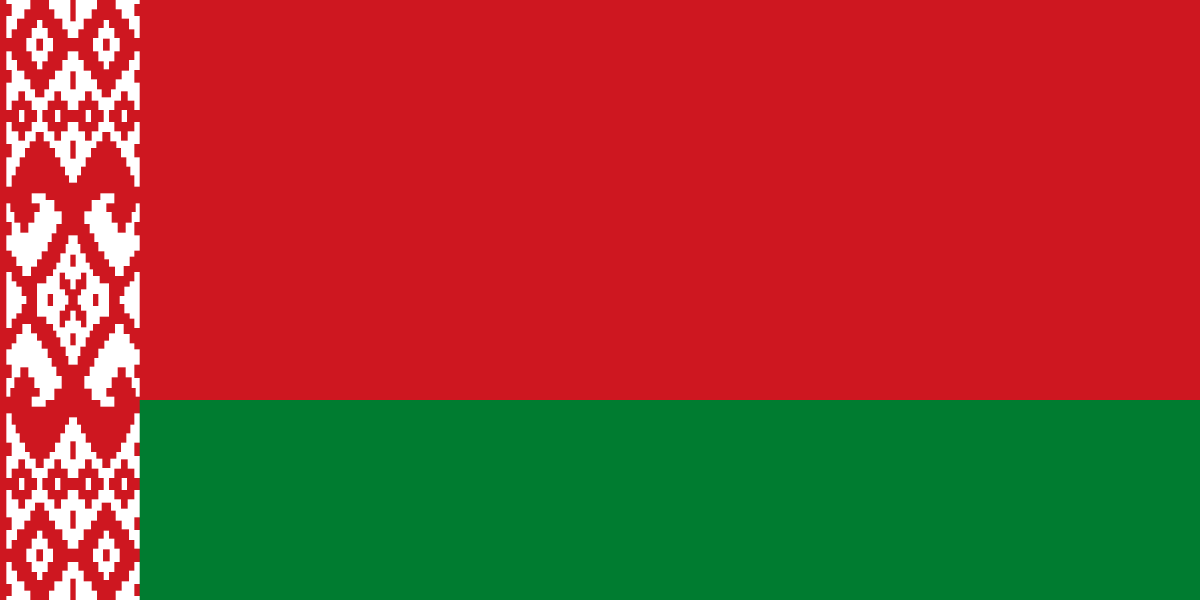
In 2011, Belarus permanently adopted UTC+3 without DST to synchronize with Russia, a move that saved an estimated 1.5 billion Belarusian rubles annually in energy costs by avoiding clock adjustments. This alignment has since become a point of national pride, symbolizing efficient time management in daily life.
Belarus, a landlocked country in Eastern Europe with a population of around 9 million, spans a single time zone that keeps its rhythm synchronized across its vast plains and forests. The capital, Minsk, serves as the heartbeat of this nation, where the ISO code BY identifies its unique cultural and temporal landscape. Understanding the time in Belarus is essential for travelers, business professionals, or anyone connecting with this Eastern European gem, as it operates on a consistent offset without the shifts of daylight saving time.
Belarus adheres to a single time zone, officially designated as Europe/Minsk in the IANA time zone database, with a fixed UTC offset of +3 hours year-round. This means that regardless of the season, clocks in Minsk and throughout the country remain steady at UTC+3, providing a predictable schedule for daily life and international coordination. The decision to forgo daylight saving time (DST) was solidified in 2011 when Belarus aligned permanently with Moscow Time to simplify operations and match its close economic ties with Russia; since then, there are no switchover dates, and no clocks are adjusted forward or backward.
In the capital Minsk, which houses over 2 million residents and serves as the political and cultural center, this Europe/Minsk zone ensures seamless functionality for government offices, tech hubs, and the bustling Oktyabrskaya Square. For those comparing with Western Europe, the time difference with London is notably consistent yet seasonal on the UK side. During London's winter (standard time, UTC+0), Belarus is 3 hours ahead—meaning if it's noon in London, it's 3 p.m. in Minsk. Come summer, when the UK observes British Summer Time (BST, UTC+1) from late March to late October, the gap narrows to 2 hours, so noon in London becomes 2 p.m. in Belarus. This fixed Belarusian offset avoids the confusion of DST transitions, making it easier for cross-continental planning, whether scheduling a virtual meeting or timing a flight arrival at Minsk National Airport.
This uniformity extends to all regions, from the historic streets of Grodno in the west to the industrial belts of Gomel in the east, eliminating any intra-country time discrepancies. For global travelers, tools like world clocks can instantly convert local times, but knowing Belarus's steadfast UTC+3 position highlights its practical approach to time management in a region often influenced by neighboring Russia's temporal policies. Overall, the absence of DST in Belarus promotes stability, reducing the fatigue associated with time changes and fostering a reliable environment for its 9 million inhabitants and visitors alike.
The daily rhythm in Belarus reflects a blend of Soviet-era efficiency and modern Eastern European warmth, centered around family, work, and seasonal traditions. Typical meal times follow a structured pattern: breakfast is enjoyed early between 7 a.m. and 9 a.m., often featuring hearty staples like kasha (buckwheat porridge) or fresh bread with cheese; lunch, the main meal of the day, occurs around 1 p.m. to 2 p.m., with dishes such as draniki (potato pancakes) or borscht in workplaces and homes; and dinner winds down between 6 p.m. and 8 p.m., lighter and family-oriented, sometimes extending into evening gatherings with tea and conversation.
Office hours in Belarus generally run from 9 a.m. to 6 p.m., Monday through Friday, with a one-hour lunch break embedded in the schedule—state institutions and banks often close precisely at 5 p.m. or 6 p.m., while private businesses in Minsk might stretch to 7 p.m. Shops and markets follow suit, opening around 10 a.m. and closing by 8 p.m., though supermarkets like those in the upscale Galleria Minsk stay open later, until 10 p.m., catering to evening shoppers. Administrative services, such as passport offices or post offices, adhere strictly to 8:30 a.m. to 5:30 p.m. weekdays, emphasizing punctuality in this culture where tardiness is frowned upon.
Local specifics add flavor to this routine: weekends, particularly Sunday, serve as the primary day of rest, with many Belarusians heading to dachas (country cottages) for relaxation or attending Orthodox church services, which often start at 9 a.m. Nightlife pulses in Minsk's vibrant scene, with clubs like Dozari open until 6 a.m. on weekends, drawing crowds for electronic music and late-night machanka (pork stew). A cherished ritual is the banya (traditional sauna), typically a Saturday evening or Sunday afternoon affair, promoting social bonding and cleansing after the week's labors. Regarding natural light, Minsk experiences stark seasonal variations due to its northern latitude (around 53°N): at the winter solstice in December, sunrise is about 8:45 a.m. and sunset around 4:15 p.m., leading to short, cozy days; conversely, the summer solstice in June brings sunrise at 4:30 a.m. and sunset near 9:30 p.m., filling evenings with twilight strolls along the Svislach River. These patterns influence everything from outdoor festivals like the Slavic Bazaar in Vitebsk to the quiet introspection of long winter nights, encapsulating Belarus's rhythmic harmony with its continental climate.