Zagreb
Croatia
--:--
Zagreb 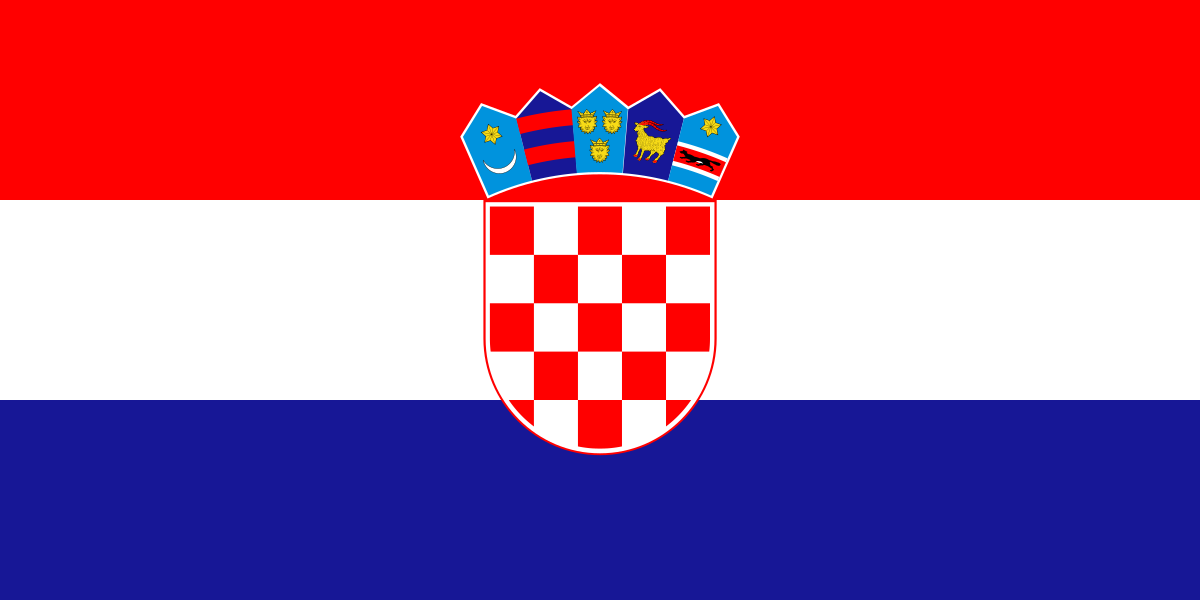
Croatia's adoption of DST in 1983 coincided with its push for energy efficiency amid Yugoslav-era policies, but a quirky local adaptation saw coastal fishermen in Dalmatia informally ignoring clock changes to align with tidal rhythms for better catches. This blend of official time and traditional practices highlights how the nation's maritime heritage subtly shapes daily life.
Croatia, a stunning European nation on the Adriatic Sea with a population of around 4 million, is renowned for its picturesque coastline, historic cities, and vibrant culture. The capital, Zagreb, serves as the political and economic heart of the country, blending Austro-Hungarian architecture with modern energy. Croatia operates in a single time zone, Central European Time (CET), making it straightforward for travelers and businesses to coordinate schedules across its diverse regions from the bustling capital to the sun-drenched islands.
Croatia adheres to the Europe/Zagreb time zone, which follows Central European Time (CET) with a standard UTC offset of +1 hour. This unified time zone spans the entire country, including the capital Zagreb and coastal hotspots like Dubrovnik and Split, ensuring seamless synchronization for locals and visitors alike. Zagreb, as the central hub, exemplifies this with its efficient public transport and event timings aligned to CET, facilitating everything from business meetings to cultural festivals.
Daylight saving time (DST) is observed in Croatia, as per EU regulations, to maximize evening daylight during warmer months. The switch to Central European Summer Time (CEST, UTC+2) occurs on the last Sunday in March, typically around 2:00 AM local time, when clocks are advanced by one hour. The return to CET happens on the last Sunday in October, with clocks falling back one hour at 3:00 AM CEST. This practice, in place since 1983 with minor adjustments, aligns Croatia with much of Western and Central Europe, promoting energy savings and extended outdoor activities in the Mediterranean climate.
When comparing to London, which uses Greenwich Mean Time (GMT, UTC+0) in winter and British Summer Time (BST, UTC+1) in summer, the time difference is notably consistent. During winter months (CET vs. GMT), Croatia is one hour ahead of London—ideal for early morning calls from the UK without much disruption. In summer (CEST vs. BST), the gap remains one hour ahead, maintaining that slight lead. For instance, if it's 9:00 AM in London during winter, it's already 10:00 AM in Zagreb, allowing for productive cross-border interactions. This predictability aids tourists planning trips, as Croatia's summer DST extends daylight for beach evenings, while winter timings suit indoor explorations of Zagreb's museums. Overall, Croatia's time zone setup simplifies international dealings, with the ISO code HR often used in digital tools for precise conversions. Whether you're booking a flight to Zagreb Airport or scheduling a virtual meeting, understanding these offsets ensures smooth connectivity in this ISO 3166-1 alpha-2 coded nation.
The daily rhythm in Croatia reflects a blend of Mediterranean leisure and Central European efficiency, varying slightly between urban Zagreb and the laid-back coastal areas. Breakfast, often light with coffee, pastries, or yogurt, is typically enjoyed between 7:00 AM and 9:00 AM, fueling the morning commute. Lunch, the main meal of the day, centers around 12:00 PM to 2:00 PM, featuring hearty dishes like grilled meats, seafood, or sarma (cabbage rolls) in family-style settings—many offices and schools pause for this social ritual, emphasizing work-life balance.
Office hours generally run from 8:00 AM to 4:00 PM or 9:00 AM to 5:00 PM, Monday through Friday, with government administrative services in Zagreb following similar schedules, often closing for lunch. Shops and businesses in cities like Zagreb operate from 9:00 AM to 7:00 PM, while coastal boutiques in Split or Dubrovnik may extend into the evening during tourist season. Sundays serve as the primary weekly rest day, with most stores closed and families prioritizing church attendance or outdoor pursuits, underscoring Croatia's Catholic heritage.
Local specifics add flavor to this tempo: in rural and island communities, an informal afternoon pause akin to a siesta might occur around 2:00 PM to 4:00 PM, especially in summer heat, allowing for rest before evening activities. Nightlife pulses vibrantly in coastal cities, where bars and clubs in Hvar or Zagreb's Tkalčićeva Street come alive from 10:00 PM onward, often lasting until dawn with live music or konobas (taverns) serving late dinners around 8:00 PM to 10:00 PM. Rituals like the evening passeggiata—strolling through town squares at dusk—foster community bonds. Sunrise and sunset timings enhance this rhythm; at the summer solstice (around June 21), dawn breaks near 5:00 AM in Zagreb, with sunset after 9:00 PM, perfect for extended festivals like the Zagreb Summer Evenings. In winter solstice (December 21), sunrise is around 7:45 AM, and sunset by 4:15 PM, prompting earlier indoor gatherings. This seasonal dance influences everything from harvest festivals in Slavonia to Advent markets in the capital, creating a harmonious flow that invites visitors to sync with Croatia's unhurried yet lively pace.