Port-au-Prince
Haiti
--:--
Port-au-Prince 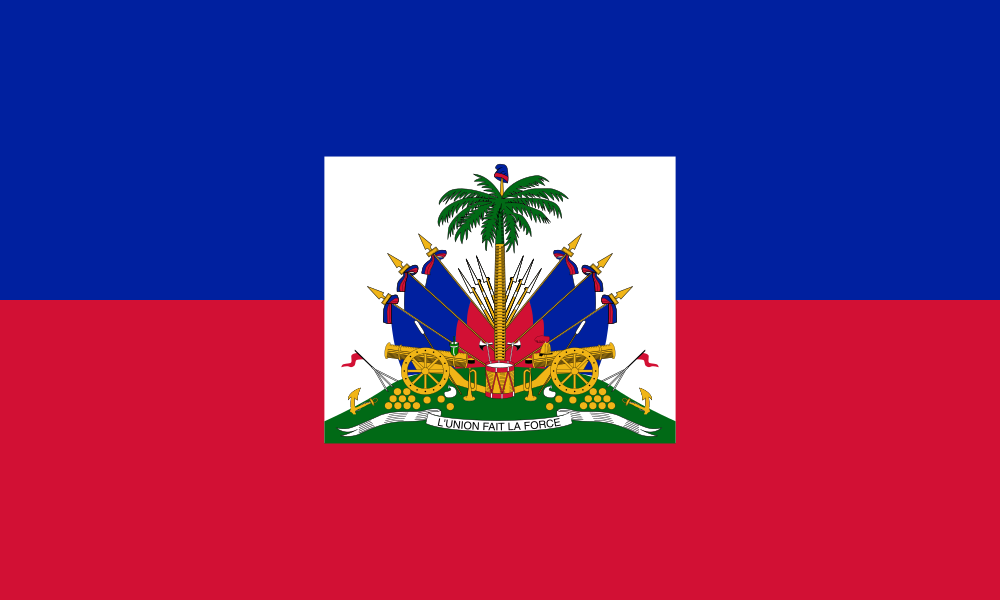
Haiti declared independence from France on January 1, 1804, at midnight in Gonaïves, marking the first successful slave-led revolution and setting a pivotal timestamp in global history that synchronized with the new year's dawn across the Americas. This event, celebrated annually with midnight vigils and the singing of the national anthem, underscores the country's deep connection to temporal milestones in its fight for freedom.
Haiti, a vibrant nation in the Caribbean region of North America, captivates with its rich history, resilient culture, and stunning landscapes, from the bustling streets of Port-au-Prince to the serene beaches of Jacmel. Home to approximately 11 million people, this island country operates on a single time zone, America/Port-au-Prince, which simplifies daily life and coordination across its diverse regions. Understanding Haiti's time organization reveals much about its national rhythm—a blend of tropical leisure, communal traditions, and adaptive schedules influenced by its geography and global connections. Whether planning a visit or a business call, grasping these temporal patterns enhances appreciation for Haiti's dynamic pace.
Haiti maintains a straightforward time zone structure with just one official zone, America/Port-au-Prince, aligning the entire country under Eastern Standard Time (EST) at UTC-5 year-round, except during daylight saving periods. This unified system, designated by the ISO code HT, ensures seamless synchronization from the capital, Port-au-Prince, to northern hubs like Cap-Haïtien and southern coastal towns such as Les Cayes. Port-au-Prince, the political and economic heart with over 3 million residents in its metropolitan area, sets the temporal pace for government offices, markets, and international flights at Toussaint Louverture International Airport. Other key cities, including Gonaïves—known for its role in Haiti's independence history—and Jérémie in the southwest, all adhere to this zone without deviations, reflecting the country's compact size of about 27,750 square kilometers.
Geographically, Haiti's position on the western third of Hispaniola island, sharing the island with the Dominican Republic, justifies this single-zone approach. The island's longitudinal span falls entirely within the Eastern Time Zone boundaries, avoiding the need for multiple offsets that larger nations might require. Politically, this uniformity stems from Haiti's post-colonial administrative decisions, prioritizing national cohesion amid its rugged terrain of mountains and plateaus that could otherwise complicate travel and communication. Adopted formally in the 20th century and standardized with IANA identifiers, the zone facilitates trade with North American partners, as Haiti's UTC-5 offset mirrors that of the eastern United States. This setup minimizes confusion for the 11 million inhabitants, who navigate everything from agricultural cycles in the Artibonite Valley to urban commerce in Port-au-Prince under the same clock. In practice, it supports efficient coordination for events like the annual Carnival in Jacmel, where synchronized timings draw crowds from across the nation. Overall, Haiti's singular time zone embodies efficiency, fostering a shared temporal framework that underpins its cultural and economic vitality.
Haiti observes daylight saving time (DST), shifting clocks forward by one hour from the second Sunday in March to the first Sunday in November, moving from UTC-5 (EST) to UTC-4 (EDT). This practice, reintroduced in 2017 after a hiatus, aligns with energy conservation goals in a country where electricity access remains inconsistent, aiming to extend evening daylight for outdoor activities and reduce reliance on artificial lighting during peak tropical heat. The switch occurs at 2:00 a.m. local time, with clocks advancing in spring and falling back in autumn, mirroring patterns in neighboring North American regions to ease cross-border interactions.
Practically, DST influences daily routines by providing an extra hour of evening light, which benefits street vendors in Port-au-Prince markets and farmers in rural areas who extend work into dusk. However, it can disrupt schedules during the transition weeks, particularly for schools and businesses adapting to the change—leading to minor productivity dips or forgotten adjustments in alarm settings. For travelers, this means potential jet-lag amplification if arriving mid-switch, though the overall impact is mild given Haiti's equatorial proximity, where seasonal daylight variations are subtle at about 12 hours year-round. In a nation prone to hurricanes from June to November, DST's end coincides with heightened storm preparedness, allowing communities to align recovery efforts without time discrepancies. This system, while practical for synchronization with the U.S., underscores Haiti's adaptive spirit in balancing modern efficiencies with its vibrant, sun-drenched lifestyle.
Haiti's daily rhythm pulses with a tropical cadence, blending French-influenced formality, African-rooted communalism, and practical adaptations to its island environment. Breakfast, often simple with coffee, bread, and plantains, kicks off around 6:00–7:00 a.m., fueling early risers in Port-au-Prince's crowded neighborhoods or Cap-Haïtien's historic districts. Lunch, the main meal featuring griot (fried pork) or diri ak djon djon (black mushroom rice), typically unfolds between 12:00 p.m. and 2:00 p.m., when offices pause and families gather— a tradition rooted in the country's agrarian heritage, where midday heat prompts siesta-like breaks in rural areas like the Central Plateau.
Office hours generally run from 8:00 a.m. to 5:00 p.m., Monday through Friday, though flexibility prevails due to traffic in the capital or power outages; government buildings in Port-au-Prince adhere closely to this, while private firms might extend to 6:00 p.m. Shops and markets, vibrant hubs of commerce, open as early as 7:00 a.m. and linger until 7:00–8:00 p.m., with iron souks in areas like La Saline staying bustling into the night. Weekends slow the pace, with many closing by noon on Saturdays.
Nightlife invigorates major cities, especially Port-au-Prince, where live kompa music fills clubs like the iconic Guava Bar from 10:00 p.m. onward, drawing crowds for dancing until dawn—though safety advisories urge caution after dark. In Jacmel, the southern gem, evenings feature artisanal rum tastings and storytelling sessions tied to Carnival preparations, starting around 9:00 p.m. Local specifics add flavor: the prevalence of Vodou ceremonies often aligns with lunar cycles or saints' days, influencing informal gatherings that extend past midnight, while the national love for soccer means matches broadcast from 7:00 p.m. can halt streets citywide. This rhythm reflects Haiti's resilience—meals as social anchors, work tempered by heat and festivities, creating a lifestyle where time bends to community and culture rather than rigid clocks.
Haiti's America/Port-au-Prince zone creates a consistent five-hour lag behind London throughout the year, as both regions observe DST in overlapping periods—London on Greenwich Mean Time (GMT, UTC+0) in winter and British Summer Time (BST, UTC+1) in summer, while Haiti shifts from EST (UTC-5) to EDT (UTC-4). This stability simplifies planning, with no disruptive gaps during transitions. Compared to New York, which shares the exact Eastern Time Zone, Haiti operates in perfect sync, making real-time coordination effortless for U.S. East Coast travelers or businesses. For Paris (Central European Time, UTC+1 winter/UTC+2 summer), the offset is six hours ahead in winter and five in summer, while Tokyo (Japan Standard Time, UTC+9) leads by 14 hours year-round, ideal for overnight emails but challenging for live calls.
From the UK, the best windows to call Haiti are early mornings in London (8:00–10:00 a.m. GMT), corresponding to 3:00–5:00 a.m. in Haiti—though locals start their day early, so 9:00 a.m. London time hits 4:00 a.m. Port-au-Prince, better for afternoon UK slots (2:00–5:00 p.m.) aligning with Haiti's 9:00 a.m.–noon business hours. U.S. callers from the East Coast enjoy identical timing, perfect for 9:00 a.m.–5:00 p.m. overlaps, while West Coast users (Pacific Time, UTC-8/-7) should aim for their 6:00 a.m.–2:00 p.m. to match Haiti's workday.
Jet-lag recommendations for travelers emphasize Haiti's minimal seasonal shifts; from London or Paris, expect mild disorientation—combat it with hydration, light exposure upon arrival, and napping no later than 3:00 p.m. local time to sync with the five-to-six-hour difference. U.S. visitors face none, but from Tokyo's 14-hour gap, phased sleep adjustments over two days help. Apps like World Clock or local SIM cards ensure accuracy, and scheduling around Haiti's flexible rhythms—factoring in potential delays from infrastructure—enhances smooth transitions for business trips to Port-au-Prince or leisure in Cap-Haïtien.
Haiti operates in the America/Port-au-Prince time zone, which follows Eastern Standard Time (EST, UTC-5) outside of daylight saving time. During DST from March to November, it shifts to Eastern Daylight Time (EDT, UTC-4). To find the current local time, use a world clock tool adjusted for your location, as it aligns directly with major U.S. East Coast cities like New York.
Yes, Haiti observes daylight saving time, advancing clocks one hour forward on the second Sunday in March and reverting on the first Sunday in November. This results in a consistent five-hour difference behind London year-round, with Haiti at UTC-5/UTC-4 and London at UTC+0/UTC+1 during their respective standard and summer periods. Travelers should confirm exact transition dates to avoid scheduling mishaps.
The optimal time to call from the UK is between 2:00 p.m. and 5:00 p.m. London time, which corresponds to 9:00 a.m. to noon in Haiti, catching the start of business hours without early-morning disruptions. For travel, aim for the dry season from December to April to avoid hurricane risks, when cooler evenings (around 20–25°C) align with jet-lag recovery; flights from London typically arrive in Port-au-Prince mid-morning local time for easy adjustment.
In Port-au-Prince, businesses and offices generally open from 8:00 a.m. to 5:00 p.m., Monday through Friday, with a lunch break around noon to 2:00 p.m. reflecting the tropical heat. Markets and shops extend later, until 7:00–8:00 p.m., while the daily rhythm includes early breakfasts by 7:00 a.m. and lively evenings starting at 9:00 p.m. for music and dining, though traffic and power issues can cause flexibility.
Vodou, a core element of Haitian spirituality, often ties rituals to specific times like moon phases or saints' feast days, such as ceremonies at midnight during full moons in rural areas near Cap-Haïtien. This blends with the Gregorian calendar, creating layered observances where community events might extend beyond standard hours, emphasizing communal timing over individual clocks.