Luxembourg
Luxembourg
--:--
Luxembourg 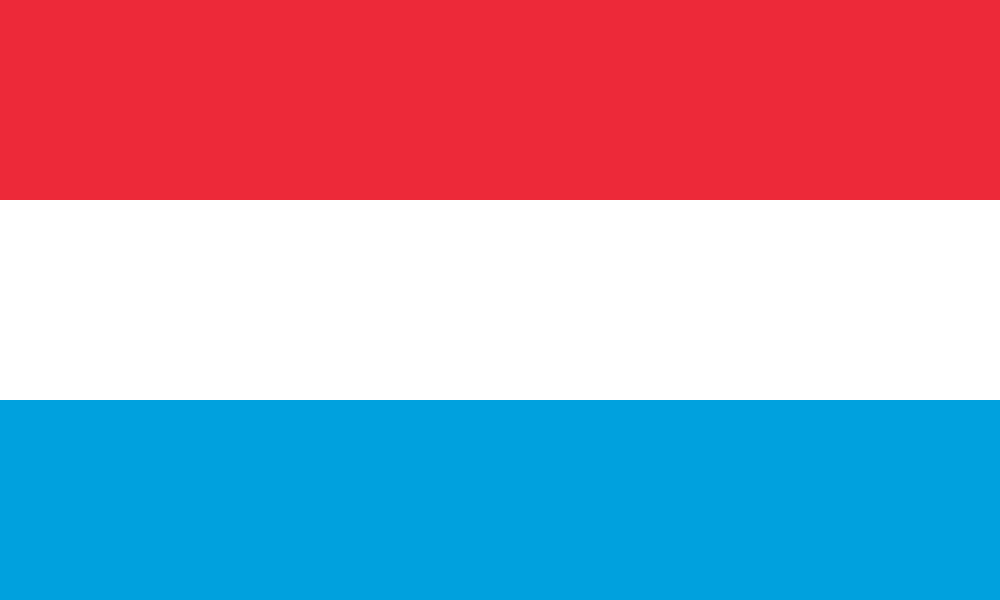
Luxembourg's adoption of daylight saving time in 1916 made it one of the first European nations to implement it, initially to conserve coal during wartime, a practice that continues today for energy efficiency. This early move highlights the country's forward-thinking approach to time management in its role as a modern financial hub.
Nestled in the heart of Western Europe, Luxembourg is a small yet vibrant nation known for its financial prowess, historic castles, and multicultural charm. With a population of around 640,000, this landlocked country shares borders with Belgium, France, and Germany, making it a crossroads of European cultures. Luxembourg operates on a single time zone, Central European Time (CET), which keeps its efficient society in sync with neighboring nations.
Luxembourg adheres to the Europe/Luxembourg IANA time zone, aligning with Central European Time (CET) at UTC+1 during standard periods. This unified time zone spans the entire country, including its capital, Luxembourg City, ensuring seamless coordination for business, travel, and daily life across its 2,586 square kilometers. As a member of the European Union, Luxembourg observes daylight saving time (DST), transitioning to Central European Summer Time (CEST) at UTC+2. The switch to DST occurs on the last Sunday of March, typically around 2:00 AM local time, when clocks are advanced by one hour to maximize evening daylight during the warmer months. The return to CET happens on the last Sunday of October, with clocks falling back one hour at 3:00 AM CEST, promoting energy conservation and aligning with broader EU practices.
This DST observance has been standard since 1981, though Luxembourg first experimented with it during World War I in 1916. For international travelers and remote workers, understanding these shifts is crucial. In winter, Luxembourg is one hour ahead of London, which runs on Greenwich Mean Time (GMT, UTC+0). During summer, when London advances to British Summer Time (BST, UTC+1), the gap remains one hour, with Luxembourg at UTC+2. This consistent offset simplifies scheduling calls or flights between the two financial hubs—London's morning meetings often align neatly with Luxembourg's mid-morning. Compared to other European spots, Luxembourg's time zone fosters strong ties with the Eurozone core, where Paris and Frankfurt share the same CET rhythm. For those planning visits, apps like World Clock or official sites from the Grand Duchy government provide real-time updates, reflecting Luxembourg's ISO code LU for precise queries. Overall, this straightforward system supports the country's role as a global banking center, where transactions and markets operate without the confusion of multiple zones.
Life in Luxembourg pulses with a blend of efficiency and leisure, reflecting its affluent, multilingual society where French, German, and Luxembourgish coexist alongside English in business settings. Typical meal times follow a continental European pattern: breakfast around 7:00–8:00 AM with coffee, croissants, or hearty breads; lunch from 12:00–2:00 PM, often a substantial affair featuring salads, quiches, or Judd mat Gaardebounen (smoked pork with beans); and dinner between 7:00–8:00 PM, lighter with cheeses, charcuterie, or international cuisines in the capital's diverse eateries. These timings allow for a balanced day, with many enjoying family meals that underscore the nation's strong community ties.
Office hours generally run from 8:00 AM to 5:00 PM or 9:00 AM to 6:00 PM, Monday through Friday, accommodating the 40-hour workweek that's among Europe's shortest, bolstered by generous vacation policies averaging 25–30 days annually. Shops and boutiques in Luxembourg City open around 9:00 AM, closing at 6:00 PM, with extended hours on Thursdays until 8:00 PM in some areas; supermarkets may stay open later, up to 8:00 PM. Administrative offices, like those for banking or immigration, stick to 8:30 AM–4:00 PM, often with a one-hour lunch closure from 12:00–1:00 PM. Sundays serve as the weekly rest day, with most non-essential shops closed by law, promoting relaxation—residents might hike in the Ardennes or visit vineyards in the Moselle Valley. A local specificity is the "Schueberfouer," an annual funfair in Luxembourg City from mid-August to early September, where time bends toward evening festivities with rides and feasts until midnight, injecting vibrant energy into the otherwise orderly rhythm.
Nightlife thrives modestly in the capital's Grund district, with bars and clubs open until 1:00–3:00 AM on weekends, catering to an international crowd. Rituals like the daily "Bierg" (hill) commutes in the hilly terrain add a physical cadence to the day. For seasonal flair, sunrise and sunset vary markedly: at the winter solstice (around December 21), the sun rises near 8:25 AM and sets by 4:35 PM, yielding about 8 hours of daylight and cozy early evenings. In summer solstice (June 21), it rises around 5:35 AM and sets after 9:45 PM, offering nearly 16.5 hours for outdoor pursuits like cycling along the Alzette River. This natural ebb and flow influences everything from tourism peaks in summer to the introspective winter focus on cultural events, making Luxembourg's daily rhythm both predictable and seasonally alive.