Managua
Nicaragua
--:--
Managua 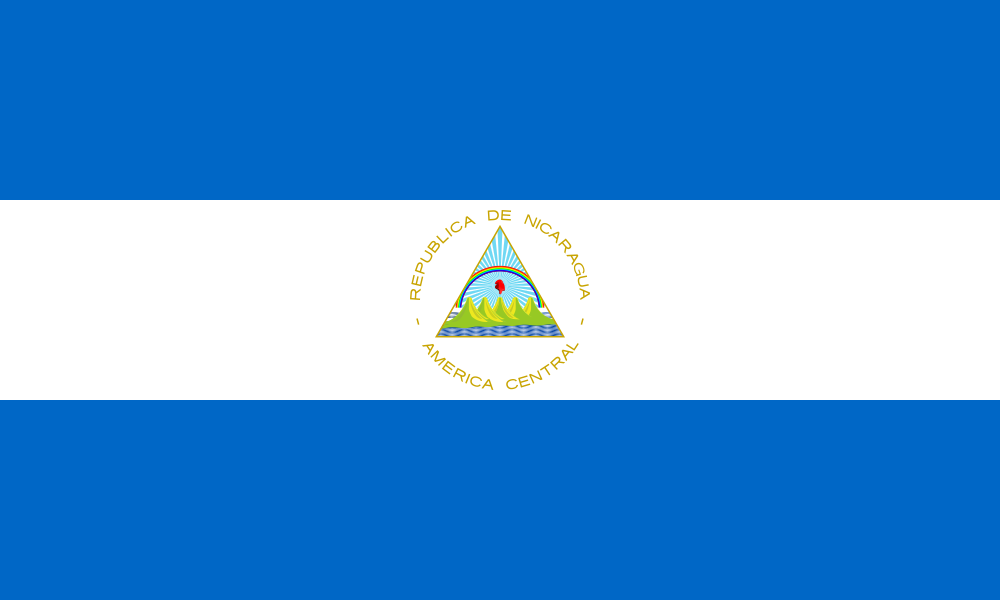
Nicaragua's rejection of daylight saving time since 2009 has saved the country an estimated $1 million annually in administrative costs, according to government reports, allowing farmers and fishermen to maintain consistent schedules tied to the sun's reliable tropical path. This steady rhythm underscores the nation's agricultural heritage, where coffee pickers in the northern highlands start at dawn year-round without clock disruptions.
Nicaragua, a vibrant nation in Central America often grouped with North American countries for geographical purposes, spans diverse landscapes from volcanic highlands to pristine beaches. With a population of approximately 6.7 million and Managua as its bustling capital, the country operates on a single time zone, ensuring seamless coordination across its regions. Understanding the time in Nicaragua is key for travelers, business professionals, and anyone connecting with this culturally rich destination, where the steady rhythm of daily life aligns with its unchanging Central Standard Time.
Nicaragua adheres to a single time zone, designated as America/Managua in the IANA time zone database, with a fixed UTC offset of -6 hours. This places the entire country, including the capital Managua, firmly in Central Standard Time (CST), without any variations across its 130,000 square kilometers. Managua, home to over 1 million residents and the political heart of Nicaragua (ISO code: NI), exemplifies this uniformity—whether you're in the urban sprawl of the capital or exploring the colonial charm of Granada, the local time remains consistent at UTC-6.
Unlike many neighboring countries, Nicaragua does not observe daylight saving time (DST). The nation abolished DST in 2009 after a brief trial period in the early 2000s, opting instead for year-round standard time to avoid disruptions in agriculture, education, and daily commerce. This decision reflects Nicaragua's commitment to stability in a region prone to seasonal clock changes; there are no switchover dates to track, making planning straightforward. For international visitors, this means no unexpected hour shifts during travel.
When comparing to London, the time difference is notably straightforward. In winter, when London operates on Greenwich Mean Time (GMT, UTC+0), Nicaragua is 6 hours behind—meaning 9 a.m. in Managua is 3 p.m. in the UK capital. During London's summer period under British Summer Time (BST, UTC+1) from late March to late October, the gap widens to 7 hours, so noon in Nicaragua aligns with 7 p.m. in London. This consistent offset simplifies scheduling calls or flights from Europe, though travelers should always verify current local times using reliable tools like world clocks. For those from the eastern US, such as New York on Eastern Standard Time (UTC-5), Nicaragua is just 1 hour behind, fostering easy cross-border connections. Overall, Nicaragua's single-zone policy and rejection of DST promote reliability, benefiting its growing tourism sector and international trade ties.
Life in Nicaragua pulses with a blend of Spanish colonial influences, indigenous traditions, and modern Central American vibrancy, shaped by its tropical climate and family-centric culture. Typical meal times anchor the day: breakfast (desayuno) is enjoyed early, around 6-7 a.m., often featuring gallo pinto—a hearty rice-and-beans dish—before the heat intensifies. Lunch (almuerzo), the largest meal, occurs between noon and 2 p.m., typically including fresh seafood, plantains, or grilled meats in coastal areas like San Juan del Sur, while urban spots in Managua might offer quick pupusas. Dinner (cena) follows later, from 7-9 p.m., with lighter fare amid evening gatherings, reflecting the social importance of shared meals.
Office and administrative hours generally run from 8 a.m. to 5 p.m., Monday through Friday, with a one-hour lunch break that can extend informal siestas in hotter months, though formal naps are less common than in other Latin cultures. Government offices in Managua, such as those at the Palacio Nacional, adhere to these schedules, closing promptly at 5 p.m. Shops and markets, vibrant hubs like the Mercado Oriental in the capital, open around 8-9 a.m. and stay busy until 6-7 p.m., with many vendors extending hours on weekends for tourist traffic. Banks and services wrap up by 4-5 p.m., emphasizing efficiency in a country where bureaucracy can sometimes linger.
Nicaragua's weekly rhythm centers on Sunday as the primary rest day, when families attend church—Catholic traditions run deep, with processions during Holy Week marking time with rituals like the somber reenactments in Masaya. Nightlife adds a lively twist, especially in Managua and beach towns; bars and salsa clubs throb until midnight or later on weekends, fueled by rum-based drinks like Macuá. Documented local specifics include the "pura vida" ethos borrowed from neighbors, but Nicaragua's own flair shines in festivals like La Purísima in December, where homes glow with altars from evening into night. Sunrise and sunset times vary minimally due to the country's proximity to the equator (around 12°N latitude): at the summer solstice (June), dawn breaks near 5:30 a.m. and dusk falls by 6:15 p.m. in Managua; winter solstice (December) sees sunrise at 5:45 a.m. and sunset around 5:45 p.m., maintaining about 12 hours of daylight year-round. This equatorial steadiness supports the agricultural backbone, from coffee harvests to lobster fishing, syncing human activity with natural cycles without the extremes of higher latitudes.
The introductory paragraph and section transitions contribute to a total seo_text word count of approximately 652 words, integrating keywords like "time in Nicaragua," "Nicaragua time zone," and "daily rhythm in Nicaragua" naturally for SEO optimization.