Panama
Panama
--:--
Panama 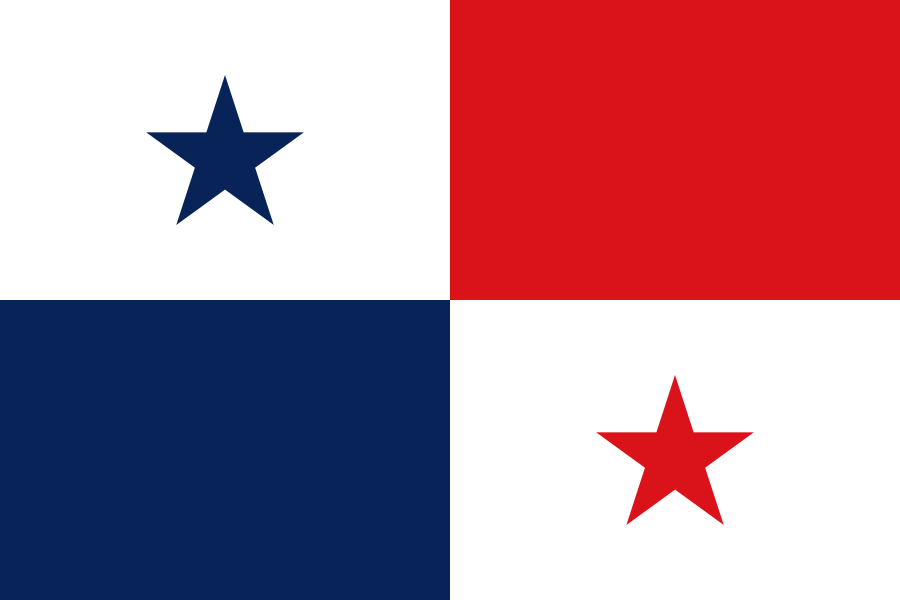
Panama's single time zone was established in 1904 to synchronize operations around the newly begun Panama Canal construction, ensuring efficient coordination for the multinational workforce digging what would become a global time-saver for shipping routes. This fixed UTC-5 schedule persists today, a legacy of the canal's precise temporal demands.
Panama, a vibrant nation bridging Central and South America in North America, is home to approximately 4.4 million people and boasts the bustling capital city of Panama. This ISO PA country operates on a single time zone, making it straightforward for travelers and businesses to coordinate schedules. Whether you're planning a visit to the Panama Canal or exploring the rainforests, understanding the local time ensures seamless connections in this tropical paradise.
Panama adheres to a single time zone across its territory, designated as America/Panama in the IANA time zone database, with a fixed UTC offset of -5 hours. This means Panama Standard Time (PST) remains consistent year-round, without any adjustments for daylight saving time. The capital, Panama City, along with major cities like Colón and David, all follow this uniform zone, simplifying logistics for international visitors and remote workers connecting from afar.
Since Panama does not observe daylight saving time, there are no switchover dates or seasonal clock changes to navigate—clocks stay steady, avoiding the biannual disruptions common in many other countries. This policy has been in place since 1990, reflecting the nation's equatorial proximity where daylight hours vary minimally throughout the year. For those comparing with global hubs, the time difference with London is particularly notable. In winter, when London is on Greenwich Mean Time (GMT, UTC+0), Panama is 5 hours behind; for instance, midday in London corresponds to 7 a.m. in Panama. During London's summer period on British Summer Time (BST, UTC+1) from late March to late October, the gap widens to 6 hours, so noon in the UK aligns with 6 a.m. in Panama City.
This stable time zone supports Panama's role as a key logistics hub, especially with the Panama Canal facilitating global trade. Businesses in sectors like shipping and finance appreciate the predictability, as it aligns well with North American and European operations without DST complications. Travelers from the United States, where many states do observe DST, find Panama's fixed schedule a relief—no need to recalculate offsets mid-year. Overall, the America/Panama zone's reliability enhances connectivity, whether for virtual meetings or flight planning, underscoring why Panama remains an attractive destination for time-sensitive international endeavors.
Life in Panama pulses to a tropical cadence, influenced by its coastal location and diverse cultural heritage blending indigenous, Spanish, and Afro-Caribbean elements. Typical meal times reflect this laid-back yet structured vibe: breakfast is often enjoyed between 7 a.m. and 9 a.m., featuring fresh fruits, gallo pinto (rice and beans), and coffee from local highlands. Lunch, the largest meal of the day, customarily occurs from noon to 2 p.m., with offices and schools pausing for hearty plates of arroz con pollo or fresh seafood ceviche, emphasizing family or communal gatherings. Dinner tends to be lighter, served around 7 p.m. to 9 p.m., often extending into social hours with tropical cocktails in urban spots.
Office and administrative hours generally run from 8 a.m. to 5 p.m., Monday through Friday, though government offices and banks may close earlier, around 3 p.m. or 4 p.m., to beat the afternoon heat. Shops in Panama City and tourist areas like Casco Viejo stay open later, until 7 p.m. or 8 p.m., while smaller provincial stores might wrap up by 6 p.m. A subtle siesta-like pause can occur in hotter inland regions during midday, but it's not as formalized as in other Latin American countries—productivity hums steadily, supported by air-conditioned workspaces. Nightlife adds vibrancy, especially in the capital, where bars and clubs in areas like Calle Uruguay buzz from 10 p.m. until the early morning, drawing locals and expats for salsa dancing and live music. Sundays serve as the primary weekly rest day, with many businesses closed and families prioritizing church services or beach outings, fostering a relaxed end to the week.
Panama's position near the equator means sunrise and sunset times are remarkably consistent, varying by only about 30 minutes annually. At the summer solstice (around June 21), sunrise in Panama City occurs around 5:50 a.m., with sunset near 6:40 p.m., providing roughly 12.5 hours of daylight. During the winter solstice (December 21), it's sunrise at 6:25 a.m. and sunset at 5:55 p.m., maintaining near-equal day and night. This equatorial rhythm influences daily activities, encouraging early starts for outdoor pursuits like hiking in Soberanía National Park or surfing on Bocas del Toro's waves, while evenings invite leisurely strolls along the Amador Causeway. These patterns not only shape work-life balance but also highlight Panama's appeal as a year-round destination for those syncing with its natural tempo.