Saint-Marin
San Marino
--:--
San Marino 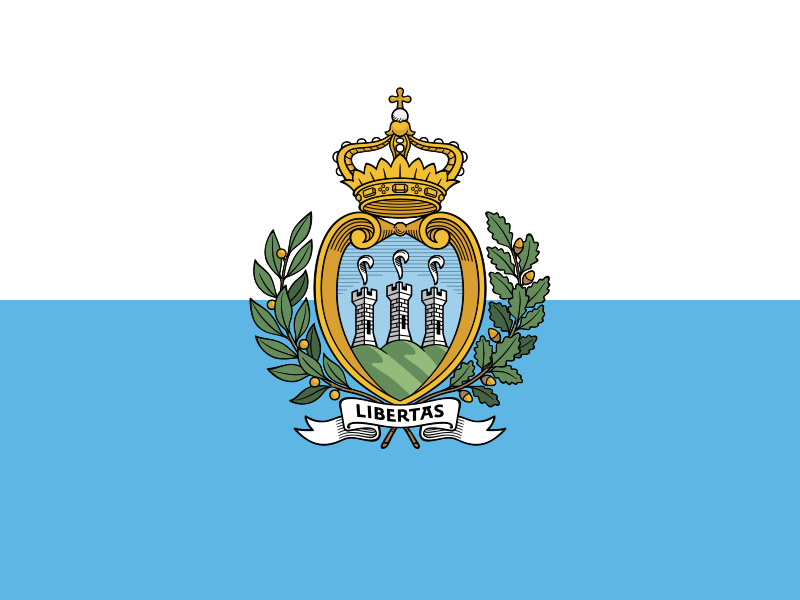
San Marino's Great Council, or General Council, has convened on the third Sunday of every July since 1463 for the changing of the guard ceremony, a ritual that precisely marks the summer midpoint and reinforces the republic's unbroken democratic traditions tied to seasonal time. This event, drawing crowds to the capital's Piazza della Libertà, exemplifies how the nation's rhythm intertwines governance with the solar calendar.
Nestled in the heart of Europe, San Marino stands as one of the world's oldest republics and a tiny enclave within Italy, boasting a population of just 33,000. This microstate operates on a single time zone, aligning seamlessly with much of southern Europe for straightforward time management in travel and business. Whether you're planning a visit to the capital, San Marino (also known as Saint-Marin), or coordinating calls across borders, understanding the local time ensures you sync with the serene rhythm of this historic nation.
San Marino adheres to Central European Time (CET), designated by the IANA time zone identifier Europe/San_Marino, with a standard UTC offset of +1 hour. This places the entire country, including the capital San Marino (Saint-Marin), firmly in this zone, eliminating any internal time discrepancies despite its compact 61 square kilometers. As a landlocked enclave surrounded by Italy, San Marino mirrors the Italian time system, making cross-border travel hassle-free for those navigating from nearby regions like Emilia-Romagna.
Daylight saving time (DST) is observed in San Marino, as confirmed by its "oui" status in regional standards. Clocks spring forward by one hour on the last Sunday of March, typically around 2:00 AM local time, shifting to Central European Summer Time (CEST) at UTC+2. This adjustment lasts until the last Sunday of October, when clocks fall back at 3:00 AM CEST to resume CET. These switchover dates align precisely with the European Union directives, which San Marino follows voluntarily due to its close ties with the EU, even though it is not a member state. The practice helps extend evening daylight during warmer months, supporting outdoor activities in the country's mountainous terrain.
Regarding time differences with London, San Marino maintains a consistent one-hour lead year-round. In winter, under CET (UTC+1), San Marino is one hour ahead of Greenwich Mean Time (GMT, UTC+0) in London. During summer, CEST (UTC+2) keeps San Marino one hour ahead of British Summer Time (BST, UTC+1). This stable offset simplifies scheduling for UK visitors or remote workers, avoiding the seasonal shifts that complicate comparisons with non-DST regions. For instance, a 9:00 AM meeting in London's winter would start at 10:00 AM in San Marino, and the same holds in summer. Travelers from the ISO code SM-designated nation often appreciate this predictability, especially when coordinating with Europe's diverse time zones. Overall, San Marino's time system reflects its European integration, ensuring reliable connectivity for global interactions.
Life in San Marino unfolds with a relaxed, Mediterranean pace influenced by its Italian neighbors, where daily routines emphasize family, tradition, and the natural landscape of its three towers and ancient walls. Typical meal times follow a classic southern European pattern: breakfast is light and early, around 7:00–8:00 AM, often consisting of coffee and cornetti at local cafés before the day begins. Lunch, the main meal, is savored between 1:00 PM and 2:30 PM, with families gathering for pasta, fresh seafood, or regional specialties like piadina flatbreads— a time when many businesses pause for this midday ritual. Dinner tends to be later, starting at 8:00 PM or even 9:00 PM, allowing for leisurely evenings under the stars, perhaps with a glass of local Sangiovese wine.
Office and administrative hours in San Marino cater to this unhurried flow, generally running from 8:00 AM to 1:00 PM and resuming from 3:00 PM to 6:00 PM or 7:00 PM on weekdays. Government offices in the capital, such as those handling the ISO SM-coded bureaucracy, close early on Fridays and remain shut on weekends, underscoring the importance of rest. Shops and boutiques in historic centers like Borgo Maggiore or Serravalle follow a similar siesta-style schedule: open 9:00 AM–1:00 PM, then 4:00 PM–7:30 PM, with many extending into the evening during tourist seasons. This split accommodates the afternoon heat and promotes work-life balance in a country where tourism drives much of the economy.
Local specifics add charm to the rhythm—Sundays are dedicated to weekly rest, with churches hosting masses and families enjoying hikes in the Apennines, reflecting San Marino's deep Catholic heritage. Nightlife is subdued yet vibrant in summer, with piazzas coming alive for folk festivals or gelato strolls until 10:00 PM, but it quiets early compared to larger cities. Rituals like the annual Crossbow Tournament in July tie into seasonal time, blending history with community gatherings. Sunrise and sunset times vary notably at solstices: on the summer solstice (around June 21), the sun rises near 5:15 AM and sets after 9:00 PM in CEST, bathing the medieval fortresses in golden light for extended outdoor pursuits. In winter, the December solstice sees sunrise around 7:30 AM and sunset by 4:30 PM in CET, encouraging cozy indoor traditions. This cyclical pattern underscores how San Marino's time zone supports a harmonious blend of work, leisure, and seasonal celebration in its tranquil European setting.