Bratislava
Slovakia
--:--
Bratislava 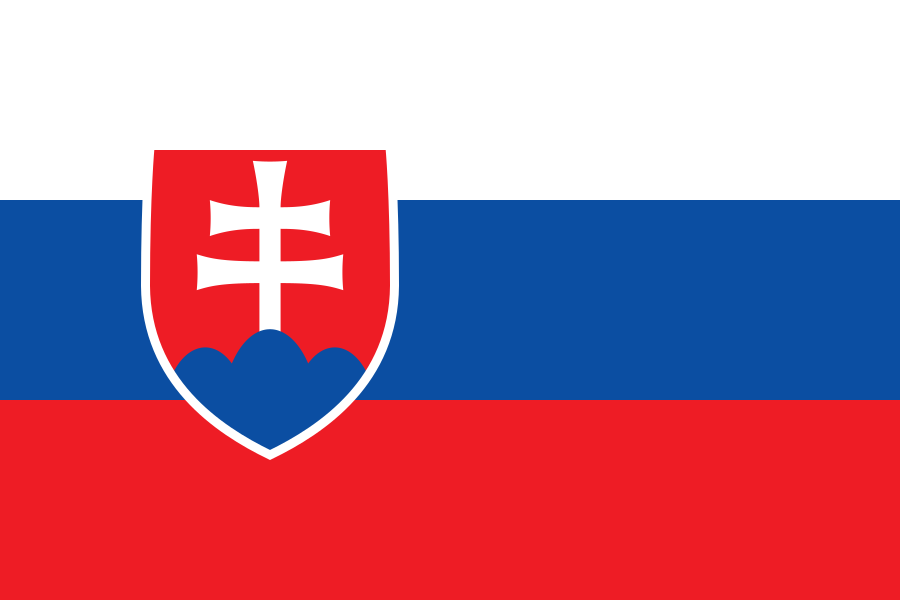
Slovakia's observance of daylight saving time dates back to 1915 during World War I, when it was first trialed as part of the Austro-Hungarian Empire to conserve coal for wartime efforts, making it one of Europe's earliest adopters of the practice. This historical nod to energy efficiency still influences modern scheduling, especially during the vibrant summer festivals in Bratislava.
Slovakia, a landlocked country in Central Europe with a population of around 5.5 million, is known for its stunning Tatra Mountains, historic castles, and vibrant cultural heritage. The capital, Bratislava, serves as the political and economic hub, blending medieval architecture with modern life. Slovakia operates on a single time zone, making it straightforward for travelers and businesses to coordinate schedules across its ISO code SK territory.
Slovakia adheres to Central European Time (CET), designated by the IANA time zone identifier Europe/Bratislava, with a standard UTC offset of +1 hour. This zone covers the entire country uniformly, from the bustling streets of Bratislava to the serene High Tatras, ensuring no regional variations complicate daily planning. In winter months, clocks align with UTC+1, providing a consistent rhythm for the nation's 5.5 million residents.
Daylight saving time (DST) is observed in Slovakia, as per EU regulations, shifting to Central European Summer Time (CEST) with a UTC+2 offset. The transition occurs on the last Sunday of March, when clocks spring forward by one hour at 2:00 a.m. local time, extending evening daylight for outdoor activities like hiking in the Slovak Paradise National Park. The switch back to CET happens on the last Sunday of October at 3:00 a.m. CEST, falling back one hour to reclaim morning light during the cooler season. This biannual adjustment, in place since 1980 with minor interruptions, promotes energy efficiency and aligns Slovakia with neighboring European nations.
Regarding time differences with London, which follows Greenwich Mean Time (GMT, UTC+0) in winter and British Summer Time (BST, UTC+1) in summer, Slovakia is typically one hour ahead. During winter (late October to late March), when Slovakia is on CET (UTC+1) and London on GMT (UTC+0), the offset is +1 hour—meaning if it's noon in London, it's 1:00 p.m. in Bratislava. In summer (late March to late October), Slovakia advances to CEST (UTC+2) while London moves to BST (UTC+1), maintaining the +1 hour difference; thus, 9:00 a.m. BST in London corresponds to 10:00 a.m. CEST in Slovakia. This predictable gap facilitates seamless communication for UK-Slovakia business ties, tourism, and family calls, though travelers should always verify current offsets via reliable tools like world clocks to account for exact transition dates. Overall, Slovakia's time zone setup supports its role as a key player in the European Union, fostering efficient cross-border interactions without the complexity of multiple zones.
Life in Slovakia pulses with a balanced blend of tradition and modernity, shaped by its Central European location and seasonal variations. Typical meal times reflect this: breakfast (raňajky) is light and early, often between 6:00 a.m. and 8:00 a.m., featuring fresh bread, cheeses, and coffee before the workday begins. Lunch (obed), the main meal, occurs from 12:00 p.m. to 2:00 p.m., with many offices and schools pausing for hearty dishes like bryndzové halušky (sheep cheese dumplings) in local restaurants or canteens. Dinner (večera) is lighter and later, around 6:00 p.m. to 8:00 p.m., often shared family-style with soups or salads, winding down the day.
Office hours generally run from 8:00 a.m. to 4:00 p.m. or 9:00 a.m. to 5:00 p.m., Monday through Friday, allowing for a structured work-life balance in sectors like automotive manufacturing and IT services centered in Bratislava and Košice. Shops and administrative offices, such as post offices or government buildings, typically open at 8:00 a.m. or 9:00 a.m. and close by 5:00 p.m. or 6:00 p.m., with larger retail chains in urban areas extending to 8:00 p.m. or even 9:00 p.m. on weekdays. Saturdays see reduced hours, often until noon or 2:00 p.m., while Sundays are the primary weekly rest day—most shops close, emphasizing family time, church attendance, or outdoor pursuits, in line with Catholic traditions prevalent in the country.
Local specifics add flavor to this rhythm: coffee culture thrives in the afternoons, with kafés serving as social hubs, and evening strolls along the Danube in Bratislava are common. Nightlife picks up in the capital after 9:00 p.m., with bars and clubs buzzing until 2:00 a.m. or later on weekends, contrasting the quieter rural pace. Rituals like the Easter Monday tradition of dousing women with water symbolize renewal, tying into seasonal time awareness. Sunrise and sunset times vary notably at solstices; on the summer solstice (around June 21), dawn breaks near 4:45 a.m. in Bratislava, with sunset after 9:00 p.m., ideal for long festivals like the Bratislava Music Festival. Winter solstice (December 21) sees sunrise around 7:45 a.m. and sunset by 4:00 p.m., prompting early indoor gatherings and illuminating Christmas markets with festive lights. This daily cadence, influenced by Slovakia's temperate climate, encourages a harmonious flow between work, leisure, and nature.