Cité du Vatican
Vatican
--:--
Vatican 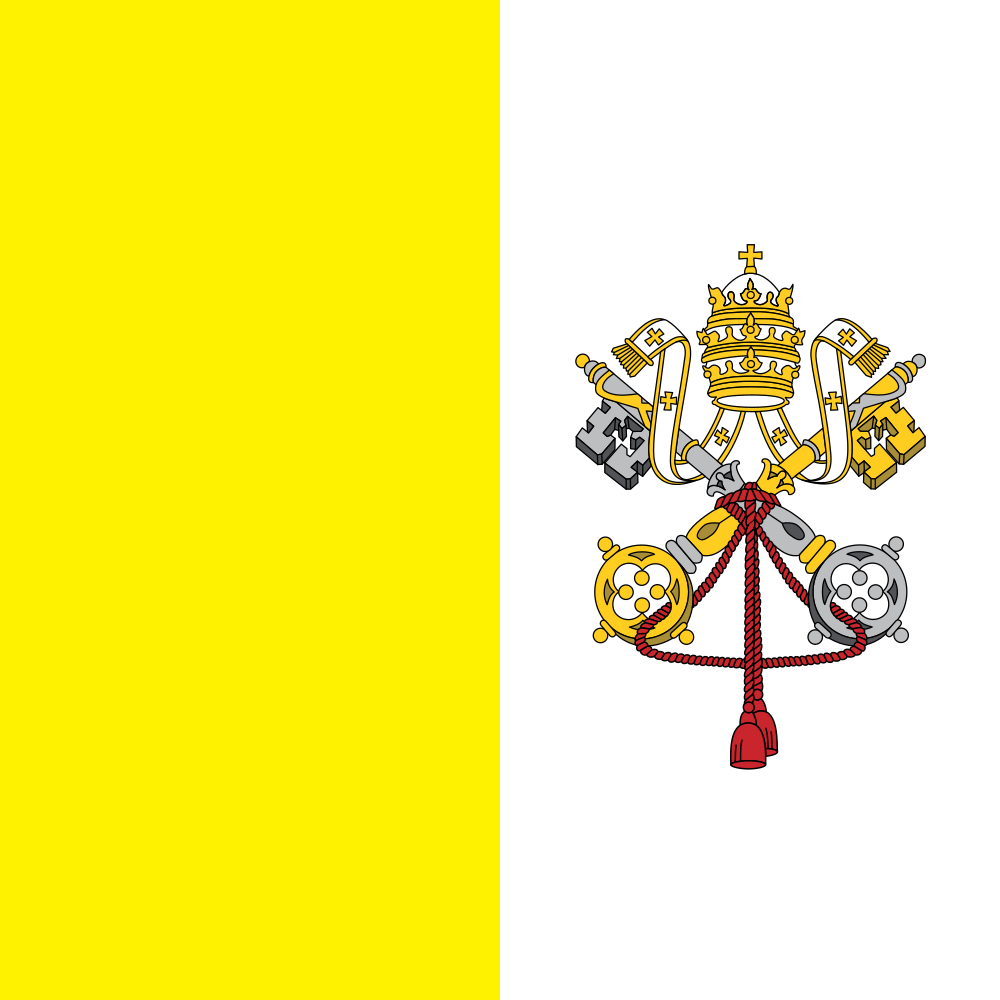
In 1582, Pope Gregory XIII initiated the Gregorian calendar reform from the Vatican, correcting the Julian calendar's drift by 10 days and introducing leap year rules still used globally today. This papal decree, aimed at aligning Easter's date more accurately, underscores the Vatican's historical influence on how the world measures time.
Nestled within the heart of Rome, the Vatican stands as the world's smallest sovereign state, a spiritual epicenter for over a billion Catholics worldwide. With a population of just around 800 residents, this European enclave operates on a single time zone that aligns seamlessly with its Italian surroundings. Time in Vatican follows Central European Time (CET), ensuring synchronized rhythms with nearby regions while accommodating the unique pace of papal duties and global pilgrimages.
The Vatican City State, with its ISO code VA and capital Cité du Vatican, adheres to the Europe/Rome IANA time zone identifier, reflecting its geographical and cultural ties to Italy. This places the Vatican on Central European Time (CET), which maintains a standard UTC+1 offset during the winter months. As a landlocked entity within Europe, it experiences no deviations across its compact 0.44 square kilometers, making time management straightforward for visitors and residents alike.
Daylight saving time (DST) is observed in the Vatican, denoted as "oui" in regional notations, transitioning to Central European Summer Time (CEST) with a UTC+2 offset. The switch to DST occurs on the last Sunday of March, when clocks spring forward by one hour at 2:00 a.m. local time, promoting longer evening daylight during the warmer seasons. The return to standard CET happens on the last Sunday of October, with clocks falling back one hour at 3:00 a.m. CEST. This biannual adjustment, harmonized with the European Union directives that Italy follows, ensures the Vatican's temporal alignment with continental norms, facilitating international diplomacy and tourism.
For those coordinating across borders, understanding the time difference with London is essential for seamless interactions. In winter, under CET, the Vatican is one hour ahead of London, which operates on Greenwich Mean Time (GMT, UTC+0). During summer, with CEST in effect, the Vatican remains one hour ahead of London on British Summer Time (BST, UTC+1), maintaining a consistent gap year-round. This stability simplifies scheduling calls or visits, whether for business with Vatican offices or planning a trip to St. Peter's Basilica. Travelers from the UK can appreciate how this offset allows for early morning departures without drastic jet lag, while the absence of multiple time zones within the Vatican itself eliminates any internal confusion. Overall, the Vatican's time zone setup supports its role as a global hub, where precision in timing underscores the meticulous organization of events like papal audiences and Holy See communications.
Life in the Vatican unfolds with a deliberate, reverent cadence shaped by its religious significance, where the daily rhythm revolves around prayer, administration, and limited commercial activity. Breakfast is typically light and early, around 7:00–8:00 a.m., often consisting of coffee and cornetti in the Swiss Guard quarters or clerical residences, aligning with the start of morning masses. Lunch, the main meal, occurs between 1:00 p.m. and 2:30 p.m., featuring Italian staples like pasta or insalata in communal dining halls, followed by a brief afternoon rest that echoes the siesta tradition of southern Europe. Dinner is late, from 8:00 p.m. onward, with simple fare to wind down the day after evening vespers.
Office and administrative hours in the Vatican generally run from 9:00 a.m. to 5:00 p.m., Monday through Friday, accommodating the Holy See's diplomatic corps and curial offices that handle global Catholic affairs. Shops and services within the Vatican walls, such as the Vatican Pharmacy or post office, mirror this schedule but close earlier, around 1:00 p.m. for lunch and reopen until 6:00 p.m., with many halting on Saturdays after noon. The Vatican Museums, a key draw for visitors, operate from 9:00 a.m. to 6:00 p.m. most days, extending to 8:00 p.m. on Fridays, though access is restricted during papal events. Nightlife is subdued, centered on spiritual rather than social pursuits; after dark, the focus shifts to illuminated basilicas and quiet reflection, with no vibrant bar scene due to the enclaves's monastic ethos.
Sundays serve as the primary weekly rest day, marked by solemn liturgies and closures across institutions, emphasizing Sabbath observance in line with Catholic doctrine. Rituals punctuate the day: the Angelus prayer at noon and public audiences on Wednesdays draw crowds, dictating a slower communal pace. Seasonal sunlight influences this rhythm; at the summer solstice (around June 21), sunrise in Cité du Vatican occurs near 5:35 a.m. CEST, with sunset at approximately 8:50 p.m., extending daylight for outdoor processions. In winter, the December solstice brings sunrise around 7:25 a.m. CET and sunset by 4:45 p.m., shortening days and intensifying indoor liturgical activities. These patterns, documented in Vatican almanacs and visitor guides, highlight how time in Vatican balances eternal traditions with practical European living, offering a serene contrast to the bustle of Rome just beyond its gates.