Ouagadougou
Burkina Faso
--:--
Ouagadougou 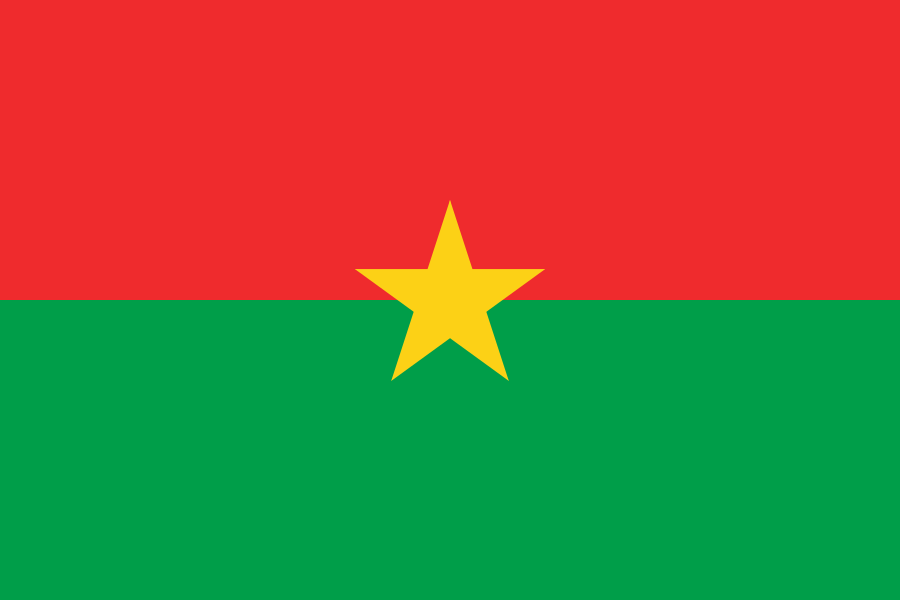
Burkina Faso's adoption of UTC+0 in 1911 under French colonial rule aligned it with the international meridian, a decision that persists today and once synchronized Upper Volta's cotton harvests with global shipping timetables for efficiency. This fixed time helped establish the country as a key transit point in West African trade networks during the early 20th century.
Nestled in the heart of West Africa, Burkina Faso is a landlocked nation known for its Sahelian landscapes, vibrant cultural festivals, and resilient communities. With a population of around 21 million people, the country—whose name translates to "Land of Honest People"—spans diverse ethnic groups and a rich history dating back to ancient Mossi kingdoms. Burkina Faso operates on a single time zone, Greenwich Mean Time (GMT/UTC+0), which provides a consistent temporal framework across its 274,200 square kilometers. This unified time organization reflects the country's compact geography and supports seamless national coordination, from bustling markets in the capital to rural agricultural cycles. As travelers and business professionals seek to understand time in Burkina Faso, grasping this straightforward system alongside the local rhythm reveals how daily life pulses with the rhythms of tradition and modernity.
Burkina Faso maintains a single time zone throughout its territory, simplifying travel and communication for its 21 million residents. The official IANA time zone identifier is Africa/Ouagadougou, aligned with UTC+0, also known as Greenwich Mean Time (GMT). This offset means that clocks in Burkina Faso run exactly on the prime meridian time, without any deviations for regions within the country. The capital, Ouagadougou, serves as the central reference point for this zone, where government offices, international airports, and major businesses all synchronize to Africa/Ouagadougou. Other key cities, such as Bobo-Dioulasso in the southwest—the nation's second-largest urban center—and Koudougou in the central region, follow the same UTC+0 standard, ensuring uniformity from the northern Sahel borders to the southern savannas.
This single-zone structure is both geographic and political in nature. Burkina Faso's location between longitudes 4°W and -2°E places it squarely within the UTC+0 band, avoiding the need for multiple zones that larger nations like neighboring Nigeria might require. Politically, the decision stems from colonial legacies under French rule, when Upper Volta (Burkina Faso's former name until 1984) adopted a unified time system for administrative efficiency. Post-independence, this was retained to foster national cohesion in a country with over 60 ethnic groups and no significant east-west expanse that would warrant splits. The logic aligns with many West African neighbors, such as Ghana and Côte d'Ivoire, promoting regional harmony in trade and diplomacy. For visitors arriving at Ouagadougou's Thomas Sankara International Airport or exploring Bobo-Dioulasso's artisan markets, this means no time adjustments within the country—ideal for itineraries that weave through cultural sites like the Moro-Naba Palace or the Bani River valleys. In practice, this setup supports Burkina Faso's economy, where agriculture and mining dominate; farmers in the north and traders in the south operate on the same clock, facilitating synchronized market days and festivals. Overall, the Africa/Ouagadougou zone embodies the nation's commitment to simplicity, making it an accessible entry point for understanding time in Burkina Faso amid its dynamic West African context.
Burkina Faso does not observe Daylight Saving Time (DST), maintaining a fixed UTC+0 offset year-round without any clock adjustments. This policy, consistent since independence in 1960, aligns with the practices of most African nations south of the Sahara, where DST is rarely implemented. The primary reasons include the equatorial climate's minimal seasonal daylight variations—sunrise hovers around 6:00 AM and sunset near 6:00 PM throughout the year—and the potential disruptions to agricultural routines in a country where over 80% of the population relies on farming. Introducing DST could confuse rural communities using traditional timekeeping methods, such as solar observations or rooster crows, and complicate cross-border trade with non-DST neighbors like Mali and Niger.
The absence of DST brings practical benefits, offering predictability that suits Burkina Faso's hot, dry harmattan winds in the dry season (November to May) and heavy rains from June to October. Businesses and schools operate without the biannual shifts that plague Europe or North America, reducing errors in scheduling events like the pan-African FESPACO film festival in Ouagadougou. For travelers, this means no unexpected time changes upon arrival, easing planning for safaris in the Arly National Park or visits to Bobo-Dioulasso's Grand Mosque. However, it can lead to longer evenings in the wet season, when early sunsets might shorten outdoor activities without the "extra" daylight DST provides elsewhere. In essence, Burkina Faso's steadfast rejection of seasonal changes underscores a cultural preference for stability, allowing the national rhythm to flow uninterrupted by artificial time tweaks.
In Burkina Faso, the daily rhythm is shaped by a blend of tropical climate, cultural traditions, and economic necessities, creating a pace that starts early and winds down with the sun. Breakfast, often a light affair of millet porridge or tea with bread, is typically consumed between 6:00 AM and 7:30 AM, fueling the day's labor as the cooler morning hours are prime for outdoor work. Lunch, the main meal featuring staples like tô (a cornmeal dough) with sauces of okra or peanut, occurs around 1:00 PM to 2:00 PM, sometimes extending into a communal family gathering that reflects the nation's strong social bonds. Dinner follows later, between 7:00 PM and 9:00 PM, with grilled meats or rice dishes shared under the stars, especially in rural areas where electricity is sporadic.
Office hours in urban centers like Ouagadougou generally run from 7:30 AM to 12:30 PM, followed by a break to avoid the midday heat, resuming from 3:00 PM to 6:00 PM—a nod to French colonial influences adapted to the Sahelian warmth. Government ministries and banks adhere closely to this, while private businesses might flex slightly for client needs. Shops and markets, such as the vibrant Grand Marché in Ouagadougou, open as early as 7:00 AM and stay bustling until 7:00 PM or later, with informal vendors operating dawn to dusk. In Bobo-Dioulasso, artisan workshops follow similar patterns, closing for siesta-like rests during peak heat.
Nightlife pulses with energy in major cities, particularly Ouagadougou, where live music venues and bars come alive after 9:00 PM, showcasing balafon rhythms and modern Afrobeat until midnight or beyond on weekends. The city's nightlife scene, centered around areas like the Zone de la Gare, draws locals and expats for dancing and storytelling sessions that extend into the early hours. Documented local specifics include the influence of Islam in northern regions, where Friday prayers might shift afternoon schedules, and the weekly market cycles—such as Ouagadougou's grand marché on Sundays—that dictate community gatherings. Festivals like the Nako music event in Tiébélé village highlight how time in Burkina Faso intertwines with rituals, where drumming marathons mark solar calendars. This rhythm fosters a resilient lifestyle, balancing hard work with communal joy, and invites visitors to sync with the unhurried yet vibrant flow of Burkinabé daily life.
Burkina Faso's UTC+0 time zone creates straightforward differences with global hubs, facilitating connections for its growing tourism and trade sectors. Compared to London, which follows UTC+0 in winter (late October to late March) and switches to British Summer Time (BST, UTC+1) from late March to late October, Burkina Faso is synchronized during London's winter months—no offset needed for calls or meetings. In London's summer, Burkina Faso lags by one hour, meaning 9:00 AM in Ouagadougou is 10:00 AM in London. For New York, on Eastern Standard Time (EST, UTC-5) in winter and Eastern Daylight Time (EDT, UTC-4) in summer, the offset is +5 hours in winter (e.g., noon in Burkina Faso is 7:00 AM in New York) and +4 hours in summer. Paris, at Central European Time (CET, UTC+1) year-round except for summer CEST (UTC+2), is one hour ahead of Burkina Faso consistently, with a two-hour gap during European summer—ideal for Euro-African business links.
Practical tips for calling from the UK or US emphasize aligning with Burkina Faso's business hours (7:30 AM to 6:00 PM local time). From the UK in winter, anytime during your workday works seamlessly; in summer, aim for before 5:00 PM UK time to catch the afternoon in Ouagadougou. US callers from New York should target 8:00 AM to 4:00 PM EST in winter (corresponding to 1:00 PM to 9:00 PM in Burkina Faso) or adjust earlier in summer to avoid late nights there. For video conferences, tools like World Time Buddy can help, and consider the +9-hour difference with Tokyo (Japan Standard Time, UTC+9, no DST), making early morning calls from Burkina Faso (e.g., 8:00 AM local = 5:00 PM in Tokyo) optimal for Asia-Pacific dealings.
Jet-lag recommendations for travelers are minimal from Europe—little adjustment needed from London or Paris, perhaps just a day to acclimate to the heat—but more pronounced from the US, where the 5-6 hour shift eastward can cause fatigue; combat it with hydration, light exposure upon arrival, and napping sparingly. Fly into Ouagadougou mid-morning to ease into the rhythm, and use the consistent time zone for planning extensions to Bobo-Dioulasso without further disruptions. These offsets highlight Burkina Faso's strategic position, making it a convenient partner for Western timelines while underscoring the value of mindful scheduling in global interactions.
Burkina Faso operates in the Africa/Ouagadougou time zone, which is UTC+0 year-round. This single zone covers the entire country, including the capital Ouagadougou and cities like Bobo-Dioulasso. It ensures consistent timing for all activities, from business to travel.
Burkina Faso does not observe Daylight Saving Time, sticking to UTC+0 without changes. The time difference with London is zero hours during the UK's winter (UTC+0), but Burkina Faso is one hour behind during British Summer Time (UTC+1) from late March to late October. This stability simplifies planning for UK-Burkina interactions.
From the UK, call during your standard business hours in winter for perfect alignment, or before 5:00 PM in summer to match Burkina Faso's 7:30 AM–6:00 PM workday. US callers from New York should aim for 8:00 AM–12:00 PM EST to hit mid-morning there, avoiding evenings. For travel, visit during the dry season (November–May) when cooler temperatures align with longer daylight for exploring sites like Ouagadougou's markets.
Daily life in Burkina Faso starts early, with offices and shops opening around 7:30 AM–12:30 PM and resuming 3:00 PM–6:00 PM to beat the heat. Major sites like the Moro-Naba Palace in Ouagadougou are open daily from 8:00 AM to 5:00 PM, while markets buzz from dawn until evening. Nightlife in the capital picks up after 9:00 PM, reflecting a rhythm that balances work, rest, and community.
In Burkina Faso, traditional timekeeping in rural Mossi communities often relies on solar cues, like the position of the sun for market timings, blending with modern clocks. Festivals such as the Nako International Music Festival are scheduled around lunar or solar calendars, honoring ancestral rhythms alongside the Gregorian system.