Brazzaville
Republic of the Congo
--:--
Brazzaville 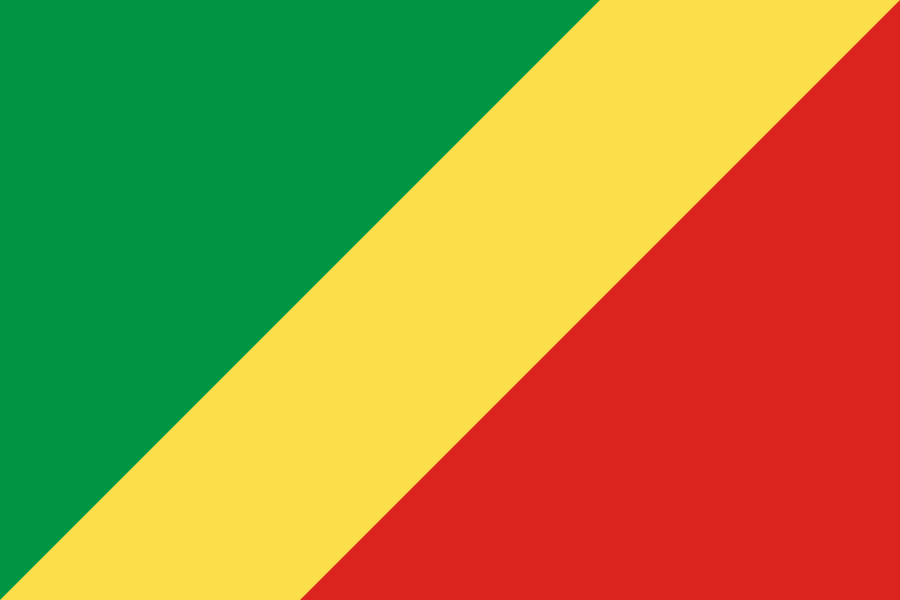
In the Republic of the Congo, the annual Fête de la Musique on June 21 coincides with the summer solstice, turning Brazzaville's streets into all-night jam sessions with local bands playing until dawn, celebrating the equatorial balance of day and night. This event, inspired by France's tradition but infused with Congolese rhythms, highlights how the country's steady UTC+1 time zone supports uninterrupted festivities without clock shifts.
The Republic of the Congo, a vibrant nation in Central Africa with a population of around 6 million, spans diverse landscapes from rainforests to the Congo River basin. Its capital, Brazzaville, serves as the political and economic hub, embodying the country's rich cultural heritage influenced by Bantu traditions and colonial history. For travelers, business professionals, and global connecters, understanding the time in Republic of the Congo is key, as the country observes a single time zone year-round, aligning seamlessly with its equatorial rhythm.
The Republic of the Congo operates on a single time zone, known as West Africa Time (WAT), with the IANA identifier Africa/Brazzaville and a fixed UTC offset of +1 hour. This uniformity simplifies scheduling across the nation's 342,000 square kilometers, from the bustling streets of Brazzaville to remote villages in the Sangha region. Brazzaville, the capital, fully adheres to this zone, ensuring that clocks in government offices, markets, and hotels all tick in sync without regional variations. As a country near the equator, the Republic of the Congo does not observe daylight saving time (DST), maintaining consistent daylight hours throughout the year—no clock changes, no seasonal adjustments, just steady progression from dawn to dusk.
This no-DST policy reflects the tropical climate's minimal variation in day length, avoiding the disruptions common in higher latitudes. For international coordination, the time difference with London is straightforward: in winter (when London is on Greenwich Mean Time, UTC+0), Brazzaville is one hour ahead. During London's summer (British Summer Time, UTC+1 from late March to late October), the two cities run on the same time, eliminating any offset. This alignment proves advantageous for UK-based businesses engaging with Congolese partners, as real-time collaboration peaks without the hassle of biannual shifts. Compared to other African nations, the Republic of the Congo's stable UTC+1 positions it ideally for interactions with Europe and parts of Asia, fostering trade in oil, timber, and minerals. Visitors from the US East Coast, for instance, face a five- to six-hour lag depending on the season, making early morning calls from New York a viable option for midday meetings in Brazzaville. Overall, the absence of DST underscores the country's practical approach to time management, prioritizing reliability in a region where equatorial stability shapes daily life.
In the Republic of the Congo, daily life pulses to a rhythm shaped by its tropical environment and cultural norms, blending African traditions with modern urban influences. Breakfast is typically a light affair around 7-8 a.m., often featuring staples like manioc porridge or bread with coffee, enjoyed before the heat intensifies. Lunch, the main meal, occurs between 12 p.m. and 2 p.m., with families gathering for hearty dishes such as grilled fish, plantains, and saka-saka (cassava leaves), reflecting the nation's reliance on riverine and forest resources. Dinner follows later, around 7-8 p.m., as the sun sets, with communal eating fostering social bonds in homes or local eateries.
Office hours generally run from 8 a.m. to 5 p.m., Monday through Friday, though government and administrative buildings in Brazzaville may extend to 6 p.m. during peak periods. Shops and markets, vibrant hubs of commerce, open around 8-9 a.m. and close by 6-7 p.m., with smaller vendors in areas like the Marché Total adapting to foot traffic. A notable local specificity is the siesta-like pause in the early afternoon, especially in rural areas, where the midday heat encourages a brief rest before resuming activities— a nod to equatorial pacing rather than strict European schedules. Nightlife in Brazzaville thrives post-9 p.m., with music clubs and bars along the Congo River offering makossa rhythms and grilled meats until midnight or later, particularly on weekends. The weekly rest day is Sunday, when churches fill with gospel services from morning, and families prioritize relaxation, underscoring the role of Christianity in Congolese culture.
Sunrise and sunset times vary little due to the country's proximity to the equator; at the summer solstice (around June 21), dawn breaks near 5:45 a.m. in Brazzaville, with sunset around 6:15 p.m., providing about 12.5 hours of daylight. In winter (December 21), it's similarly balanced at roughly 6 a.m. to 6 p.m., ensuring consistent energy for outdoor pursuits like fishing or farming. This predictable cycle supports the Republic of the Congo's agricultural backbone, where communities sync planting and harvesting to natural light, enhancing the overall harmony of daily routines.