Djibouti
Djibouti
--:--
Djibouti 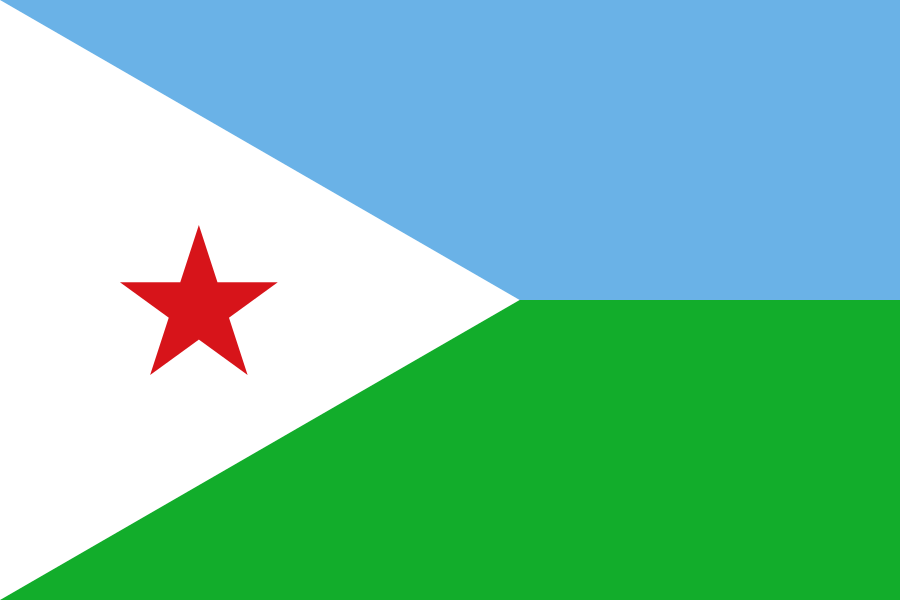
Djibouti's Doraleh Multipurpose Port operates on a 24/7 schedule under its fixed UTC+3 time zone, handling over 1 million TEUs annually and serving as a critical time-sensitive hub for Ethiopia's import-export trade since its 2017 opening. This non-stop rhythm underscores the country's pivotal role in global shipping, where precise timing prevents costly delays in Red Sea routes.
Djibouti, a small yet strategically vital nation in the Horn of Africa, serves as a key gateway to the Red Sea and Indian Ocean. With a population of around 1 million and its capital city bearing the same name, Djibouti operates on a single time zone that aligns with its arid climate and bustling port activities. Understanding the time in Djibouti is essential for travelers, business professionals, and anyone coordinating across continents, especially given its role in international shipping and military bases.
Nestled on the eastern edge of Africa, Djibouti is a compact country with a population of approximately 1 million, where the capital, Djibouti City, pulses as the economic and administrative heart. The nation adheres to Eastern Africa Time (EAT), making it straightforward for global visitors to sync their watches upon arrival. This single time zone simplifies scheduling for everything from diplomatic meetings to leisure explorations of its volcanic landscapes and coral reefs.
Djibouti follows the Africa/Djibouti time zone, which maintains a fixed UTC+3 offset year-round, reflecting its position in the Horn of Africa without the complications of seasonal adjustments. This IANA-standard zone encompasses the entire country, including the capital, Djibouti City, where major ports, government offices, and international hubs like the Doraleh Container Terminal operate on this consistent schedule. As a nation that does not observe daylight saving time (DST), Djibouti avoids the biannual clock changes common in many Western countries, ensuring stability for its 24/7 maritime operations and multinational partnerships. The absence of DST means no switchover dates to track—clocks remain steady, which is particularly beneficial for the country's role as a logistics hub serving Ethiopia and beyond.
For those comparing with major global cities, the time difference with London is notably straightforward. During London's winter months (Greenwich Mean Time, GMT, UTC+0), Djibouti is 3 hours ahead, so when it's noon in London, it's 3 p.m. in Djibouti. In summer, with London on British Summer Time (BST, UTC+1) from late March to late October, the gap narrows to 2 hours ahead—meaning a 9 a.m. London meeting aligns with 11 a.m. in Djibouti. This predictability aids in planning transcontinental calls or flights, especially since Djibouti's time zone aligns closely with neighbors like Somalia and Ethiopia, fostering seamless regional trade. The fixed UTC+3 also positions Djibouti favorably for early-morning connections with Asia (e.g., 4-5 hours behind Tokyo) and late-evening syncs with the U.S. East Coast (7-8 hours ahead of New York). Overall, the lack of DST underscores Djibouti's practical approach to time management in a hot, desert climate where daylight hours are already intense from dawn to dusk. This stability supports its growing economy, driven by foreign investments and its ISO code DJ designation in international databases. Whether you're booking a cargo shipment or a safari tour, knowing Djibouti's unwavering time zone ensures efficient coordination without the hassle of seasonal shifts.
Life in Djibouti revolves around the relentless heat of its desert environment, shaping a daily rhythm that emphasizes early starts, midday lulls, and evening social gatherings. Breakfast, often a light affair of coffee, bread, and fruits like dates or bananas, is typically enjoyed between 6 a.m. and 8 a.m., fueling the workforce before temperatures soar. Lunch, the main meal, occurs around noon to 2 p.m., featuring dishes such as spiced goat stew (lahoh flatbread with berbere sauce) or fish from the Gulf of Tadjoura, often shared in family or communal settings to break the midday heat.
Office and administrative hours generally run from 7:30 a.m. to 2:30 p.m., with government buildings like those in Djibouti City closing early to allow for rest during the peak afternoon sun, a nod to the Islamic-influenced culture where Friday serves as the primary weekly rest day, akin to a Sabbath. Shops and markets, vibrant with Somali, Afar, and Arab influences, open around 8 a.m. and may extend into the evening, but many pause from 1 p.m. to 4 p.m. for siesta-like breaks. Banks and post offices follow similar patterns, typically 7:45 a.m. to 1 p.m., while larger retailers in the capital might stay open until 8 p.m. to cater to after-work shoppers.
Evenings come alive with rituals like the communal iftar during Ramadan, where fasting breaks at sunset with sweets and teas, fostering a sense of unity in this multicultural society. Nightlife in Djibouti City centers on seaside cafes and modest bars serving camel milkshakes or qat sessions among locals, though it's subdued compared to urban hubs elsewhere, winding down by 10 p.m. to midnight. The weekly Friday prayer at mosques marks a collective pause, with many businesses shortening hours or closing entirely. Sunrise and sunset times vary minimally due to Djibouti's proximity to the equator (around 11.5°N latitude); at the summer solstice (June), dawn is about 5:20 a.m. and dusk around 6:40 p.m., providing roughly 13 hours of daylight, while winter solstice (December) shortens it to about 11.5 hours with sunrise at 6:15 a.m. and sunset at 5:50 p.m. This equatorial stability influences the rhythm, encouraging outdoor activities like beach volleyball or port watching in the cooler mornings and evenings, while the heat dictates indoor repose midday. For visitors, aligning with this flow—early rises for markets and late dinners under the stars—enhances immersion in Djibouti's resilient, sun-baked lifestyle.
The blend of African, Middle Eastern, and French colonial influences in Djibouti's daily rhythm makes it a fascinating study in adaptation, where time isn't just measured by clocks but by the sun's arc and communal bonds. With its single time zone and no DST, Djibouti offers a reliable temporal framework for exploring its salt flats, hot springs, and strategic ports. Whether for business in the ISO DJ-coded nation or cultural adventures, grasping these essentials ensures smoother travels across this East African gem.