Banjul
Gambia
--:--
Banjul 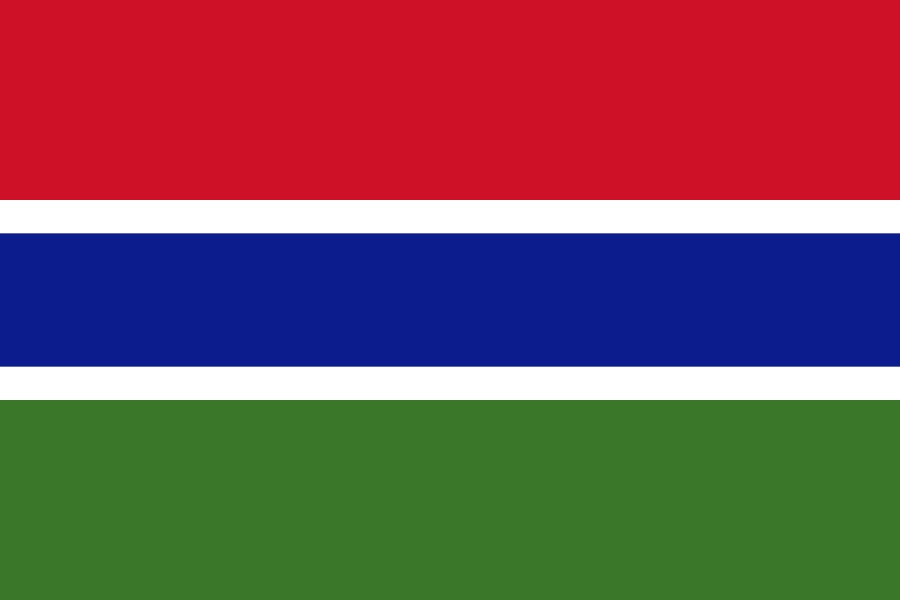
Gambia, one of the world's smallest countries by land area, follows UTC+00:00 without DST, a legacy of its British colonial past that keeps it synchronized with the UK during winter months—historically aiding the timely arrival of British tourists who flock to its beaches for "winter sun" escapes. This time alignment has supported Gambia's nickname as the "Smiling Coast," where dawn patrols by anti-poaching rangers in Kiang West National Park begin precisely at 6:00 AM to protect its diverse birdlife.
Gambia, a vibrant West African nation officially known as the Republic of The Gambia, captivates with its lush riverine landscapes and rich cultural heritage along the Gambia River. Nestled on the continent of Africa, this small country with a population of approximately 2.4 million residents operates on a single time zone, making it straightforward for travelers and businesses to coordinate schedules. Its capital, Banjul, serves as the bustling heart, where the rhythm of daily life aligns seamlessly with Greenwich Mean Time.
Nestled along the banks of the Gambia River, the Republic of The Gambia is a coastal gem in West Africa, renowned for its diverse wildlife, colonial history, and welcoming communities. With an ISO code of GM and a population hovering around 2.4 million, Gambia maintains a unified time zone that simplifies international interactions. The country's single time zone, Africa/Banjul, adheres strictly to UTC+00:00 year-round, ensuring consistency without the disruptions of seasonal changes. Whether planning a visit to Banjul's vibrant markets or coordinating with global partners, understanding Gambia's time essentials is key to seamless connectivity in this equatorial paradise.
Gambia's time zone is defined by the IANA identifier Africa/Banjul, which corresponds to a standard UTC offset of +00:00, aligning it directly with Coordinated Universal Time (UTC) and Greenwich Mean Time (GMT). This zone encompasses the entire country, including the capital city of Banjul, where government offices, markets, and ports operate under this consistent framework. As a tropical nation straddling the equator's influence, Gambia does not observe Daylight Saving Time (DST), a policy that has remained unchanged since its independence in 1965. This absence of DST means there are no switchover dates to adjust clocks—clocks remain fixed throughout the year, avoiding the biannual shifts that affect many northern hemisphere countries.
For international comparisons, Gambia's time difference with London is particularly straightforward. During the UK's winter months (from late October to late March), when London is on Greenwich Mean Time (GMT, UTC+00:00), Gambia shares the exact same time, facilitating easy real-time communication for business calls or virtual meetings without any offset. However, in the UK's summer period (from late March to late October), London advances to British Summer Time (BST, UTC+01:00), placing Gambia one hour behind. This seasonal variance can influence scheduling; for instance, a 9 AM meeting in London during summer would be 8 AM in Banjul. Travelers from Europe or North America appreciate this stability, as it minimizes jet lag adjustments when arriving from GMT-aligned regions. In contrast to neighboring countries like Senegal, which also follows UTC+00:00 without DST, Gambia's zone ensures border crossings don't require time recalibrations. This reliability supports its growing tourism sector, where visitors from the UK—Gambia's largest source of tourists—can plan flights and activities with precision. Overall, the Africa/Banjul zone's adherence to UTC+00:00 without DST underscores Gambia's practical approach to time management in a globalized world, benefiting trade, diplomacy, and leisure alike. (248 words)
In Gambia, the daily rhythm pulses with the warmth of West African hospitality, influenced by its Muslim-majority population and tropical climate. Meals typically follow a communal and unhurried pace: breakfast is enjoyed early, around 6:00 to 8:00 AM, often featuring simple staples like porridge or bread with tea, aligning with the dawn call to prayer. Lunch, the main meal, occurs between 1:00 and 2:00 PM, comprising rice dishes like benachin (jollof rice) shared family-style, providing a midday respite from the heat. Dinner is lighter and later, from 7:00 to 9:00 PM, with grilled fish or domoda (peanut stew) under the evening stars, fostering social bonds after the day's labors.
Office and administrative hours generally run from 8:00 AM to 4:00 PM, Monday through Friday, with government buildings in Banjul closing promptly to allow for afternoon prayers and rest. Shops and markets, such as the bustling Albert Market in Banjul, extend longer, often 9:00 AM to 7:00 PM, catering to evening shoppers amid the lively street commerce. A notable local specificity is the Friday Jumu'ah prayer, when many businesses shorten hours around noon for mosque attendance, reflecting Islamic traditions that shape the weekly cadence. The primary day of rest is Sunday, when families prioritize church services (for the Christian minority) or relaxed gatherings, though markets remain partially active. Nightlife in urban areas like Banjul or Serekunda picks up after 9:00 PM, with live kora music performances and beach bars offering a vibrant close to the day, though rural areas wind down earlier by 10:00 PM.
Sunrise and sunset times vary seasonally due to Gambia's position at about 13°N latitude. On the winter solstice (around December 21), sunrise in Banjul is approximately 7:40 AM, with sunset at 7:10 PM, providing about 11.5 hours of daylight. During the summer solstice (June 21), the sun rises around 6:50 AM and sets at 7:35 PM, extending daylight to roughly 12.5 hours. These patterns influence agricultural rhythms, with farmers starting fieldwork at dawn and fishermen on the Gambia River casting nets as the sun dips. This natural cycle, combined with cultural rituals like evening storytelling sessions, creates a harmonious blend of tradition and modernity in Gambia's everyday flow. (312 words)