Bissau
Guinea-Bissau
--:--
Bissau 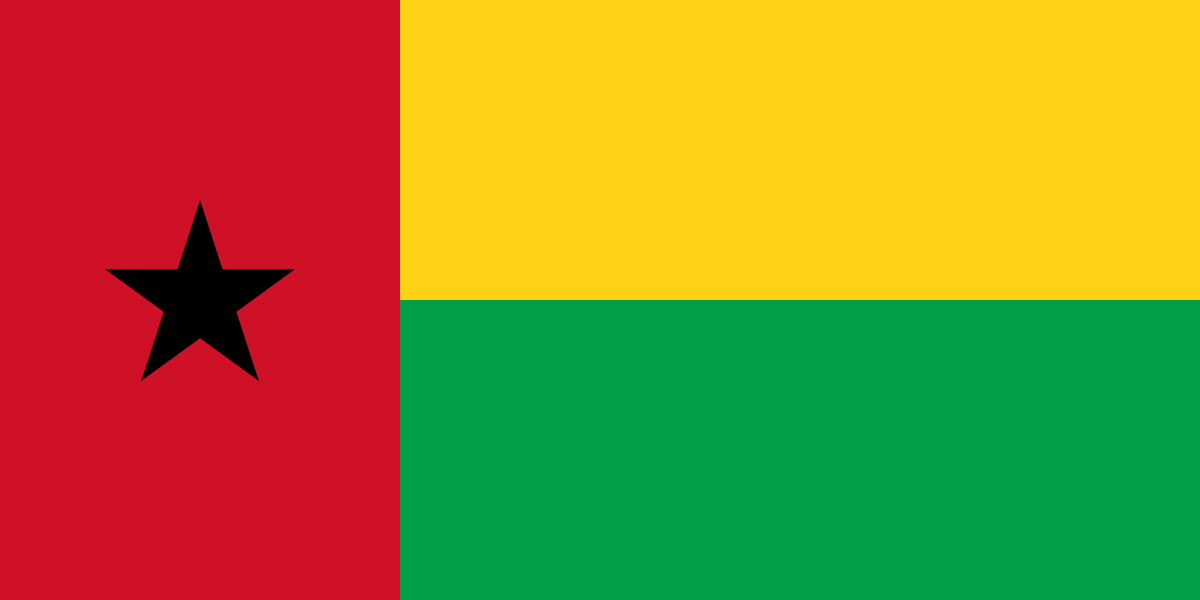
In Guinea-Bissau, the annual Festival Nacional de Música in Bissau, held in May, synchronizes with the steady UTC+0 rhythm to feature all-night performances of traditional kora and drum music, drawing crowds that dance until dawn without the interruption of DST shifts. This event highlights the country's unchanging time zone, allowing seamless blending of day and night in its cultural celebrations.
Guinea-Bissau, a coastal nation in West Africa with a population of around 2 million, operates on a single time zone that aligns closely with global standard time. Known for its lush mangroves, island archipelagos, and vibrant Creole culture, the country uses the Africa/Bissau time zone, which is UTC+0 year-round. Whether you're planning a trip to the capital Bissau or coordinating business across the continent, understanding the local time in Guinea-Bissau ensures seamless connections in this Portuguese-speaking gem.
Guinea-Bissau adheres to a straightforward time system with just one time zone nationwide, making it easy for travelers and businesses to navigate. The primary IANA time zone is Africa/Bissau, set at a UTC offset of +0 hours, which places it in sync with Coordinated Universal Time without any seasonal adjustments. This means clocks in Bissau, the bustling capital and economic hub, tick at exactly UTC+0 throughout the year, reflecting the country's position along the Greenwich Meridian's influence in West Africa. Major cities like Bafatá and Gabú follow the same uniform timing, eliminating the confusion of multiple zones often seen in larger African nations.
Unlike many European countries, Guinea-Bissau does not observe daylight saving time (DST), a policy that has remained consistent since its independence in 1974. There are no switchover dates or clock changes to contend with; the nation stays firmly on Greenwich Mean Time (GMT) equivalent all year. This stability is practical for a tropical climate where daylight hours vary minimally due to the country's latitude near the equator—sunrise hovers around 6:30 a.m. and sunset near 7:00 p.m. most days. For international comparisons, the time difference with London is zero hours during the UK's winter months (late October to late March), when both are on UTC+0. However, during London's summer period under British Summer Time (BST, UTC+1 from late March to late October), Guinea-Bissau falls one hour behind, so a 9 a.m. meeting in Bissau would be 10 a.m. in London. This no-DST approach simplifies scheduling for connections with other West African neighbors like Senegal and Guinea, both also on UTC+0 without adjustments. Businesses exporting cashew nuts—Guinea-Bissau's key commodity—or coordinating with global partners appreciate this predictability, as it avoids the disruptions of time shifts that affect productivity elsewhere. In essence, the Africa/Bissau zone's reliability supports the country's role in regional trade and tourism, from exploring the Bijagós Archipelago to engaging in diplomatic ties under its ISO code GW.
Life in Guinea-Bissau pulses to a relaxed, tropical cadence shaped by its coastal environment, multicultural heritage, and predominantly Muslim and animist influences, with Sunday as the primary weekly rest day. Daily routines emphasize community and adaptation to the heat, starting with an early breakfast around 7-8 a.m., often featuring fresh bread, coffee, or millet porridge amid the morning calls to prayer in urban areas like Bissau. Lunch, the main meal, typically occurs between 1 p.m. and 2 p.m., with families gathering for rice, fish, or peanut stew; this midday break aligns with the hottest hours, sometimes extending into a short siesta for those who can afford it, though formal siestas are less rigid than in neighboring Portuguese-influenced cultures.
Office and administrative hours generally run from 8 a.m. to 12:30 p.m., resuming after lunch from 3 p.m. to 5:30 or 6 p.m., Monday through Friday, allowing workers to dodge peak afternoon sun. Government offices in Bissau, including those handling visas or customs under the GW ISO code, close promptly at these times, while banks might wrap up by 4 p.m. Shops and markets, vibrant with cashew vendors and textile sellers, often open from 9 a.m. to 7 p.m. but may pause for lunch or Friday prayers, reflecting Islamic traditions in a country where over half the population follows the faith. Evenings come alive with dinner around 8-9 p.m., followed by social gatherings—gumbe music sessions or storytelling under the stars—extending into a modest nightlife in Bissau's bars until 11 p.m. or midnight, though rural areas wind down earlier by 9 p.m. to respect the night's humidity.
Seasonal daylight adds nuance: at the June solstice, sunrise is about 6:20 a.m. and sunset 7:35 p.m., providing nearly 13 hours of light, while December's solstice shortens it to 6:50 a.m. sunrise and 6:25 p.m. sunset, around 11.5 hours. This near-equatorial rhythm influences agricultural cycles, with farmers rising pre-dawn for rice paddies. Local specifics include the Carnival of Bissau in late February, a pre-Lenten burst of masked dances that disrupts normal hours, or the Tabaski festival in June, where communal feasts stretch into the night. Overall, Guinea-Bissau's daily flow balances work, rest, and ritual, fostering a resilient pace in this African nation of 2 million.