Malabo
Equatorial Guinea
--:--
Malabo 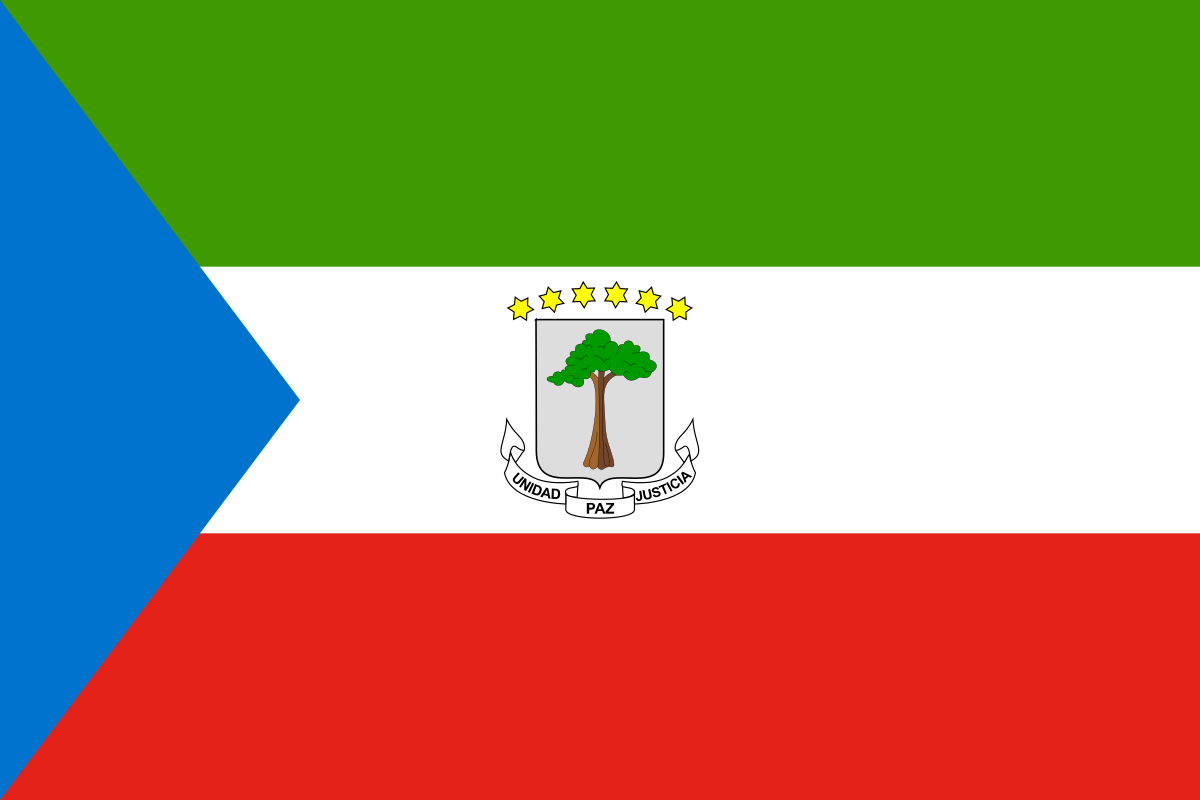
Equatorial Guinea's consistent 12-hour day-night cycle near the equator inspired early explorers like 15th-century Portuguese navigators to use it as a natural timekeeper for voyages, relying on solar positions rather than mechanical clocks. This equatorial reliability still influences modern festivals, such as the August Independence Day celebrations in Malabo, which kick off precisely at sunset for evening parades and fireworks.
Equatorial Guinea, a small Central African nation with a population of around 1.4 million, spans the mainland and several islands in the Gulf of Guinea. Known for its oil-rich economy and lush rainforests, the country operates on a single time zone that aligns with its equatorial location, making time in Equatorial Guinea straightforward for travelers and businesses. The capital, Malabo, on Bioko Island, serves as the political hub where this unified time system is most evident in daily operations.
Equatorial Guinea adheres to a single time zone, West Africa Time (WAT), designated by the IANA identifier Africa/Malabo, with a fixed UTC offset of +01:00. This means clocks in the country, including the capital Malabo, are set one hour ahead of Coordinated Universal Time year-round, reflecting its position just north of the equator where consistent daylight patterns reduce the need for adjustments. As a tropical nation, Equatorial Guinea does not observe daylight saving time (DST), so there are no seasonal switchover dates or clock changes—times remain stable throughout the year, simplifying scheduling for international visitors from the ISO code GQ region.
This lack of DST creates predictable time differences with major global cities. For instance, compared to London, which follows Greenwich Mean Time (GMT, UTC+00:00) in winter and British Summer Time (BST, UTC+01:00) from late March to late October, Equatorial Guinea is one hour ahead during London's winter months and synchronized during summer. In practical terms, a midday meeting in Malabo at 12:00 PM WAT would be 11:00 AM GMT in London during winter or 12:00 PM BST in summer, avoiding the confusion of biannual shifts. This stability benefits the country's growing oil sector and diplomatic ties, where precise timing is crucial for coordination with European partners. Overall, the Africa/Malabo zone ensures that time in Equatorial Guinea flows evenly, supporting a rhythm attuned to its equatorial climate without the disruptions seen in DST-observing nations.
Life in Equatorial Guinea pulses to the beat of its equatorial climate, where the sun rises and sets with remarkable consistency around 6:00 AM and 6:00 PM year-round, varying by mere minutes even at solstices—offering about 12 hours of daylight daily without the extremes of higher latitudes. This steady light influences a daily rhythm centered on family, work, and community, with meals playing a key role: breakfast is typically light and early, around 7:00–8:00 AM, often featuring fresh fruits, bread, and coffee; lunch, the main meal, occurs between 1:00 PM and 3:00 PM, emphasizing starchy staples like cassava or plantains with fish or meat in a social setting; and dinner is lighter, served after 8:00 PM, winding down the day with communal gatherings.
Office and administrative hours generally run from 8:00 AM to 4:00 PM or 5:00 PM, Monday through Friday, though government offices in Malabo may close earlier on Fridays for prayers, reflecting the country's predominantly Christian and animist influences blended with some Islamic practices among expatriates. Shops and markets bustle from dawn until dusk, with informal vendors in Bata or Malabo extending into evenings, but a siesta-like pause often occurs midday due to the intense heat and humidity. The weekly rest day is Sunday, when churches fill for services starting at 8:00 AM, and families prioritize relaxation or beach outings on Bioko Island. Nightlife adds vibrancy, particularly in urban areas, where bars and clubs in Malabo come alive after 10:00 PM, featuring Afrobeat music and dancing that can stretch into the early hours, though rural areas wind down earlier with traditional storytelling rituals under the stars. This blend of structured workdays and leisurely evenings underscores the unhurried pace of Equatorial Guinean life, where time in Equatorial Guinea harmonizes with natural cycles rather than rigid clocks.