Téhéran
Iran
--:--
Tehran 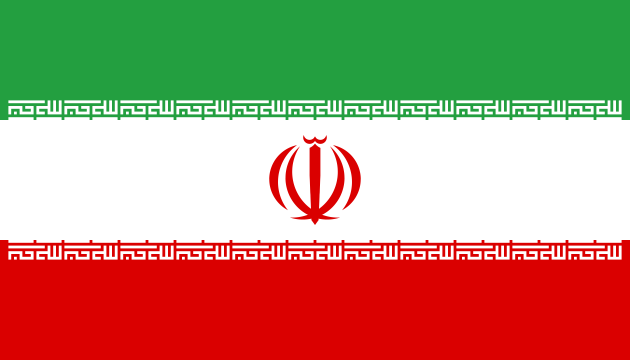
Indépendance, Liberté, République islamique
Iran's UTC+3:30 offset originated in 1935 when it was set to the 52.5°E meridian, 30 minutes east of standard UTC+3, making it one of only a few countries worldwide with a half-hour deviation to better match Tehran's longitude. This quirky timing has persisted through political changes, including post-1979 Revolution adjustments.
L'Iran utilise IRST (UTC+3:30), IRDT (UTC+4:30) en été.
Nestled in the heart of the Middle East, Iran spans a vast landscape from the Caspian Sea to the Persian Gulf, covering over 1.6 million square kilometers and home to approximately 87 million people. As a nation rich in ancient history and diverse cultures, Iran operates on a single time zone, Iran Standard Time (IRST), which simplifies coordination across its expansive territory. This unified system, offset by UTC+3:30, reflects the country's geographic centrality and political decisions to maintain national cohesion. Whether you're planning a business trip to Tehran or curious about daily life in bustling bazaars, understanding Iran's time organization is key to syncing with its vibrant rhythm. In this article, we'll explore the overview of Iran's time zones, internal divisions and major cities, daylight saving practices, the unique daily lifestyle influenced by time, differences with global capitals, historical context, and practical tips for travelers and professionals engaging with this dynamic country.
Iran maintains a straightforward time zone structure with just one official IANA time zone covering the entire nation: Asia/Tehran, which corresponds to Iran Standard Time (IRST) at UTC+3:30 year-round in standard periods. This single-zone approach is largely political and practical, given Iran's elongated east-west span of about 2,000 kilometers, which would naturally straddle multiple zones if divided geographically. Instead, the government has opted for uniformity to foster national unity, economic efficiency, and ease of administration across provinces from the mountainous northwest to the arid southeast. Geographically, Iran lies primarily between 44°E and 63°E longitude, positioning it roughly 3.5 hours ahead of the Greenwich meridian, aligning with its placement in the Middle East where most neighbors like Iraq and Pakistan also use offsets east of UTC. This offset, one of the world's few half-hour deviations, stems from historical meridian choices tied to Tehran's longitude around 51°E. Within the Middle East continent, Iran's time zone bridges Europe-Asia transitions, making it a pivotal hub for regional trade and diplomacy. The absence of multiple zones avoids the complexities seen in larger countries like Russia, ensuring that from the bustling streets of Tehran to remote villages in Sistan and Baluchestan, clocks tick in unison. This system supports Iran's role as a key player in OPEC and global energy markets, where synchronized timing is crucial for oil shipments and international negotiations.
As a single-time-zone country, Iran experiences no internal variations, with Asia/Tehran encompassing all 31 provinces and major urban centers. The capital, Tehran, located in the north-central region at coordinates 35.7°N, 51.4°E, fully adheres to IRST, serving as the political, economic, and cultural heartbeat where government offices and stock exchanges operate on this standard. Other prominent cities follow suit: Isfahan, renowned for its Persian architecture and handicrafts, shares the same UTC+3:30 offset, as does Mashhad in the northeast, a pilgrimage site for Shia Muslims drawing millions annually. Tabriz in the northwest, near the Turkish border, and Shiraz in the south, famous for its poetry and gardens, also synchronize perfectly with the national time, eliminating any need for regional adjustments during travel. Even peripheral areas like the port city of Bandar Abbas on the Strait of Hormuz or the high-altitude city of Yazd in the desert interior maintain this uniformity, which is advantageous for nationwide logistics in a country with diverse climates from snowy Alborz Mountains to subtropical coasts. There are no edge cases such as overseas territories or islands with derogating zones—Iran's territory is contiguous, excluding minor exclaves, so no special provisions apply. This cohesion is particularly beneficial for the 87 million residents, facilitating seamless communication via Iran's extensive rail and road networks connecting these cities.
Iran does observe daylight saving time (DST), known as Iran Daylight Time (IRDT) at UTC+4:30, to extend evening daylight during warmer months and conserve energy. The switch occurs on the first day of spring in the Iranian calendar, typically March 21 or 22, when clocks advance one hour at 2:00 AM local time to 3:00 AM. The fallback happens on the first day of autumn, around September 21 or 22, with clocks turning back at 2:00 AM to 1:00 AM, restoring IRST. This practice, reintroduced in 2008 after previous abolitions, is motivated by reducing electricity consumption in a nation prone to summer heatwaves and supporting agricultural cycles in rural areas. Politically, it aligns with Iran's solar-based calendar, syncing seasonal changes with natural light patterns. Practically, DST impacts international flights, with airlines like Iran Air adjusting schedules to avoid mid-flight clock shifts, and it affects communications—business calls from Europe may feel the one-hour leap. For commerce, the extra evening hour boosts retail in Tehran’s Grand Bazaar, but it can disrupt stock market trading with global partners during transitions. Travelers should update devices to avoid missing connections, as the half-hour base offset already complicates standard world clocks.
Iran's daily rhythm blends Islamic traditions, Persian customs, and modern urban demands, creating a pace that starts early and winds down later than in Western countries like the UK or US. Breakfast, often a light affair of bread, cheese, tea, and herbs, is typically enjoyed between 6:00 AM and 8:00 AM, fueling the start of the workday before the sun intensifies. Lunch, the main meal featuring rice, kebabs, and stews, occurs around 12:00 PM to 2:00 PM, sometimes extending into a brief rest period in hotter regions, akin to a mini-siesta though not as formalized as in Spain. Office hours in government and private sectors generally run from 8:00 AM to 4:00 PM or 9:00 AM to 5:00 PM, Monday through Thursday, with Fridays as the holy day off—shorter workweeks reflecting religious observance. Shops and markets, vibrant hubs like Tehran's Tajrish Bazaar, open from 9:00 AM to 10:00 PM, with many small vendors operating later into the night, especially during Ramadan when routines shift to evening iftar meals around sunset. Administrative services, such as banks and post offices, align with office hours but extend to 8:00 PM in urban areas. Nightlife in major cities like Tehran pulses with teahouses and cafes open until midnight or later, though alcohol-free due to laws; family-oriented outings to parks or theaters peak post-dinner, which is served between 8:00 PM and 10:00 PM—later than the 6:00 PM US norm. In contrast to the UK's early pub closures, Iran's 24/7 services are limited to hospitals and fuel stations, but urban youth culture thrives in late-night hookah lounges. Rural areas follow solar cues more closely, with earlier bedtimes, highlighting the urban-rural divide in this time-structured society.
Navigating time differences with Iran requires accounting for its UTC+3:30 base and DST to UTC+4:30 from late March to late September. Compared to London (UTC+0 standard, UTC+1 during British Summer Time from late March to late October), Iran is 3.5 hours ahead in winter (IRST vs. GMT) and 3.5 hours ahead in summer (IRDT vs. BST), as both observe DST similarly—meaning no extra gap during overlapping periods. With New York (UTC-5 standard, UTC-4 DST from mid-March to early November), the offset is 8.5 hours ahead in winter and 8 hours in summer, making morning calls from the US align with Iran's afternoon. For Paris (UTC+1 standard, UTC+2 DST), Iran leads by 2.5 hours winter and 2.5 summer. Tokyo (UTC+9, no DST) sees Iran 5.5 hours behind year-round, ideal for evening business links. Sydney (UTC+10 standard, UTC+11 DST October to April) has Iran 6.5 hours behind in its winter (Sydney summer) and 7.5 in its summer (Iran DST). Here's a quick mental table for English speakers: From London, add 3:30 for most interactions; from New York, add 8–8:30, so a 9 AM EST meeting hits 5:30–6 PM Tehran time. Seasonal syncs with Europe minimize disruptions, but the half-hour quirk demands precise clock apps for Asia-Pacific dealings.
Iran's time zone history is marked by 20th-century reforms aligning with its modernization efforts. In 1925, under Reza Shah, Iran adopted standard time based on the 52.5°E meridian near Tehran, settling on UTC+3:30 by 1935 to reflect geographic centrality and distance from Greenwich. This half-hour offset, unique globally, was influenced by astronomical observations at Tehran's meridian. DST was first trialed in the 1970s but abolished post-1979 Revolution due to religious and energy policy shifts; it returned in 2008 for economic reasons before a 2022 suspension—though currently observed per recent policy. A pivotal event was the 1992 unification, eliminating minor regional variations for national solidarity. Culturally, time ties deeply to the Solar Hijri calendar, starting March 21 with Nowruz, the Persian New Year celebrating spring equinox—a solar festival involving house cleaning (khooneh takouni) and jumping over fires at twilight, symbolizing renewal. This equinox-based system, more precise than the Gregorian, underscores Iran's astronomical heritage from ancient observatories like those in Persepolis. Another tradition is the haft-seen table during Nowruz, where items represent hopes for the year, observed at dawn to align with cosmic timing, blending Zoroastrian roots with Shia Islam.
When coordinating with Iran from abroad, timing is everything— from London, the best window for calls is 8:00 AM to 4:00 PM GMT, hitting Iran's 11:30 AM to 7:30 PM, ideal for morning meetings without encroaching on evenings. From New York, aim for 10:00 AM to 6:00 PM EST, corresponding to 6:30 PM to 2:30 AM Tehran time the next day—better for afternoons to catch Iran's workday start. Jet-lag wise, westward travelers from Europe face minimal issues with the 3.5-hour difference, but eastward from the US should prioritize hydration and light exposure upon arrival in Tehran to adjust to the 8.5-hour shift; apps like Timeshifter can personalize plans. For financial markets, Tehran's Tehran Stock Exchange operates 9:00 AM to 12:30 PM IRST (no afternoon session), so traders from London should align with 5:30 AM to 9:00 AM GMT; main administrations like ministries run 8:00 AM–4:00 PM, syncing with European mornings. DST precautions are crucial—confirm switch dates via official sources, as Iran's March/September changes may not match partners', risking hour mismatches in video calls; use dual-time watches or world clock tools. Visas and flights via Imam Khomeini International Airport demand advance planning, with peak travel during Nowruz avoiding time-sensitive disruptions.
Iran operates on a single time zone, Asia/Tehran, known as Iran Standard Time (IRST) at UTC+3:30. During daylight saving time from late March to late September, it shifts to Iran Daylight Time (IRDT) at UTC+4:30. This unified system covers the entire country, including the capital Tehran.
Iran has only one time zone, making it simple for nationwide coordination. The standard offset with London is 3 hours and 30 minutes ahead (IRST vs. GMT), remaining the same during summer due to aligned DST periods (IRDT vs. BST).
Yes, Iran observes DST, advancing clocks by one hour on the first day of Farvardin (around March 21) at 2:00 AM to UTC+4:30. Clocks fall back on the first day of Mehr (around September 21 or 22) at 2:00 AM, returning to UTC+3:30, primarily to save energy and match seasonal light.
The optimal window from the UK is between 9:00 AM and 5:00 PM GMT, which corresponds to 12:30 PM to 8:30 PM in Tehran, overlapping peak business hours. Avoid evenings in London to respect Iran's family-oriented late dinners.
In Tehran, offices and businesses run from about 8:00 AM to 4:00 PM or 5:00 PM, with shops open until 10:00 PM. Meals follow a rhythm of breakfast by 8:00 AM, lunch around 1:00 PM, and dinner after 8:00 PM, influenced by cultural and religious norms.
The ideal period is spring (March to May) or autumn (September to November), aligning with milder weather and Nowruz festivities in March, when longer days from DST enhance sightseeing. Avoid summer heatwaves when adjusted evenings still feel warm.
Unlike Turkey, which uses a single UTC+3 zone without DST (Eastern European Time), Iran's UTC+3:30 with DST creates a 30-minute to 1.5-hour difference, complicating cross-border trade but highlighting Iran's unique solar calendar alignment.