Monrovia
Liberia
--:--
Monrovia 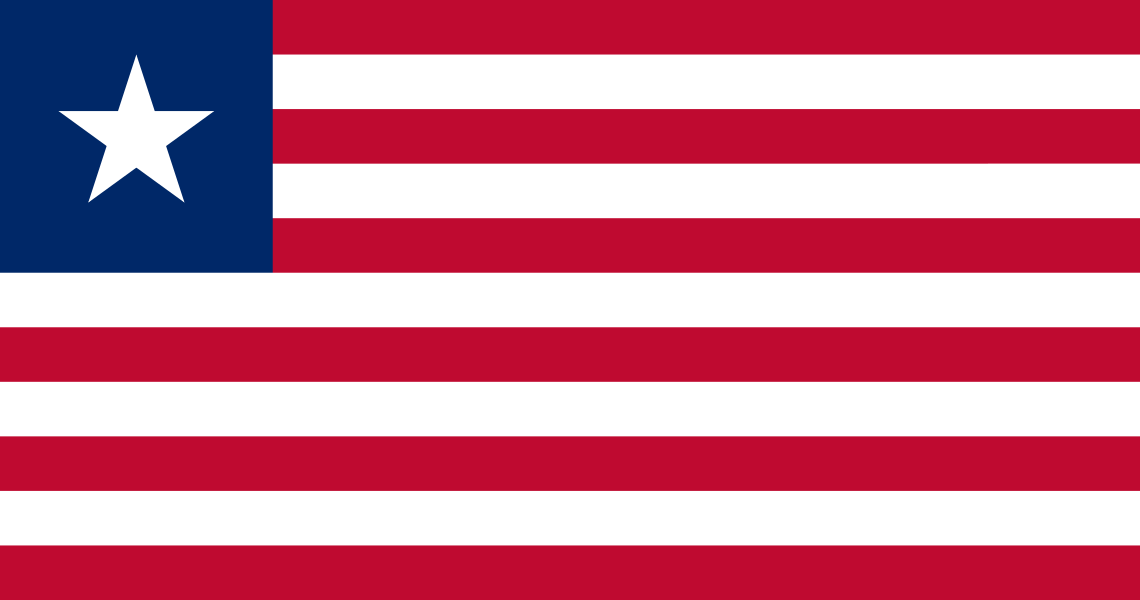
Liberia's adoption of UTC+0 dates back to its founding in 1847 by the American Colonization Society, aligning the young republic's timekeeping with Greenwich to facilitate maritime trade along its Atlantic coast— a practical choice that persists today without DST interruptions. This made Monrovia one of Africa's earliest adopters of international standard time, predating many European colonies.
Liberia, a vibrant coastal nation in West Africa with a population of around 5 million, is renowned for its lush rainforests, Atlantic beaches, and rich cultural heritage shaped by indigenous traditions and American settler influences. The country's capital, Monrovia, serves as the economic and political hub, welcoming visitors curious about its unique blend of history and modernity. When planning travel or business, understanding the time in Liberia is essential, as it operates on a single time zone that aligns closely with international standards, making coordination straightforward for global connections.
Liberia adheres to a single time zone across its territory, utilizing the Africa/Monrovia IANA identifier with a fixed UTC offset of +0, commonly known as Greenwich Mean Time (GMT) or Coordinated Universal Time (UTC). This uniformity simplifies scheduling for the nation's 5 million residents, from the bustling streets of Monrovia to remote rural communities. Monrovia, the capital and largest city, fully embodies this zone, ensuring that clocks throughout Liberia tick in sync without regional variations—ideal for a country spanning about 111,000 square kilometers along the Gulf of Guinea.
Unlike many nations that adjust for seasonal changes, Liberia does not observe daylight saving time (DST), maintaining its UTC+0 offset year-round. This consistent approach avoids the biannual clock shifts that can disrupt routines elsewhere, providing stability for international trade, diplomacy, and tourism. For those comparing with major global cities, the time difference with London is particularly noteworthy. In winter (from late October to late March), when London is on GMT (UTC+0), Liberia shares the exact same time, allowing seamless real-time communication without adjustments. During London's summer period (late March to late October), when it switches to British Summer Time (BST, UTC+1), Liberia lags one hour behind—meaning if it's 9 AM in London, it's 8 AM in Monrovia. This predictable offset fosters strong ties with the UK, a key partner in Liberia's post-conflict recovery and development efforts. Travelers from Europe or North America appreciate this reliability, as it minimizes jet lag confusion when arriving at Roberts International Airport in Monrovia. Overall, Liberia's steadfast commitment to UTC+0 reflects its practical orientation, supporting efficient operations in sectors like shipping, agriculture, and emerging tech industries without the complications of DST transitions.
Life in Liberia pulses with a rhythmic blend of work, community, and tradition, influenced by its tropical climate and cultural mosaic of over 16 ethnic groups alongside descendants of freed American slaves. Typical meal times follow a structured yet relaxed pattern: breakfast around 7-8 AM, often featuring cassava fufu or rice bread with coffee; lunch between 1-2 PM, a hearty affair with palm oil-rich dishes like jollof rice or grilled fish; and dinner by 7-8 PM, lighter and family-oriented, sometimes extending into evening gatherings. These timings accommodate the equatorial day's consistent daylight, fostering a balance between productivity and social bonds.
Office and administrative hours generally run from 8 AM to 5 PM, Monday through Friday, with government offices in Monrovia opening at 8:30 AM and closing by 4:30 PM to allow for afternoon traffic. Banks and post offices operate similarly, from 9 AM to 3 PM, while shops and markets buzz from dawn until dusk—around 7 AM to 7 PM—catering to the informal economy that employs most Liberians. In urban areas like Monrovia, private businesses may extend to 6 PM, but rural areas wind down earlier with the sunset. The weekly rest day is Sunday, observed as a time for church services, family visits, and rest, reflecting Liberia's deep Christian roots (about 85% of the population identifies as Christian), with mosques serving the Muslim minority on Fridays. Local specifics add flavor: morning rituals often include communal drumming or storytelling in villages, while evenings might feature beachside barbecues or live music in Monrovia's nightlife spots, though conservative norms keep things modest compared to global party capitals. Nightlife peaks on weekends with clubs open until midnight or later, but public transport halts by 8 PM, emphasizing community safety.
Sunrise and sunset variations are minimal due to Liberia's proximity to the equator (latitudes 4°-8°N), with summer solstice (June 21) seeing sunrise around 6:20 AM and sunset at 6:45 PM in Monrovia, providing about 12.5 hours of daylight. In the December solstice, it's roughly 6:45 AM sunrise and 6:15 PM sunset, maintaining a near-even split that supports year-round agricultural cycles like rubber tapping, which starts at dawn. This steady rhythm underscores Liberia's resilience, where daily life harmonizes with nature's reliable cadence, inviting visitors to immerse in its unhurried yet vibrant flow.
The time in Liberia, governed by its single UTC+0 zone, offers a gateway to exploring this African gem's essentials—from Monrovia's historic landmarks to its coastal rhythms—making it a compelling destination for culturally attuned travelers searching for authentic West African experiences.