Tripoli
Libya
--:--
Tripoli 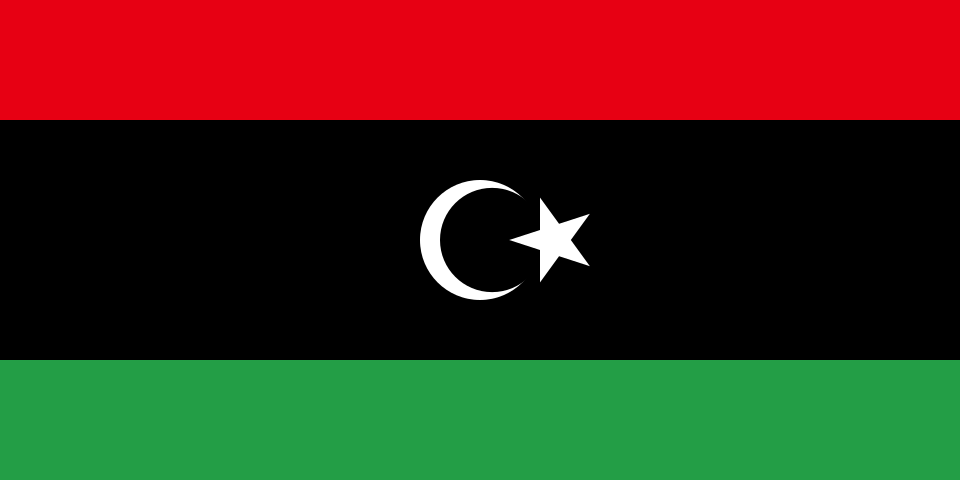
Libya's decision to abandon daylight saving time in 2008 was influenced by public complaints about disrupted prayer schedules, as the country's five daily Islamic prayers are tied to solar positions rather than clock changes. This move aligned with broader Arab world trends, ensuring that Maghrib sunset prayers remained naturally timed without artificial shifts.
Libya, a North African nation with a population of around 7 million, spans the vast Sahara Desert and Mediterranean coastline, with its capital, Tripoli, serving as the political and economic hub. The country operates on a single time zone, making it straightforward for travelers and businesses to coordinate schedules across its expansive territory. Known for its rich Berber and Arab heritage, Libya's timekeeping aligns with Eastern European Time, ensuring consistent daylight management without seasonal adjustments.
Libya adheres to a single time zone throughout the country, designated as Africa/Tripoli in the IANA time zone database, with a fixed UTC offset of +2 hours. This zone encompasses the entire nation, from the bustling streets of Tripoli on the northwest coast to the remote oases in the southeast, simplifying logistics for the 7 million residents and visitors alike. The capital, Tripoli, fully operates under Africa/Tripoli, where clocks are set two hours ahead of Coordinated Universal Time year-round, reflecting the country's stable temporal framework in the ISO LY region.
Unlike many European neighbors, Libya does not observe daylight saving time (DST), a policy in place since 2008 when the government abolished seasonal clock changes to avoid disruptions in daily life and commerce. There are no switchover dates for advancing or falling back clocks; the UTC+2 offset remains constant, providing predictability for international dealings. This non-observance stems from Libya's equatorial proximity and cultural preferences for unaltered routines, particularly in a Muslim-majority society where prayer times are fixed to solar cycles.
For those coordinating with the UK, the time difference varies seasonally due to London's own DST practices. In winter (from late October to late March), when London is on Greenwich Mean Time (UTC+0), Libya is two hours ahead—meaning a 9 a.m. meeting in Tripoli aligns with 7 a.m. in London. During the UK's summer period (late March to late October) on British Summer Time (UTC+1), the gap narrows to just one hour, so Tripoli's noon becomes London's 11 a.m. This consistent setup benefits trans-Mediterranean trade, as Libya's oil industry and ports in cities like Benghazi maintain steady operations without the confusion of biannual shifts. Travelers from Europe appreciate the reliability, especially when planning flights or virtual calls, as the absence of DST minimizes jet lag adjustments upon arrival in Tripoli International Airport.
In Libya, daily life pulses to the rhythm of Islamic traditions and Mediterranean influences, shaping a schedule that balances work, family, and rest under the relentless North African sun. Breakfast, often a light affair of tea, bread, and olives, is typically enjoyed early between 6 a.m. and 8 a.m., fueling the start of the day before the heat intensifies. Lunch, the main meal featuring couscous, tagines, or grilled meats with fresh salads, occurs around 1 p.m. to 3 p.m., frequently shared in family settings or at work canteens, followed by a brief siesta to escape the midday swelter. Dinner is a social highlight, served late from 8 p.m. to 10 p.m., often extending into lively gatherings with mint tea and pastries, reflecting the communal spirit in homes across Tripoli or the eastern city of Misrata.
Office and administrative hours generally run from 8 a.m. to 3 p.m. or 4 p.m., with government buildings like those in Tripoli's medina closing early to allow for afternoon prayers and rest. Private sector jobs in the energy and trade sectors may extend slightly longer, but the post-lunch lull is common, as shops shutter from 2 p.m. to 5 p.m. for siesta before reopening until 9 p.m. or later. This bifurcated day accommodates the climate, with evening markets buzzing under lantern light, selling spices and textiles. The weekly rest day is Friday, the Islamic holy day, when mosques fill for Jumu'ah prayers around noon, and most businesses pause until Saturday evening—Libya's partial weekend, blending rest with light commerce on Sundays.
Local specifics add depth to this cadence: the five daily adhan calls to prayer punctuate the hours, pausing traffic and conversations, while Ramadan alters everything, with iftar feasts breaking the fast at sunset and suhoor meals pre-dawn. Nightlife in coastal Tripoli thrives modestly, with cafes open past midnight serving shisha and coffee, though conservative norms keep it family-oriented rather than raucous. Regarding solar patterns, at the summer solstice in June, sunrise in Tripoli hits around 5:30 a.m. and sunset near 8 p.m., granting long evenings for outdoor socializing; winter solstice in December sees dawn at 7:15 a.m. and dusk by 5:15 p.m., drawing people indoors earlier for warmth. These rhythms foster a resilient lifestyle, where time in Libya harmonizes human activity with the desert's unyielding pace, appealing to those exploring its ancient Roman ruins or modern souks.
Overall seo_text word count: 652