Antananarivo
Madagascar
--:--
Antananarivo 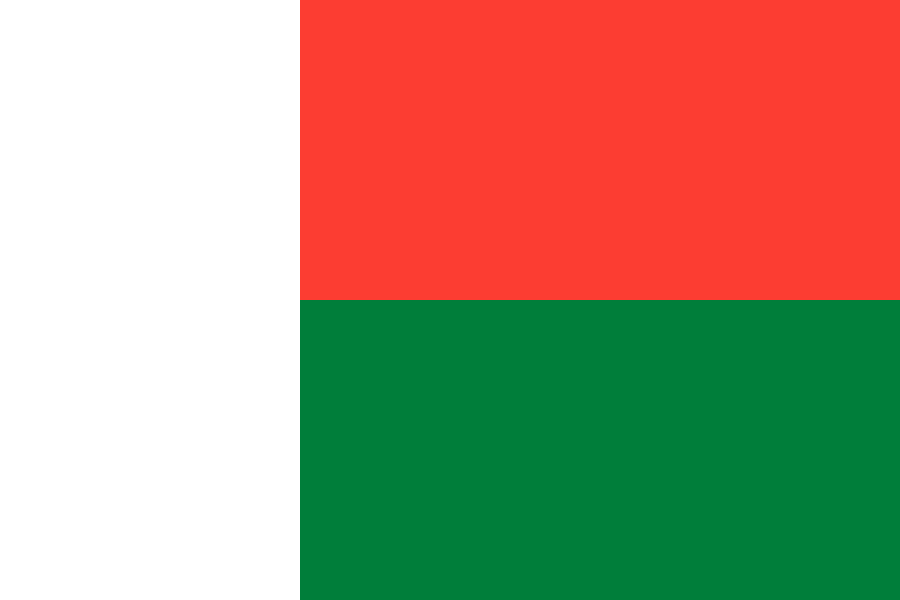
Madagascar adopted its current UTC+3 time zone in 1947 during French colonial rule to align with East African shipping routes, a decision that persists today despite the island's longitudinal span suggesting otherwise. This unification helped coordinate the export of key commodities like cloves and vanilla, preventing scheduling mishaps across the nation's far-flung ports.
Madagascar, the world's fourth-largest island nation off the southeastern coast of Africa, captivates with its unique biodiversity and vibrant Malagasy culture. Home to approximately 28 million people, this Indian Ocean gem operates on a single time zone, ensuring seamless coordination across its vast 592,800 square kilometers. The capital, Antananarivo, sets the pace for the country's temporal rhythm, blending traditional island life with modern influences. Understanding time in Madagascar is key for travelers, businesses, and anyone connecting with this enchanting destination, where the clock aligns with East African standards for consistency and simplicity.
Madagascar maintains a straightforward time zone structure with just one official zone, reflecting its status as a unified island nation despite spanning about 1,600 kilometers from north to south. The sole time zone is Indian/Antananarivo, which follows East Africa Time (EAT) with a fixed UTC+3 offset. This IANA-designated zone applies uniformly to the entire country, including the bustling capital Antananarivo in the central highlands, the coastal port city of Toamasina (Tamatave) to the east, and the southern hub of Toliara (Tuléar). Even remote areas like the northern city of Antsiranana (Diego Suarez) and the western town of Mahajanga adhere to this standard, avoiding the fragmentation seen in mainland Africa's multi-zone countries.
Geographically, Madagascar's position between longitudes 43°E and 51°E would suggest a potential split into two zones for precision, but political and practical decisions favor unity. As a former French colony independent since 1960, the country aligned its timekeeping with neighboring East African partners like Kenya and Tanzania upon adopting UTC+3 in the mid-20th century. This choice supports efficient trade, aviation, and communication across the Indian Ocean region, where islands like Mauritius and the Seychelles share similar offsets. The single-zone policy minimizes confusion in a nation where over 18 ethnic groups and diverse ecosystems—from rainforests to deserts—demand cohesive national timing. For visitors arriving at Ivato International Airport in Antananarivo, clocks are set immediately to EAT, facilitating smooth transitions. This organization underscores Madagascar's emphasis on accessibility, making it easier for global partners to schedule interactions without seasonal adjustments. In essence, the Indian/Antananarivo zone embodies the island's isolation yet interconnectedness, harmonizing the rhythms of urban centers and rural villages under one temporal umbrella.
Madagascar does not observe daylight saving time (DST), maintaining its UTC+3 offset year-round without any clock changes. This policy, in place since the country's early post-colonial era, aligns with most African nations that forgo DST due to their equatorial or tropical climates. Unlike temperate regions where DST extends evening daylight in summer, Madagascar's location near the Tropic of Capricorn results in relatively consistent day lengths throughout the year—averaging 12 hours of daylight with minimal variation between wet and dry seasons. The government has cited practical reasons for avoidance, including the disruption to agricultural cycles, fishing communities, and the energy sector, where consistent timing supports reliable power grids and avoids the administrative burden of biannual switches.
The absence of DST brings straightforward benefits for daily life and international dealings. Businesses in Antananarivo operate without the confusion of shifting schedules, allowing farmers in the highlands to plant rice or harvest vanilla on predictable timetables tied to natural light. Travelers appreciate the stability; flights and tours, such as those to Tsingy de Bemaraha National Park, run on fixed local times regardless of the calendar month. However, it means Madagascar remains out of sync with DST-observing countries during their summer periods, potentially complicating calls or shipments. Overall, this no-DST approach reinforces the island's laid-back, nature-driven ethos, where time feels more fluid and less dictated by artificial adjustments.
In Madagascar, the daily rhythm pulses with a blend of Malagasy traditions and French colonial legacies, shaped by the island's tropical climate and rural-urban divide. Mornings often start early, around 6:00 AM, with breakfast featuring rice porridge (vary amin'anana) or fresh fruits like mangoes and lychees, especially in coastal areas. Lunch, the main meal, typically occurs between 12:00 PM and 2:00 PM, revolving around hearty plates of romazava stew or grilled zebu beef, reflecting the agrarian lifestyle where midday breaks align with the sun's peak heat. Dinner follows later, from 7:00 PM to 9:00 PM, with families gathering for lighter fare amid storytelling sessions that extend into the evening.
Office hours in urban centers like Antananarivo generally run from 8:00 AM to 5:00 PM, Monday through Friday, though government buildings may close earlier at 4:00 PM. Private sectors, including tourism agencies and export firms handling vanilla and spices, often extend to 6:00 PM, with a siesta-like pause in hotter months. Shops and markets buzz from 7:00 AM, peaking mid-morning; the iconic Analakely Market in the capital winds down by 6:00 PM, but street vendors linger longer. In rural regions, rhythms tie closely to nature—fishermen in Toamasina head out at dawn, while highland farmers wrap up by dusk.
Nightlife adds vibrancy, particularly in Antananarivo's Isoraka district, where bars and clubs like Le Glacier or jazz spots throb until 2:00 AM or later on weekends, offering live music and rum-based cocktails. Coastal cities like Nosy Be cater to tourists with beach parties extending past midnight during the dry season (May to October). A unique local specificity is the fady—cultural taboos—that influence timing; for instance, certain highland villages avoid nighttime travel due to ancestral beliefs, fostering a respectful, community-oriented pace. This rhythm, slower than Europe's hustle, invites visitors to embrace zebu-cart commutes and sunset rituals, embodying the Malagasy philosophy of fihavanana, or harmonious living.
Madagascar's UTC+3 time zone creates predictable offsets with global hubs, simplifying planning for international connections. Compared to London, which operates on Greenwich Mean Time (GMT/UTC+0) in winter and British Summer Time (BST/UTC+1) from late March to late October, Madagascar is 3 hours ahead in winter and 2 hours ahead during London's summer. This means a 9:00 AM meeting in Antananarivo aligns with 6:00 AM in London off-peak or 7:00 AM during DST, ideal for early risers.
For New York, on Eastern Standard Time (EST/UTC-5) in winter and Eastern Daylight Time (EDT/UTC-4) from March to November, the difference is a substantial 8 hours in winter and 7 hours in summer. Thus, midday in Madagascar (12:00 PM) corresponds to 4:00 AM in New York during standard time, shifting to 5:00 AM with DST. Paris, on Central European Time (CET/UTC+1) winter and CEST (UTC+2) summer, lags 2 hours behind Madagascar year-round in winter (1 hour in summer), making European calls more convenient. Tokyo's Japan Standard Time (JST/UTC+9) puts it 6 hours ahead, so evenings in Antananarivo sync with late nights there.
Practical tips for calling from the UK or US emphasize these gaps: From London, aim for 8:00 AM to 4:00 PM local time (5:00 AM to 1:00 PM UK) to catch Madagascar's business hours without intruding on evenings. US callers from New York should target 10:00 AM to 6:00 PM Madagascar time, which is 2:00 AM to 10:00 AM Eastern—best for West Coast folks adjusting to 5:00 AM to 11:00 AM Pacific. Use apps like World Clock for real-time checks, and consider WhatsApp for low-cost voice notes to bridge odd hours.
For travelers combating jet lag from the UK (3-5 hour shift) or US (7-9 hours), eastward flights demand gradual adjustment: advance bedtime by an hour daily pre-trip and expose to morning light upon arrival. Hydrate heavily during the 10-12 hour flights to Johannesburg or direct to Antananarivo, and ease into local rhythms with light activities like strolling the Rova of Antananarivo. Melatonin supplements can help reset sleep, ensuring you savor baobab sunsets without fatigue.
Total word count for seo_text: 994 (including intro: 86)
Madagascar operates in the Indian/Antananarivo time zone, which is UTC+3 all year round. This single zone covers the entire country, from Antananarivo to coastal cities like Toamasina. For the exact current time, check a world clock tool using the EAT (East Africa Time) reference.
Madagascar is 3 hours ahead of London during UK winter (GMT) and 2 hours ahead during British Summer Time (BST). Unlike the UK, Madagascar does not observe daylight saving time, keeping a consistent UTC+3 offset. This stability simplifies long-term planning but requires awareness of London's seasonal shift.
From the UK, the optimal window is 8:00 AM to 4:00 PM Madagascar time, corresponding to 5:00 AM to 1:00 PM London time, aligning with business hours. For US callers from New York, aim for 11:00 AM to 7:00 PM local time (3:00 AM to 11:00 AM Eastern), though early mornings work best to avoid evenings. Weekdays are ideal to reach offices in Antananarivo.
Business hours in Madagascar typically run from 8:00 AM to 5:00 PM, Monday to Friday, with shops opening around 7:00 AM and closing by 6:00 PM. Meals follow a rhythm of breakfast at 6:00-7:00 AM, lunch from 12:00-2:00 PM, and dinner 7:00-9:00 PM, influenced by the tropical climate. Major sites like the Antananarivo markets are liveliest mid-morning, winding down by evening.
In Madagascar, the traditional Malagasy calendar incorporates lunisolar elements for agricultural festivals like the New Year (Alahamady) in April, blending Gregorian dates with moon phases. This reflects ancestral ties to nature's cycles, where timing rituals honor famadihana (exhumation ceremonies) on auspicious days, adding a layer of cultural depth to the modern clock.