Maputo
Mozambique
--:--
Maputo 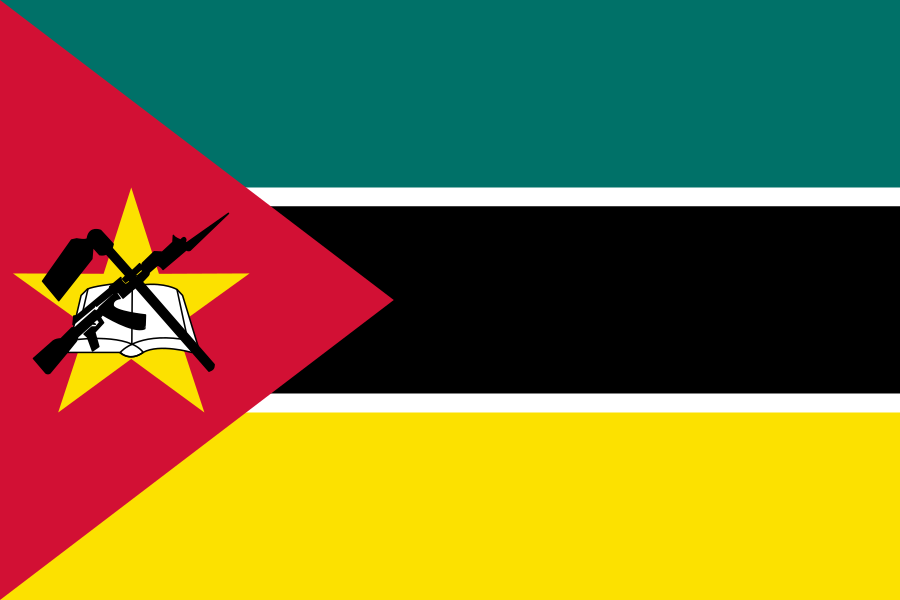
In 1911, during Portuguese colonial rule, Mozambique standardized its time zone to UTC+2 to synchronize with Lisbon's maritime needs, a decision that persists today despite independence. This alignment once facilitated the export of ivory and spices across the Indian Ocean on precise sailing schedules.
Mozambique, a vibrant nation on Africa's southeastern coast, spans over 800,000 square kilometers and is home to approximately 32 million people, with Maputo as its bustling capital. This Portuguese-speaking country, known for its stunning Indian Ocean beaches, diverse wildlife, and rich cultural heritage, operates on a single time zone that simplifies daily life and international coordination. Understanding the time in Mozambique is essential for travelers, business professionals, and anyone connecting with this dynamic African destination, as its consistent clock aligns with the region's tropical rhythm and economic pulse.
Mozambique maintains a straightforward time zone structure with just one official zone, making it one of the simpler countries in Africa for time management. The entire nation adheres to the Africa/Maputo time zone, which corresponds to Central Africa Time (CAT) and operates at a fixed UTC+2 offset year-round. This zone covers all provinces from the northern Cabo Delgado region to the southern Gaza Province, encompassing major cities like Maputo, Beira, Nampula, and Quelimane without any internal variations.
The choice of UTC+2 reflects both geographic and historical logic. Positioned along the eastern edge of the African continent, Mozambique's longitude places it roughly between 30°E and 40°E, which naturally aligns with a +2 hour offset from Coordinated Universal Time (UTC). This positioning ensures that solar noon occurs around midday, supporting agricultural and coastal activities that form the backbone of the economy. Politically, the unified zone stems from Mozambique's colonial past under Portuguese rule, when time standardization was imposed to facilitate administration and trade across the territory, now independent since 1975. Unlike neighboring countries such as Tanzania (UTC+3) or South Africa (also UTC+2), Mozambique's single zone avoids the complications of cross-border discrepancies, promoting seamless interactions within the Southern African Development Community (SADC).
In practice, this uniformity aids tourism and commerce. For instance, flights arriving at Maputo International Airport or the port in Beira operate on this clock, syncing effortlessly with regional partners. Visitors to the Gorongosa National Park or the Bazaruto Archipelago can plan itineraries without worrying about time shifts, while businesses in Nampula's cashew nut industry coordinate exports reliably. The IANA identifier Africa/Maputo is the standard reference used in global systems, ensuring accuracy in digital calendars and apps. Overall, this single-zone approach underscores Mozambique's commitment to efficiency in a country where over 99% of the population—urban dwellers in Maputo to rural farmers in Zambezia—lives by the same temporal framework, fostering national cohesion in a diverse landscape of 11 provinces.
Mozambique does not observe Daylight Saving Time (DST), maintaining its UTC+2 offset consistently throughout the year without any clock adjustments. This policy has been in place since the country's independence in 1975, aligning with most African nations that forgo seasonal time shifts due to equatorial proximity and minimal variation in daylight hours. The decision stems from practical considerations: near the Tropic of Capricorn, Mozambique experiences relatively stable day lengths, with sunrise around 5-6 AM and sunset between 5-7 PM across seasons, reducing the need for artificial extensions of evening light.
Historically, Portuguese colonial authorities briefly experimented with DST in the early 20th century, but it was abandoned post-World War II as inefficient for a tropical economy reliant on agriculture and fishing, where natural light patterns dictate work cycles. Today, the absence of DST simplifies life for the 32 million residents, avoiding the confusion of biannual changes that can disrupt sleep, productivity, and transportation schedules. For businesses in Maputo's central business district or fishermen in Inhambane, consistent timing supports reliable operations without the administrative burden of adjustments.
Practically, this means no spring-forward or fall-back dates to remember, making international scheduling straightforward. Travelers from DST-observing regions appreciate the predictability, as meetings or flights don't shift unexpectedly. In a nation where power outages can already complicate daily routines, forgoing DST enhances stability, allowing focus on cultural festivals like the Marrabenta music nights or market days that run on unchanging local time.
The daily rhythm in Mozambique blends African traditions with Portuguese influences, creating a laid-back yet vibrant pace that revolves around family, community, and the tropical climate. Breakfast, often a light affair of porridge (xima) made from maize or fresh fruits with coffee, is typically enjoyed between 6:30 AM and 8:00 AM, fueling early risers for the day's start. Lunch, the main meal, occurs from 12:00 PM to 2:00 PM, featuring staples like grilled fish (pescado grelhado) or matapa (cassava leaves in coconut sauce) shared communally, reflecting the social importance of midday gatherings in both urban homes and rural villages.
Office hours in cities like Maputo and Beira generally run from 8:00 AM to 5:00 PM, Monday through Friday, with a siesta-like pause in hotter months for the afternoon heat. Government offices and banks close around 3:30 PM, while private sectors in tourism or mining may extend slightly. Shops and markets, such as the bustling Municipal Market in Maputo, open early around 7:00 AM and stay active until 6:00 PM or later, with informal vendors operating into the evening. In rural areas like Tete Province, agricultural work aligns with sunrise, winding down by dusk to accommodate limited electricity.
Nightlife pulses with energy in major cities, particularly Maputo's vibrant scene along the Avenida Marginal, where bars and clubs like Coconuts or Feito em Casa kick off around 9:00 PM and throb until 2:00 AM or dawn on weekends. Live Marrabenta music and seafood spots draw crowds, embodying the "noite boa" (good night) culture. Local specifics include the influence of Islamic traditions in northern Nampula, where evenings might center on mosque prayers rather than late outings, and the post-civil war emphasis on family dinners by 7:00 PM to 9:00 PM nationwide. This rhythm promotes work-life balance, with Sundays reserved for church or beach relaxation, highlighting Mozambique's resilient spirit amid its coastal lifestyle.
Mozambique's UTC+2 time zone creates straightforward yet notable differences with global hubs, aiding travelers and remote workers in planning connections. Compared to London, which runs on Greenwich Mean Time (GMT, UTC+0) in winter and British Summer Time (BST, UTC+1) from late March to late October, Mozambique is 2 hours ahead in winter and 1 hour ahead during London's summer. This means a 9:00 AM meeting in Maputo aligns with 7:00 AM in London off-season or 8:00 AM in summer, ideal for early European starts.
With New York on Eastern Standard Time (EST, UTC-5) in winter and Eastern Daylight Time (EDT, UTC-4) from March to November, the offset is a significant 7 hours ahead in winter and 6 hours in summer. A midday call from Maputo at 12:00 PM would reach New York at 5:00 AM EST or 6:00 AM EDT, respectively. For Paris (Central European Time, UTC+1 winter; UTC+2 summer), Mozambique matches exactly in winter (1 hour ahead) and is level during Paris's summer DST, simplifying Franco-Mozambican ties given historical linguistic links.
Practical tips for calling from the UK or US emphasize overlapping business hours: from London, aim for 10:00 AM to 4:00 PM UK time (noon to 6:00 PM in Mozambique) to catch the productive afternoon. US callers from New York should target 11:00 AM to 3:00 PM EST/EDT (6:00 PM to 10:00 PM in Mozambique) for evening availability without disrupting sleep. For video calls, tools like World Time Buddy can sync schedules, accounting for Mozambique's no-DST stability.
Jet-lag recommendations for travelers focus on eastward flights: from London (2-hour difference), adjust gradually with light exposure upon arrival; a short hop means minimal disruption, but hydrate and nap briefly if needed. From New York (6-7 hours), expect moderate fatigue—fly overnight to arrive morning in Maputo, then combat drowsiness with outdoor activities like a walk in the Maputo Special Reserve. Acclimatize by aligning meals to local times immediately, and use melatonin for the first nights if crossing multiple zones. Business visitors to Beira's ports or tourists to the Quirimbas Archipelago benefit from this prep, ensuring smooth immersion in Mozambique's equatorial tempo.
Mozambique operates entirely in the Africa/Maputo time zone, which is UTC+2. This single zone applies nationwide, including in the capital Maputo and cities like Beira and Nampula, without any variations. As a result, the current local time is always 2 hours ahead of Coordinated Universal Time (UTC).
Mozambique is 2 hours ahead of London during the UK's winter (GMT) and 1 hour ahead during British Summer Time (BST) from late March to late October. Mozambique does not observe Daylight Saving Time, so its UTC+2 offset remains constant year-round. This consistency makes scheduling between the two straightforward, with no unexpected shifts.
The best window to call from the UK is between 9:00 AM and 5:00 PM local time in Mozambique (7:00 AM to 3:00 PM GMT/BST), aligning with business hours. From the US East Coast, aim for 2:00 PM to 8:00 PM Mozambique time (8:00 AM to 2:00 PM EST/EDT) to overlap with mornings. For travel, the dry season from May to October offers mild weather (20-30°C) and peak wildlife viewing, ideal for minimizing jet lag disruptions.
Daily life in Mozambique follows a tropical rhythm with work starting around 8:00 AM and winding down by 5:00 PM, meals at noon for lunch and 7:00-9:00 PM for dinner. The Maputo Central Market (Mercado Municipal) opens daily from 6:00 AM to 7:00 PM, bustling in the mornings for fresh produce and seafood. Evenings often extend into social activities, especially in urban areas.
Mozambique's UTC+2 zone matches South Africa, Eswatini, and Zimbabwe, easing cross-border trips by train or bus without time adjustments. However, it's 1 hour behind Tanzania (UTC+3) to the north, so plan for that when heading to shared attractions like Lake Malawi. This setup supports seamless SADC regional integration for trade and tourism.