Kampala
Uganda
--:--
Kampala 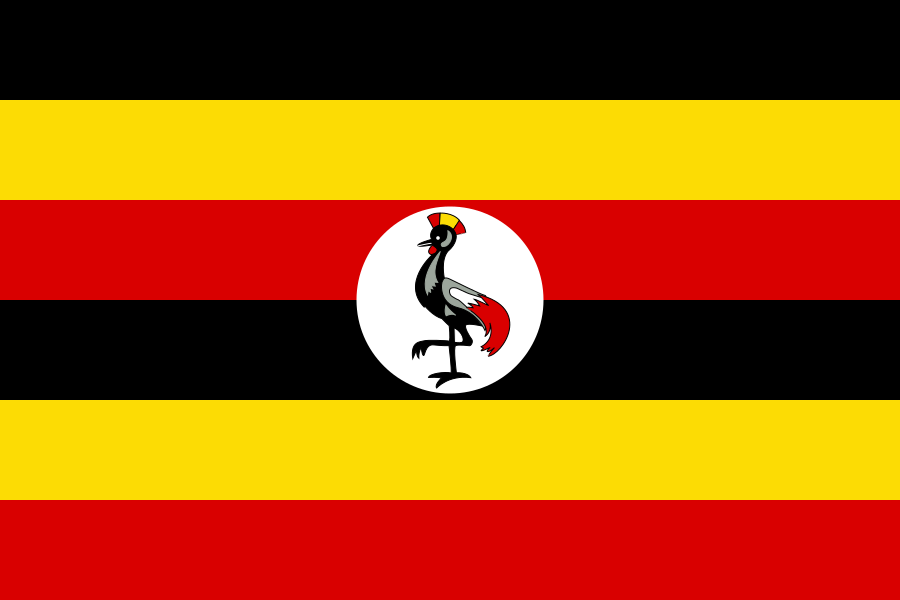
Uganda's equatorial position means it experiences the world's most consistent day length, with sunrise and sunset varying by mere minutes annually, a phenomenon that has historically guided traditional Baganda farmers in timing rituals around the steady solar cycle since pre-colonial eras. This reliability was key during the 1928 adoption of standard East Africa Time, aligning the nation without the clock confusions faced elsewhere.
Nestled in East Africa, Uganda is a landlocked nation renowned for its diverse landscapes, from the snow-capped Rwenzori Mountains to the vast Lake Victoria, the world's second-largest freshwater lake. With a population exceeding 46 million and Kampala as its bustling capital, Uganda embodies a vibrant cultural mosaic influenced by over 50 ethnic groups. The country operates on a single time zone, East Africa Time (EAT), which simplifies daily life and aligns with its equatorial position for consistent daylight patterns. This unified time organization supports Uganda's dynamic national rhythm, blending traditional agrarian lifestyles with modern urban energy in cities like Kampala and Entebbe.
Uganda maintains a straightforward time zone structure with just one official zone, reflecting its compact geography and regional harmony. The sole time zone is East Africa Time (EAT), designated by the IANA identifier Africa/Kampala, and it operates at a fixed UTC+3 offset year-round. This zone encompasses the entire country, from the northern borders with South Sudan to the southern edges touching Lake Victoria and Tanzania, ensuring seamless coordination across its 241,038 square kilometers.
Kampala, the political and economic heart of Uganda, fully adheres to Africa/Kampala, where government offices, markets, and international airports like Entebbe International Airport synchronize to this standard. Other key cities, such as Jinja—the historic source of the White Nile—and Gulu in the north, also follow EAT without deviation, facilitating efficient trade and travel. Fort Portal, nestled in the west near the Rwenzori ranges, and Mbale in the east, share this uniformity, allowing farmers in coffee-rich regions to align planting and harvesting with national schedules.
Geographically, Uganda's placement astride the equator justifies this single-zone approach, as the country spans only about 4 degrees of latitude and 7 degrees of longitude, minimizing natural time variations. Politically, adopting EAT aligns Uganda with neighboring East African Community members like Kenya, Tanzania, and Rwanda, promoting cross-border commerce through the East African Railway and shared markets. This decision traces back to colonial influences under British rule, when standard time was imposed in the early 20th century to streamline administration. Today, it supports Uganda's growing economy, driven by agriculture, tourism, and oil exploration, where consistent timing aids everything from stock market openings to wildlife safaris in Bwindi Impenetrable Forest. For travelers querying "Uganda time zone," this simplicity means no need for adjustments within the country, making it an accessible destination for global visitors.
Uganda does not observe daylight saving time (DST), maintaining its UTC+3 offset throughout the year without any clock adjustments. This policy stems from the country's equatorial location, where day and night lengths remain remarkably consistent at about 12 hours each, eliminating the seasonal daylight shifts seen in higher latitudes. Introduced during British colonial times, the fixed EAT was retained post-independence in 1962 to avoid disruptions in a nation reliant on agriculture and informal trade, where unpredictable clock changes could confuse rural communities and markets.
The absence of DST means no switchover dates to track—clocks stay steady from January through December. Reasons for forgoing it include minimal benefits in an equatorial climate, where sunrise hovers around 6:45 AM and sunset near 7:00 PM daily, unaffected by seasons. Equatorial nations like Uganda prioritize stability over energy savings, as DST's rationale of extending evening light doesn't apply here. Politically, aligning with non-DST neighbors in East Africa further solidifies this choice, fostering regional integration.
Practically, this consistency benefits daily life: farmers in tea plantations near Kericho can plan harvests without seasonal confusion, while urban professionals in Kampala enjoy predictable commutes. Tourists exploring gorilla trekking in Mgahinga or birdwatching in Queen Elizabeth National Park face no time surprises, simplifying itineraries. For businesses, it streamlines international dealings, as partners know Uganda's hours remain constant. Overall, the lack of DST underscores Uganda's rhythmic reliability, allowing its 46 million residents to focus on cultural festivals like the Nyege Nyege event or religious observances without temporal interruptions.
Uganda's daily rhythm pulses with a blend of traditional communal values and modern urban hustle, shaped by its equatorial consistency and agricultural backbone. Meals anchor the day: breakfast typically unfolds between 7:00 AM and 8:00 AM, featuring staples like posho (maize porridge) or katogo (mixed bananas and beans) in rural homes, while Kampala's cafes serve matooke (steamed plantains) with a side of Rolex (chapati rolled with eggs). Lunch, the main meal, clusters around 1:00 PM to 2:00 PM, often communal in workplaces or markets, with dishes like luwombo (stew wrapped in banana leaves) providing sustenance for afternoon labors. Dinner winds down the day from 7:00 PM to 8:00 PM, lighter and family-oriented, emphasizing ugali (cornmeal) and peanut sauce, though urbanites might extend it later during social gatherings.
Office hours generally run from 8:00 AM to 5:00 PM, Monday through Friday, in sectors like banking and government in Kampala's central business district. Many businesses, including shops in Owino Market, open by 8:00 AM and close around 7:00 PM, with a midday siesta rare but afternoon lulls common in hotter months. Public services, such as post offices, mirror this, while schools start at 8:00 AM and end by 4:00 PM. In rural areas, the rhythm ties to sunrise, with farmers rising at dawn for coffee or cassava fields before the midday heat peaks.
Nightlife invigorates major cities, particularly Kampala, where the rhythm shifts post-8:00 PM. Venues like Guvnor Club or Ndere Cultural Centre buzz until 2:00 AM or later on weekends, hosting Afrobeat dances and live music that reflect Uganda's youthful energy—over 70% of the population is under 30. Entebbe offers quieter evenings with lakeside bars open till midnight. Local specifics include the influence of Islam and Christianity, leading to Friday prayers or Sunday services that adjust weekly flows, and the boda-boda (motorcycle taxi) culture, which keeps streets alive until late. Festivals like the Uganda Martyrs Day on June 3 disrupt routines with all-day events, while matatu (minibus) schedules align with peak hours, underscoring a resilient, community-driven tempo that balances work, worship, and revelry.
Navigating time differences with Uganda's fixed UTC+3 East Africa Time (EAT) is straightforward, aiding connections between this African gem and global hubs. Compared to London, which follows Greenwich Mean Time (GMT, UTC+0) in winter and British Summer Time (BST, UTC+1) from late March to late October, Uganda is 3 hours ahead in winter and 2 hours ahead during London's summer. This means a 9:00 AM meeting in Kampala aligns with 6:00 AM in London off-peak or 7:00 AM in summer, ideal for early risers.
For New York, operating on Eastern Standard Time (EST, UTC-5) in winter and Eastern Daylight Time (EDT, UTC-4) from March to November, the gap widens to 8 hours ahead in winter and 7 hours in summer. A Tokyo call, on Japan Standard Time (JST, UTC+9) year-round, places Uganda 6 hours behind, so midday in Kampala hits evening in Tokyo. Paris, at Central European Time (CET, UTC+1) winter and CEST (UTC+2) summer, sees Uganda 2 hours ahead in winter and 1 hour in summer.
Practical tips for calling from the UK or US emphasize these offsets. From London, the best window is 8:00 AM to 4:00 PM UK time, landing in Uganda's 11:00 AM to 7:00 PM—perfect for business or casual chats without encroaching on dinner hours. US East Coast callers should aim for 7:00 AM to 3:00 PM EST/EDT, translating to Uganda's 3:00 PM to 11:00 PM, avoiding very late nights. Apps like World Clock or Time Buddy help sync schedules, and consider Uganda's +256 country code for affordable VoIP options.
Jet-lag recommendations for travelers are minimal, given Uganda's single zone and equatorial stability—most arrive without severe disruption. From London (2-3 hour shift), adjust by advancing sleep a day prior; hydration and light exposure upon landing ease the transition. New York flights (7-8 hours) warrant melatonin for eastward travel, with a 1-2 day acclimation focusing on morning sunlight in Kampala. Business visitors to trade fairs or leisure seekers heading to Lake Bunyonyi should prioritize rest post-flight, as Uganda's consistent rhythm—sunrise at 6:45 AM—quickly resets internal clocks. Always check for holidays like Independence Day (October 9), which might shift routines.
Uganda operates solely in the East Africa Time zone (EAT), which is UTC+3 with no daylight saving adjustments. This applies nationwide, including in Kampala and Entebbe, ensuring uniformity for all activities. To find the exact current time, use a world clock tool set to Africa/Kampala.
Uganda is 3 hours ahead of London during UK winter (GMT) and 2 hours ahead during British Summer Time (BST). Uganda does not observe daylight saving time, maintaining a constant UTC+3 offset year-round due to its equatorial location. This stability simplifies planning for transatlantic communications.
From the UK, call between 8:00 AM and 4:00 PM local time to reach Uganda during its 11:00 AM to 7:00 PM window, ideal for business or family chats. US callers should dial from 7:00 AM to 3:00 PM EST to hit Uganda's afternoon and evening. For travel, visit during the dry seasons (June to September or December to February) when temperatures are milder (20-28°C), minimizing jet lag from a 2-8 hour shift.
In Uganda, daily life starts early with offices and shops opening around 8:00 AM and closing by 5:00-7:00 PM, while meals center on lunch at 1:00 PM. Major sites like the Uganda Museum in Kampala operate 9:00 AM to 5:00 PM weekdays, and Entebbe Wildlife Education Centre from 8:00 AM to 6:00 PM daily. Nightlife in Kampala picks up after 8:00 PM, with clubs open until 2:00 AM.
Yes, Uganda's straddling of the equator results in nearly equal 12-hour days and nights year-round, influencing a consistent national rhythm without seasonal extremes. This equatorial positioning eliminates the need for daylight saving time and supports agriculture, as farmers align activities with predictable sunlight from 6:45 AM to 7:00 PM.