Dakar
Senegal
--:--
Dakar 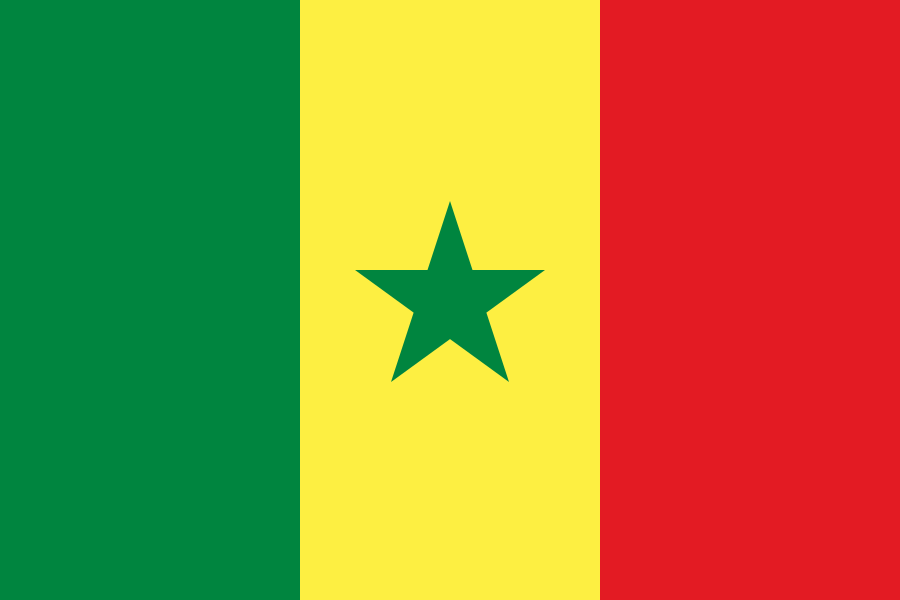
Un Peuple, Un But, Une Foi
Senegal adopted the Gregorian calendar in 1910 during French colonial rule, but traditional Wolof communities still reference lunar phases for events like the annual Magal pilgrimage in Touba, which draws over four million people on the 18th Rabi' al-Awwal—equivalent to a fixed Hijri date that shifts in the solar calendar by about 10-11 days each year. This blend highlights how time in Senegal layers modern UTC+0 with Islamic lunar traditions for one of Africa's largest religious gatherings.
Le Sénégal utilise GMT (UTC+0) toute l'année, sans changement d'heure.
Senegal, a vibrant West African nation on the Atlantic coast, captivates with its rich cultural heritage, bustling markets, and stunning landscapes from the Sahel to the beaches of Dakar. Home to approximately 17 million people, this ISO SN-coded country thrives in a single time zone, aligning its daily life with Greenwich Mean Time (GMT). This unified time organization reflects Senegal's compact geography and tropical climate, fostering a national rhythm that blends traditional Wolof influences, Islamic practices, and modern urban energy. Whether you're planning a trip to the capital Dakar or coordinating business across the country, understanding Senegal's straightforward time setup ensures seamless synchronization with global schedules.
Senegal operates under a single time zone, making it one of the simpler countries for travelers and businesses to navigate temporally. The official IANA time zone identifier is Africa/Dakar, which corresponds to UTC+0, also known as Coordinated Universal Time (UTC) or Greenwich Mean Time (GMT). This offset places Senegal in sync with the Prime Meridian, a legacy of its colonial history under French rule and its position as a key maritime hub in West Africa.
The capital, Dakar, embodies this zone fully, with clocks ticking at UTC+0 year-round. As Senegal's political, economic, and cultural heart, Dakar sets the pace for the nation, where government offices, international airports like Blaise Diagne International Airport, and major ports operate on this standard. Other representative cities follow suit: Saint-Louis, a UNESCO World Heritage site in the north, shares the same UTC+0 timing, allowing for fluid travel along the coastal Route Nationale 2. Inland hubs like Thiès, a transportation nexus connecting Dakar to the interior, and Kaolack, known for its peanut trade and markets, also adhere strictly to Africa/Dakar without deviations.
Geographically, Senegal's choice of a single zone makes logical sense. Spanning about 196,000 square kilometers, the country stretches from the Senegal River in the north to the Casamance region in the south, but its latitude—mostly between 12°N and 17°N—keeps it within a narrow band where solar time variations are minimal. Politically, this uniformity promotes national cohesion in a multilingual society where French serves as the official language alongside Wolof, Pulaar, and others. Unlike neighbors such as Mali (also UTC+0) or Mauritania (UTC+0), Senegal's zone avoids the complexities of multiple offsets seen in larger African nations like Nigeria. This setup supports efficient cross-border trade within the West African Economic and Monetary Union (UEMOA), where synchronized time facilitates everything from fishing cooperatives in coastal Gorée Island to agricultural planning in the Ferlo Desert region. For visitors, the absence of intra-country time shifts means no adjustments needed when venturing from urban Dakar to rural Sine-Saloum Delta, enhancing the flow of Senegal's dynamic daily life.
Senegal does not observe Daylight Saving Time (DST), maintaining a consistent UTC+0 offset throughout the year without any clock adjustments. This decision stems from the country's equatorial proximity and tropical climate, where daylight hours vary little seasonally—sunrise hovers around 7:00 AM and sunset near 7:30 PM year-round. Unlike European nations that shift clocks to extend evening light during shorter winters, Senegal's stable solar patterns render DST unnecessary, avoiding the confusion and energy costs associated with biannual changes.
Historically, Senegal briefly experimented with DST during French colonial times in the mid-20th century, but post-independence in 1960, the government opted for permanence to align with regional West African standards and support agriculture-dependent economies. The lack of DST ensures predictable scheduling for farmers in the groundnut basin and fishermen along the Petite Côte, where seasonal rhythms are dictated by monsoons rather than artificial time tweaks.
Practically, this consistency benefits international relations and tourism. Business meetings in Dakar remain uninterrupted by offset shifts, and events like the Dakar Festival in November proceed without seasonal disruptions. For locals, it simplifies Islamic prayer times (salat), which follow solar calculations and vary predictably. Travelers from DST-observing countries appreciate the stability, reducing administrative hassles at borders with Gambia or Guinea-Bissau, both also on UTC+0 without changes. Overall, Senegal's no-DST policy underscores a practical, sun-aligned lifestyle that prioritizes reliability over fleeting gains in evening daylight.
Senegal's daily rhythm pulses with a blend of African warmth, Islamic traditions, and urban vibrancy, all synchronized to UTC+0. Mornings often start early, around 6:00 AM, with the call to prayer (adhan) echoing from mosques, influencing the routines of the predominantly Muslim population. Breakfast, typically thiakry (millet porridge) or beignet (doughnuts) with café Touba (spiced coffee), is enjoyed between 7:00 AM and 9:00 AM, fueling street vendors and office workers alike.
Lunch, the main meal, clusters around 1:00 PM to 2:30 PM, featuring staples like thieboudienne (rice with fish and vegetables) shared family-style. This midday break aligns with the heat of the day, sometimes incorporating a short rest in rural areas, though less formal than a Spanish siesta. Offices in Dakar and Thiès generally open from 8:00 AM to 5:00 PM, Monday through Friday, with a one-hour lunch closure; government buildings like the Palais de la République may extend to 6:00 PM. Banks and post offices follow suit, opening at 8:30 AM, while markets like Sandaga in Dakar buzz from dawn till dusk, with peak activity 9:00 AM to 7:00 PM.
As evening descends, dinner is a late affair, often after 8:00 PM, with lighter fare like yassa (marinated chicken or fish) enjoyed communally. Nightlife in major cities ignites post-9:00 PM: Dakar's Plateau district throbs with live mbalax music at venues like Just 4 U until 2:00 AM or later, while Saint-Louis's colonial streets host jazz festivals extending into the wee hours. Saly on the Petite Côte offers beach clubs open till midnight, blending Senegalese sabar drumming with international beats.
Local specifics add flavor—Friday's Jumu'ah prayer may shorten workdays, and Ramadan shifts meals to iftar (sunset breaking of fast around 7:30 PM) and suhoor (pre-dawn). In Casamance, animist influences tie rhythms to lunar cycles for festivals like the Boukout initiation rites. This temporal flow reflects teranga (hospitality), where time bends flexibly for social bonds, yet remains anchored by UTC+0 for global connectivity.
Senegal's UTC+0 time zone creates straightforward differences with major global cities, ideal for transatlantic coordination. Compared to London, which follows GMT/UTC+0 in winter (late October to late March) and British Summer Time (BST/UTC+1) from late March to late October, Senegal matches exactly during London's winter months—no offset. In summer, Senegal lags one hour behind London (e.g., 8:00 PM in Dakar is 9:00 PM in London), simplifying calls without drastic adjustments.
With New York, on Eastern Standard Time (EST/UTC-5) in winter and Eastern Daylight Time (EDT/UTC-4) in summer, the gap is wider: Senegal leads by 5 hours in winter (e.g., noon in Dakar is 7:00 AM in New York) and 4 hours in summer. Paris, relevant for Senegal's Francophone ties, mirrors London's pattern at UTC+1 in winter (CET) and UTC+2 in summer (CEST), so Senegal trails by 1 hour year-round in winter and 2 hours in summer.
For UK callers, the best windows are mornings in Senegal (8:00 AM to 12:00 PM Dakar time), aligning with London's 8:00 AM to 12:00 PM in winter or 7:00 AM to 11:00 AM in summer—perfect for business without encroaching on evenings. From the US East Coast, aim for Senegal's afternoons (1:00 PM to 5:00 PM Dakar), which hit New York's 8:00 AM to 12:00 PM in winter or 9:00 AM to 1:00 PM in summer, catching the start of the workday.
Jet-lag recommendations for travelers are minimal from Europe: Direct flights from London (6-7 hours) or Paris (5-6 hours) often arrive without severe disruption, as the 0-2 hour differences allow quick adaptation—stay hydrated, expose to natural light upon arrival, and align meals with local times. From New York (8-9 hours flight), the 4-5 hour advance can cause mild fatigue; counter it by shifting sleep gradually pre-flight and embracing Dakar's early sunrises. For Tokyo (UTC+9, 9-hour lag for Senegal), business travelers should schedule calls for Dakar's mornings (Tokyo evenings). Overall, Senegal's stable time invites easy integration, whether for Gorée Island tours or Niokolo-Koba National Park safaris—check apps like World Clock for real-time conversions to avoid mishaps in this welcoming destination.
Senegal uses the Africa/Dakar time zone, which is UTC+0 year-round. This single zone applies nationwide, including in the capital Dakar, ensuring uniformity across the country. For the exact current time, tools like time zone converters or official clocks in Senegal reflect Greenwich Mean Time without any offsets.
Senegal does not observe daylight saving time, sticking to UTC+0 consistently. In contrast, London switches to UTC+1 during summer months (March to October), creating a one-hour difference where London is ahead. This stability in Senegal simplifies planning for interactions with the UK outside of British summer.
From the UK, call Senegal in the morning (8:00 AM to 12:00 PM local time) during winter for perfect alignment, or slightly earlier in summer to account for the one-hour gap. US East Coast callers should target Senegal's afternoons (1:00 PM to 5:00 PM) to hit morning hours back home. For travel, November to April offers cooler dry weather, minimizing jet-lag recovery in Senegal's mild climate—flights from major hubs land refreshed for exploring.
Daily life in Senegal starts early with markets like Dakar's Sandaga opening around 7:00 AM and peaking until 7:00 PM. Major sites such as the Gorée Island Museum operate 10:00 AM to 5:00 PM, while the Dakar Cathedral welcomes visitors from 8:00 AM to 6:00 PM; offices and shops generally run 8:00 AM to 5:00 PM with a lunch break. Evenings come alive after 8:00 PM, especially nightlife in the Plateau district.
Senegal's UTC+0 aligns cultural events with solar and lunar calendars, like the timing of Tabaski (Eid al-Adha) celebrations that span evenings starting around sunset at 7:30 PM. Festivals such as the Saint-Louis Jazz Festival in May sync with consistent daylight, running from afternoon sets till late night without DST disruptions, enhancing the communal teranga spirit.