Singapour
Singapore
--:--
Singapore 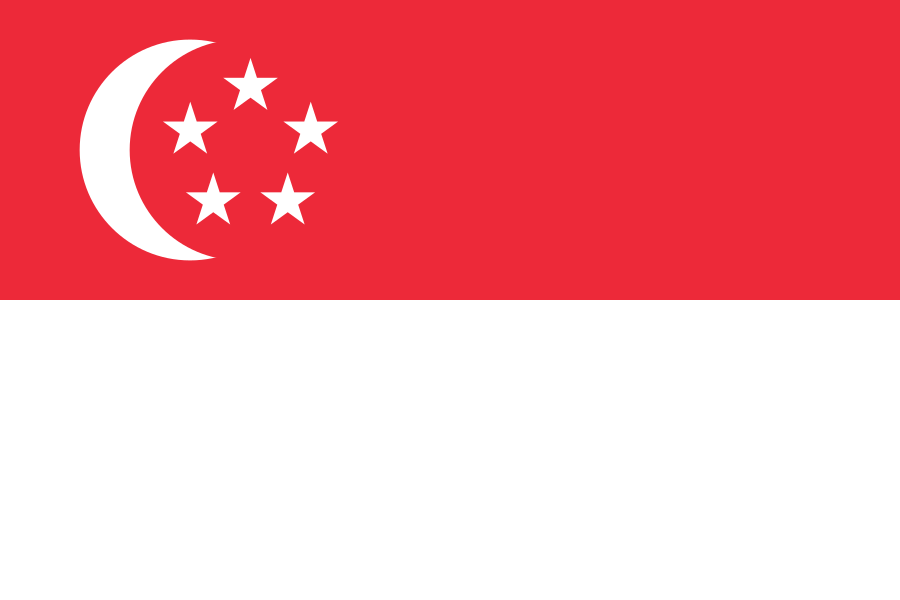
Singapore's time zone, Asia/Singapore, was pivotal in the 1905 adoption of UTC+08:00, making it one of the first places to standardize time for maritime navigation in Asia— a legacy that still supports its status as the world's busiest transshipment port, handling over 37 million TEUs annually with clockwork precision. This equatorial timing also means the city experiences two equinoxes yearly with nearly identical day lengths, inspiring events like the iLight Singapore festival that synchronizes art installations to the unchanging sunset around 7 p.m.
Singapore, a vibrant city-state in Asia with a population of approximately 5.9 million, serves as its own capital under the name Singapour in some international contexts, though commonly known as Singapore. This bustling hub in Southeast Asia operates on a single time zone, Singapore Time (SGT), which keeps the nation synchronized with its dynamic economic and cultural pulse. Whether you're planning a business trip or a vacation, understanding the time in Singapore ensures seamless coordination across its efficient urban landscape.
Singapore adheres to a single time zone, identified by the IANA time zone database as Asia/Singapore, with a fixed UTC offset of UTC+08:00. This consistency reflects the country's equatorial location and its role as a global financial center, where precision in timing is paramount for trade, aviation, and international dealings. The capital, Singapour—encompassing the entire island nation—fully aligns with this zone, meaning there's no variation across its compact 728 square kilometers. Singapore does not observe daylight saving time (DST), a policy established since 1905 when it adopted a standard offset without seasonal adjustments, avoiding the disruptions common in many northern hemisphere countries. This non-observance simplifies scheduling for residents and visitors alike, as clocks remain steady year-round, supporting the 24/7 operations of its world-class port and Changi Airport.
For those comparing with other major cities, the time difference between Singapore and London is notably straightforward due to the lack of DST in Singapore. In London's winter (Greenwich Mean Time, UTC+00:00), Singapore is 8 hours ahead—meaning when it's noon in London, it's 8 p.m. in Singapore. During London's summer (British Summer Time, UTC+01:00, typically from late March to late October), the gap narrows to 7 hours, so noon in London becomes 7 p.m. in Singapore. This predictable offset aids in planning transcontinental calls or flights; for instance, a morning meeting in London aligns with evening availability in Singapore, fostering strong ties in finance and tech sectors. The ISO code SG further standardizes Singapore's temporal identity in global systems, ensuring accurate timestamping for everything from stock exchanges to e-commerce. Overall, this stable framework underscores Singapore's reputation for reliability, with no switchover dates to complicate calendars—clocks have stayed put since the nation's independence in 1965, emphasizing efficiency in its fast-paced Asian context.
The daily rhythm in Singapore pulses with a blend of efficiency and multiculturalism, shaped by its diverse population of Chinese, Malay, Indian, and expatriate communities. Typical meal times follow a structured pattern: breakfast is often enjoyed between 7 a.m. and 9 a.m., featuring quick bites like kaya toast or nasi lemak at hawker centers that buzz from dawn. Lunch, the main midday meal, clusters around 12 p.m. to 2 p.m., when offices pause for affordable, flavorful options like chicken rice or laksa, reflecting the city's UNESCO-recognized street food culture. Dinner winds down the day from 7 p.m. to 9 p.m., with families gathering for dim sum or seafood at lively spots like Newton Food Centre, though late-night eats extend into the wee hours for night owls.
Office hours in Singapore typically run from 9 a.m. to 6 p.m., Monday through Friday, with many in the central business district adhering to this for sectors like banking and tech—punctuality is a cultural cornerstone, often tied to the "kiasu" mindset of not wanting to fall behind. Shops and malls, such as the iconic Orchard Road, generally open from 10 a.m. to 10 p.m. daily, while administrative services like the Immigration & Checkpoints Authority operate 8 a.m. to 5 p.m. on weekdays. Sundays serve as the primary weekly rest day, with quieter streets and family-oriented activities, though tourist areas remain vibrant; mosques observe Friday prayers around noon, adding a rhythmic pause for the Muslim community. Nightlife thrives post-10 p.m., especially in Clarke Quay or Marina Bay, where bars and clubs pulse until 3 a.m. or later, blending Eastern and Western vibes in a safe, regulated environment.
Given its position near the equator, sunrise and sunset times in Singapore vary little seasonally. At the summer solstice (around June 21), sunrise occurs about 7:05 a.m. and sunset around 7:20 p.m., providing roughly 12 hours and 15 minutes of daylight. During the winter solstice (December 21), it's similarly balanced at sunrise 7:00 a.m. and sunset 7:15 p.m., with minimal deviation—ideal for year-round outdoor pursuits like Gardens by the Bay visits. This equatorial constancy reinforces Singapore's non-stop energy, where rituals like the evening chinatown market strolls or morning tai chi in parks weave into the fabric of daily life, making time management intuitive for locals and adaptable for global visitors.