Mogadiscio
Somalia
--:--
Mogadishu 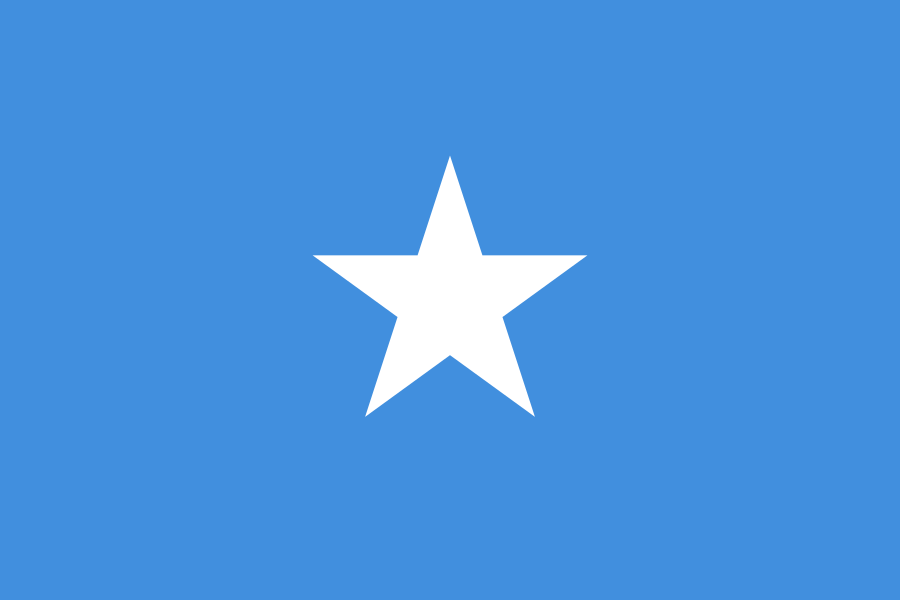
Somalia adopted the Gregorian calendar in the early 20th century under Italian and British colonial rule, but its Muslim population often references the Islamic Hijri calendar for religious events, leading to dual observances like Ramadan starting on lunar sightings rather than fixed dates. This blend ensures holidays like Eid al-Fitr align with community moonsighting councils in Mogadishu.
Somalia, a resilient nation on the eastern Horn of Africa, spans over 637,000 square kilometers and is home to approximately 17 million people, with Mogadishu as its bustling capital. This Somali Federal Republic operates on a single time zone, aligning its clocks uniformly across the country to facilitate national cohesion amid its diverse clans and regions. Understanding the time in Somalia is key for travelers, businesses, and diaspora connections, as it reflects not just UTC offsets but also the cultural rhythms shaped by Islamic traditions, nomadic heritage, and equatorial climate. From dawn prayers to evening markets, Somalia's time organization underscores a lifestyle attuned to the sun's path and community ties.
Somalia maintains a straightforward time zone structure with just one official zone, simplifying coordination in a country that stretches from the Gulf of Aden to the Indian Ocean. The IANA time zone identifier is Africa/Mogadishu, which corresponds to Eastern Africa Time (EAT) at UTC+3. This offset remains constant year-round, covering the entire territory including the capital Mogadishu, the northern hub of Hargeisa in Somaliland, the port city of Bosaso in Puntland, and southern locales like Kismayo and Baidoa. Geographically, Somalia lies primarily between 8° and 12° north latitude, straddling the equator's influence but unified under this single zone despite its elongated shape along the coast.
The choice of UTC+3 reflects both historical and practical logic. Colonized by Britain, Italy, and influenced by Ethiopia and Kenya—all in the East Africa Time bloc—Somalia adopted EAT post-independence in 1960 to align with regional trade partners and avoid the fragmentation seen in multi-zone nations like Russia. Politically, this uniformity supports federal governance, even as semi-autonomous regions like Somaliland and Puntland operate independently; their clocks sync with the national standard to ease cross-border commerce in livestock, fisheries, and remittances. For instance, Mogadishu's international airport and major ports run on Africa/Mogadishu time, ensuring seamless scheduling for flights from Dubai or Nairobi, both also on UTC+3. This single-zone approach minimizes confusion in a country where infrastructure challenges, from civil unrest to arid terrain, already complicate logistics. Visitors to Hargeisa's markets or Bosaso's beaches experience the same local time as in the capital, fostering a sense of national rhythm despite ethnic diversity. In essence, Somalia's time zone embodies efficiency, mirroring the adaptability of its people who navigate a landscape of dunes, savannas, and urban sprawl under one temporal umbrella.
Somalia does not observe Daylight Saving Time (DST), maintaining its UTC+3 offset throughout the year without any clock adjustments. This decision stems from the country's equatorial position, where daylight hours vary little—typically 12 hours of day and night annually—rendering DST unnecessary for energy savings or extended evening light. Unlike temperate regions that shift clocks to align with seasonal sunrises, Somalia's consistent photoperiod, influenced by its proximity to the equator, supports a stable schedule that aligns with agricultural cycles and prayer times in its predominantly Sunni Muslim population.
The absence of DST dates or switchovers simplifies life in a nation recovering from decades of conflict, where reliable timekeeping aids humanitarian operations and business. Practically, this means no biannual disruptions, reducing errors in scheduling for ports, schools, and clinics. For travelers, it eliminates the need to recalculate times upon arrival, though the intense tropical heat—averaging 30°C (86°F)—influences daily patterns more than any artificial clock change. Overall, Somalia's no-DST policy promotes predictability, allowing communities to focus on resilience rather than temporal tweaks.
In Somalia, the daily rhythm pulses with the cadence of Islamic traditions, family gatherings, and the equatorial sun, shaping a lifestyle that blends urban hustle with pastoral roots. Breakfast, often camel milk, tea, and flatbread like canjeero, is typically enjoyed early, around 6-7 AM, shortly after the Fajr dawn prayer, energizing nomads heading to grazing lands or city dwellers starting commutes. Lunch, the main meal featuring rice, goat stew, or fish in coastal areas, falls between 1-2 PM, coinciding with the Dhuhr prayer and a brief siesta in hotter months to beat the midday scorch.
Office hours in stable areas like Mogadishu or Hargeisa generally run from 8 AM to 4 PM, with government ministries and NGOs adhering to this for efficiency, though private businesses may extend to 6 PM. Shops and markets, vibrant hubs of Somali commerce, open around 7-8 AM and close by 7-8 PM, winding down after Maghrib sunset prayers; in Mogadishu, the Bakaara Market buzzes until dusk with haggling over spices and textiles. Nightlife remains subdued due to security concerns, but in safer pockets of Hargeisa or Bosaso, tea houses and modest eateries host evening gatherings until 10 PM, where poetry recitals or qat chewing sessions— a cultural stimulant—extend social bonds under starlit skies.
Local specifics highlight Somalia's adaptability: In rural Juba Valley, farmers sync planting with lunar cycles alongside Gregorian dates, while urban youth in Mogadishu increasingly follow global hours for online freelancing. Prayer calls five times daily punctuate the schedule, fostering communal pauses that reinforce social fabric. This rhythm, resilient amid challenges, underscores a people who value time for kinship over rigid clocks, with weekends (Fridays as the holy day) blending rest and reflection.
Somalia's fixed UTC+3 position creates straightforward offsets with global hubs, aiding connections for the Somali diaspora and international partners. Compared to London, which operates on Greenwich Mean Time (GMT, UTC+0) in winter and British Summer Time (BST, UTC+1) from late March to late October, Somalia is 3 hours ahead in winter and 2 hours ahead during London's summer. For New York on Eastern Standard Time (EST, UTC-5) or Eastern Daylight Time (EDT, UTC-4), the gap widens to 8 hours ahead in winter and 7 hours during U.S. summer DST (March to November). Paris, on Central European Time (CET, UTC+1) or CEST (UTC+2), trails Somalia by 2 hours in winter and 1 hour in summer.
For callers from the UK, the best windows align with Somalia's morning or afternoon: Dial between 8 AM and 12 PM London time for a 11 AM-3 PM reception in Mogadishu, catching offices post-prayer. From the US East Coast, aim for 10 AM-2 PM New York time to hit 6-10 PM Somali evening, ideal for family chats without late-night disruptions. Business pros recommend tools like world clocks on apps for precision, especially since Somalia skips DST.
Jet-lag tips for travelers: Flying west from Europe (e.g., 7-hour flight from London) means arriving ahead, so expose to morning light in Mogadishu upon landing to reset circadian rhythms—hydrate against the heat and nap briefly if needed. From the US, the 8-hour shift east demands pre-flight adjustments: Shift sleep earlier and use melatonin for the first nights. In Somalia's consistent climate, focus on hydration and light meals to ease adaptation, allowing quick sync to local prayer-timed days. These strategies ensure smooth immersion in Somalia's vibrant, sun-driven tempo.
Somalia uses Eastern Africa Time (EAT), identified as Africa/Mogadishu in the IANA database, with a fixed offset of UTC+3. This single time zone applies nationwide, from Mogadishu to Hargeisa. No DST means clocks stay steady year-round.
Somalia does not observe Daylight Saving Time, keeping UTC+3 constant. The time difference with London is 3 hours ahead during GMT (winter) and 2 hours ahead during BST (summer, March to October). This stability simplifies planning for UK-Somali interactions.
From the UK, call between 9 AM and 1 PM London time to reach Somalia during its 12-4 PM window, aligning with lunch and office hours. US callers should aim for 11 AM-3 PM Eastern Time for 7-11 PM in Somalia, catching evenings post-dinner. Avoid weekends, as Friday prayers shift routines.
In Mogadishu, businesses and offices typically open from 8 AM to 4 PM or 5 PM, with a midday break around 1-2 PM for prayers and lunch. Markets like Bakaara run longer, until 7-8 PM. Security and heat may cause variations, so confirm locally.
As a Muslim-majority nation, Somalia's five daily prayers—Fajr at dawn, Dhuhr midday, Asr afternoon, Maghrib sunset, and Isha night—structure routines, pausing work and meals. This creates a rhythmic flow, with communities gathering at mosques, enhancing social ties amid the UTC+3 schedule.