Djouba
South Sudan
--:--
Juba 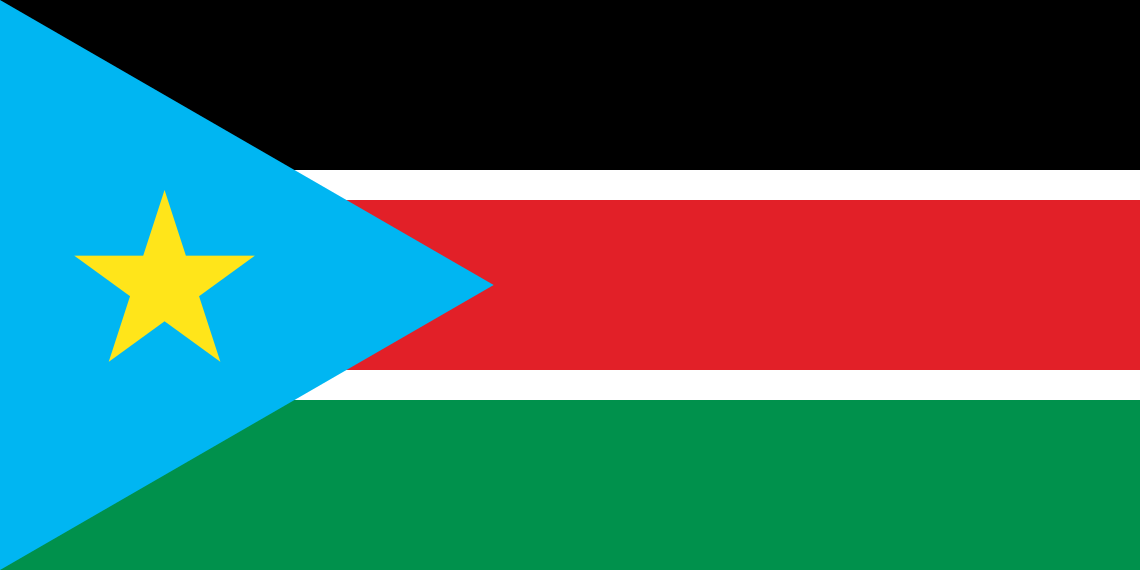
South Sudan adopted the Gregorian calendar upon independence on July 9, 2011, becoming the 54th African nation to do so, which synchronized its official timekeeping with global standards while honoring local lunar influences in pastoral calendars for cattle migrations. This shift helped align the young country's rhythms with international partners, notably during its UN accession ceremonies timed precisely to New York clocks.
Nestled in the heart of East Africa, South Sudan is a young nation that declared independence in 2011, boasting a population of around 11 million people across its vast savannas and riverine landscapes. As a landlocked country sharing borders with Sudan, Ethiopia, Kenya, Uganda, and the Democratic Republic of the Congo, it operates under a single time zone, aligning its clocks to the rhythm of equatorial life. This unified time structure simplifies daily coordination in a country where Juba serves as the bustling capital, fostering a national rhythm influenced by pastoral traditions, seasonal floods, and a growing urban pulse. Understanding South Sudan's time organization reveals how its people balance ancient customs with modern aspirations in a region defined by the Nile's flow and communal gatherings.
South Sudan maintains a straightforward time zone system with just one official zone, reflecting its compact geographic and political unity despite its size of over 619,000 square kilometers. The country adheres to East Africa Time (EAT), designated by the IANA as Africa/Juba, with a fixed UTC offset of +3 hours year-round. This places Juba, the capital and economic hub, along with major cities like Malakal, Wau, and Yei, all synchronized to the same clock—no internal borders or regional variations disrupt this harmony.
The choice of Africa/Juba stems from South Sudan's position in the eastern quadrant of the African continent, where longitude roughly aligns with 30–35° East, naturally suiting a +3 UTC offset without the need for multiple zones. Politically, this single-zone approach was inherited and retained from its time as part of Sudan but adapted post-independence to promote national cohesion in a diverse federation of 10 states. Geographically, the zone encompasses the White Nile's basin and the Sudd wetland, where timekeeping supports agriculture, fishing, and trade routes that connect to neighboring East African Community partners like Kenya and Uganda, both on EAT. In practice, this uniformity aids cross-border commerce, such as cattle markets in border towns, and simplifies logistics for humanitarian aid, which flows into Juba's airport from global partners. For travelers arriving via Entebbe or Addis Ababa, the consistent +3 offset eases transitions, while locals in remote villages rely on solar clocks or community bells to mark the day, blending traditional time sense with the official standard. This setup underscores South Sudan's commitment to stability, allowing its 11 million residents—many in rural herding communities—to focus on rebuilding amid post-conflict recovery.
South Sudan does not observe daylight saving time (DST), maintaining its UTC+3 offset throughout the year without any clock adjustments. This decision aligns with the practices of most African nations, particularly those near the equator, where seasonal daylight variations are minimal due to the country's latitude between 3° and 12° North. The equatorial climate means days and nights remain roughly 12 hours each year-round, eliminating the energy-saving rationale behind DST in temperate zones. Post-independence, South Sudan's government opted against DST to avoid confusion in a society still standardizing institutions, prioritizing simplicity for farmers, traders, and civil servants who depend on predictable schedules.
The absence of DST has practical benefits, such as stable business operations and reduced administrative burdens in a developing economy. For instance, Juba's markets and offices run without the twice-yearly disruptions common elsewhere, supporting consistent supply chains for imports like fuel and food. However, it means South Sudan stays three hours ahead of Greenwich Mean Time even during European summer, potentially complicating international calls. Travelers appreciate the no-switch policy, as it prevents jet-lag from artificial shifts, though the tropical heat—peaking at 40°C in dry seasons—naturally influences activity patterns, with siestas common in afternoons. Overall, this steady time framework reinforces the national rhythm, allowing communities to attune to natural cycles like the rainy season's June-to-October downpours rather than imposed clock changes.
In South Sudan, the daily rhythm pulses with a blend of pastoral traditions and emerging urban energy, shaped by the tropical climate and cultural diversity among groups like the Dinka, Nuer, and Bari peoples. Breakfast typically occurs early, around 6–7 a.m., often featuring porridge made from sorghum or maize, aligning with sunrise to fuel morning herding or farming tasks before the heat intensifies. Lunch, the main meal, is served midday between 12–2 p.m., comprising staples like millet bread, beans, and grilled fish or goat from the Nile regions, enjoyed communally in homes or roadside eateries in Juba. Dinner follows in the evening, around 7–9 p.m., with lighter fare under the stars, fostering family bonds after the day's labors.
Office hours in government buildings and NGOs in Juba generally run from 8 a.m. to 4 p.m., Monday through Friday, with a short lunch break to dodge peak afternoon temperatures; private businesses like banks and telecoms may extend to 5 p.m. Shops and markets, vibrant hubs of trade, open as early as 7 a.m. and close by 6–7 p.m., though informal stalls in places like Wau's markets operate dawn to dusk year-round. Nightlife in major cities remains subdued due to security concerns and power outages, but Juba offers modest options: rooftop bars and live music venues like the Nile-inspired lounges kick off around 8 p.m., drawing locals and expats for grilled meats and traditional dances until midnight. Weekends shift toward rest, with Sunday church services starting at 9 a.m., reflecting the strong Christian influence—over 60% of the population attends, often extending into afternoon feasts. Local specifics include the impact of seasonal floods, which slow rural paces during rains, and the cultural emphasis on "African time," a flexible approach where social events like weddings may start late but last deep into the night, prioritizing relationships over rigid schedules. This rhythm, resilient amid challenges, highlights South Sudan's vibrant spirit, where time serves community over clocks.
South Sudan's fixed UTC+3 position creates straightforward yet notable time differences with global hubs, aiding planners in the UK and US. In winter (November to March), when London operates on Greenwich Mean Time (UTC+0), South Sudan is three hours ahead—meaning 9 a.m. in Juba is 6 a.m. in London. During UK summer (late March to late October) on British Summer Time (UTC+1), the gap narrows to two hours. For New York, on Eastern Standard Time (UTC-5) in winter, the difference is eight hours (noon in Juba is 4 a.m. in NYC); it shrinks to seven hours during US daylight saving (March to November, UTC-4). Paris, at UTC+1 in winter and UTC+2 in summer, sits two or one hour behind Juba, respectively, easing European connections.
For calls from the UK, the best windows are late morning to early afternoon London time (11 a.m.–3 p.m. GMT), translating to early afternoon to late evening in South Sudan (2–6 p.m. EAT), when offices are active and evenings suit personal chats. From the US East Coast, aim for 10 a.m.–2 p.m. NYC time in winter (6–10 p.m. Juba), avoiding early mornings or late nights; apps like WhatsApp thrive here, given spotty infrastructure. Tokyo, at UTC+9, is six hours ahead, so midday Juba meetings align with evening Tokyo—ideal for aid coordination.
Jet-lag tips for travelers: Flying east from London (3–8 hour shifts) or west from New York (7–8 hours), expect mild disruption due to no DST; adjust by advancing sleep a day before and hydrating against dry cabin air. Upon arrival in Juba's humid 30°C+, nap briefly post-flight but embrace local early rises with light exposure. For business trips, schedule arrivals midweek to sync with 8 a.m. starts, and use melatonin for eastward hops. These offsets underscore South Sudan's accessibility, bridging African heartlands with Western timelines for diplomacy, trade, and tourism.
South Sudan operates in the East Africa Time zone (EAT), which is UTC+3 with no daylight saving adjustments. This single zone covers the entire country, including the capital Djouba, ensuring uniform timekeeping nationwide. Clocks in South Sudan remain consistent year-round, making it easy for visitors to set their watches upon arrival.
South Sudan is three hours ahead of London in winter (when London is on GMT, UTC+0) and two hours ahead during British Summer Time (UTC+1). South Sudan does not observe daylight saving time, so its UTC+3 offset stays fixed, avoiding any seasonal clock changes. This stability simplifies planning for transatlantic communications.
From the UK, the optimal calling window is 11 a.m. to 3 p.m. London time, which falls in the early afternoon to evening in South Sudan, aligning with business and family hours. For US callers, try 10 a.m. to 2 p.m. Eastern Time, corresponding to evening in Juba. Travel-wise, the dry season from December to April offers milder weather (25–35°C) and better road access, ideal for safaris or cultural visits, though security advisories should be checked.
Business hours in South Sudan typically run from 8 a.m. to 4 p.m. or 5 p.m., Monday to Friday, with a midday break for lunch amid the heat. The daily rhythm starts early with breakfast around 6–7 a.m., peaks with communal lunches at noon, and winds down by evening dinner at 7–9 p.m. In Djouba, major sites like the National Museum open around 9 a.m. to 5 p.m., closing earlier on weekends.
South Sudan follows the Gregorian calendar but incorporates cultural nuances, such as flexible "African time" in social events where gatherings like festivals may start later to accommodate travel. Independence Day on July 9 marks a key calendar event, celebrated with all-night festivities that blend modern clocks with traditional storytelling under the stars.