Omdourman
Sudan
--:--
Khartoum 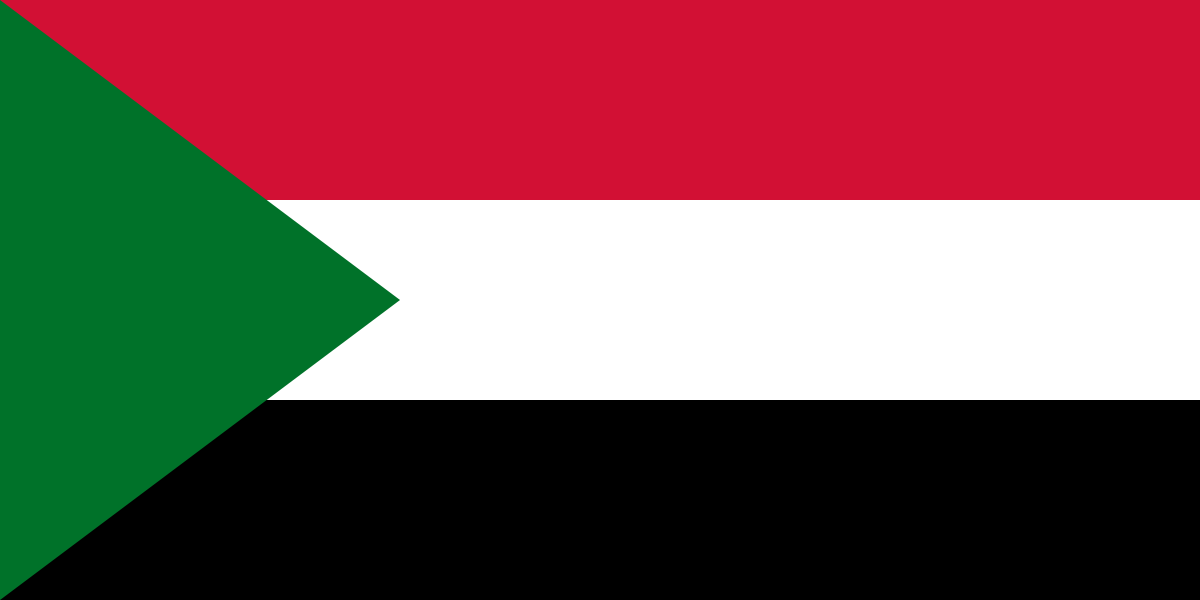
In Sudan, the ancient Kingdom of Kush developed one of Africa's earliest calendars around 1070 BCE, using a 365-day solar system similar to the Egyptian one, which influenced timekeeping along the Nile for millennia. This predates the Gregorian calendar by over 2,000 years and tied seasonal rhythms to the river's floods for agriculture.
Sudan, officially the Republic of the Sudan, is a vast North African nation spanning over 1.8 million square kilometers, with a population of approximately 44 million people. As the third-largest country in Africa by area, it stretches from the Red Sea in the east to the deserts of the west, encompassing diverse landscapes from the Nile River valley to the Nubian Mountains. Sudan's time organization is straightforward, adhering to a single time zone that aligns with its geographic position and facilitates national coordination in a country marked by both urban vibrancy and rural traditions. This unified system supports the daily rhythms influenced by Islamic culture, seasonal Nile floods, and the heat of the Sahara, where time often bends to prayer calls and communal gatherings.
Sudan operates under a single time zone, designated as Africa/Khartoum in the IANA database, with a fixed UTC offset of +2 hours (UTC+2). This zone covers the entire territory of the country, from the bustling capital of Khartoum in the center to the coastal city of Port Sudan on the Red Sea and the western hub of Nyala in Darfur. Khartoum, home to over 5 million residents, serves as the political and economic heart, where the confluence of the White and Blue Nile rivers symbolizes the nation's unity—much like its singular time zone unifies scheduling across regions. Other key cities, such as Omdurman (the largest by population) and Atbara in the north, all follow this same offset, ensuring seamless connectivity for transportation, trade, and communication.
The choice of a single time zone reflects both geographic and political logic. Sudan's longitude, primarily between 22°E and 38°E, naturally aligns with UTC+2, which is standard for much of Northeast Africa and avoids the fragmentation seen in larger nations like Russia or the United States. Politically, maintaining one zone promotes national cohesion in a country with a history of regional tensions, including the division that led to South Sudan's independence in 2011. This setup simplifies logistics for the country's oil exports, agricultural trade along the Nile, and international flights into Khartoum International Airport. For travelers or businesses dealing with Sudan's ISO code SD, understanding this uniform system is essential, as it eliminates intra-country time adjustments and supports efficient planning across its 18 states.
Sudan does not observe daylight saving time (DST), maintaining its UTC+2 offset year-round without any clock changes. This policy has been in place since the country's early independence era, with no seasonal switchovers implemented in recent decades. The decision stems from practical considerations: Sudan's equatorial proximity and intense year-round sunlight make artificial time shifts unnecessary, as daylight hours vary minimally—typically 11 to 13 hours daily. Additionally, the predominantly Muslim population aligns daily life with solar-based Islamic prayer times rather than manipulated civil clocks, reducing the administrative burden in a developing economy focused on agriculture and resource management.
The absence of DST brings straightforward practical consequences for residents and visitors. Schedules remain consistent, aiding reliability in sectors like farming, where the Nile's flood season (July to October) dictates planting without added confusion from time changes. Businesses in Khartoum avoid the productivity dips associated with spring-forward adjustments, and international dealings with partners in the Middle East or Europe are predictable. For tourists, this means no unexpected disruptions to tours of ancient sites like the pyramids of Meroë, though they should note the hot summers (up to 45°C) that naturally shift outdoor activities to cooler evenings. Overall, Sudan's no-DST approach fosters stability in a nation where time is already shaped by environmental and cultural rhythms.
In Sudan, the daily rhythm is deeply intertwined with Islamic traditions, the tropical climate, and a blend of urban professionalism and rural simplicity, all synchronized to the Africa/Khartoum time zone. Typical meal times reflect this: breakfast (futoor) is light and early, around 6-8 AM, often featuring ful medames beans and tea before the heat intensifies. Lunch, the main meal, occurs between 1-3 PM, with families gathering for dishes like kisra flatbread and stews, aligning with the midday prayer (Dhuhr) and a post-lunch rest in hotter months. Dinner is late, from 8-10 PM, emphasizing communal iftar during Ramadan, when the day's fast breaks at sunset, fostering social bonds in homes or street-side eateries.
Office hours in cities like Khartoum generally run from 7:30 AM to 2 PM for government and banking sectors, allowing employees to avoid peak afternoon temperatures exceeding 40°C; private businesses may extend to 4-5 PM with air-conditioned spaces. Shops and markets, vibrant hubs of Sudanese life, open around 8 AM and close by 8-9 PM, with souks in Omdurman buzzing until late for evening bargaining. Nightlife in major cities is subdued yet cultural—Khartoum's Nile-side cafes and tea houses come alive after 9 PM for shisha sessions and live Sudanese music (tariqa Sufi performances), though conservative norms limit alcohol and rowdy venues. In Port Sudan, Red Sea breezes extend seaside gatherings into the night. Documented local specifics include the influence of the five daily prayers, which pause work five times—dawn (Fajr) to night (Isha)—and the khat chewing tradition in some eastern regions, mildly altering afternoon alertness. This rhythm promotes work-life balance, with weekends on Thursday-Friday, adapting to the nation's 44 million people navigating modernity amid timeless desert ways.
Sudan's UTC+2 time zone creates consistent offsets with global cities, unaffected by its lack of DST. Compared to London (UTC+0 in winter, UTC+1 in summer under British Summer Time), Sudan is 2 hours ahead in winter and 1 hour ahead in summer—meaning a 9 AM London meeting is 11 AM in Khartoum during standard time or 10 AM in DST months (late March to late October). For New York (UTC-5 in winter, UTC-4 in summer with Eastern Daylight Time), the difference is larger: 7 hours ahead in winter and 6 hours in summer, so midday EST calls from the US align with evening in Sudan. Relevant to Sudan's African and Arab ties, Paris (UTC+1 winter, UTC+2 summer) matches Sudan exactly in winter and falls 1 hour behind in summer. Tokyo (UTC+9 year-round) is 7 hours ahead of Sudan, ideal for overnight business syncs.
Practical tips for calling from the UK or US emphasize these gaps to minimize disruptions. From the UK, the best window is early morning London time (7-10 AM GMT), corresponding to 9 AM-12 PM in Sudan—perfect for business outreach before the afternoon heat slows pace. US callers from the East Coast should aim for 8-11 AM EST (3-6 PM Sudan time), catching the post-lunch productivity slot; avoid evenings there, as it hits midnight in Khartoum. For video calls, tools like World Time Buddy help visualize overlaps, and scheduling around Friday half-days in Sudan is key. Jet-lag recommendations for travelers: Flying east from London (2-3 hour difference) requires minimal adjustment—advance bedtime by 1-2 hours and stay hydrated against arid air. From New York, the 7-hour shift demands more prep: expose to morning light upon arrival, nap briefly, and ease into Sudan's early starts with light meals. Business visitors to Khartoum should book flights arriving by noon local time to acclimate before evening social hours, while tourists to Nile cruises benefit from westward returns to combat fatigue.
Sudan uses the Africa/Khartoum time zone, which is UTC+2 year-round. This single zone applies nationwide, including in the capital Khartoum and cities like Port Sudan. There are no variations or DST adjustments, making it straightforward for checking real-time clocks via apps or websites.
Sudan does not observe daylight saving time, sticking to UTC+2 throughout the year. Its offset with London is +2 hours in winter (when London is UTC+0) and +1 hour in summer (when London is UTC+1). This consistency simplifies planning for UK-Sudan interactions without seasonal shifts.
The best time to call from the UK is 7-10 AM London time, aligning with 9 AM-12 PM in Sudan for productive daytime hours. From the US East Coast, aim for 8-11 AM EST, which is 3-6 PM Sudan time. For travel, visit October to April to avoid extreme heat (over 40°C in summer), when milder weather suits exploring Khartoum or the Red Sea coast.
Offices in Sudan, especially in Khartoum, typically operate from 7:30 AM to 2 PM, with some private sectors extending to 4-5 PM. Major sites like the National Museum in Khartoum are open 9 AM-6 PM daily, closing earlier on Fridays; souks and markets run longer, until 8-9 PM, reflecting the evening social rhythm.
During Ramadan, Sudan's daily rhythm shifts around fasting from dawn to sunset, with iftar meals breaking the fast around 6-7 PM in Khartoum. Work hours shorten to 9 AM-2 PM, and nightlife focuses on post-iftar gatherings, emphasizing community prayers and family time in this predominantly Muslim nation.