Lomé
Togo
--:--
Lome 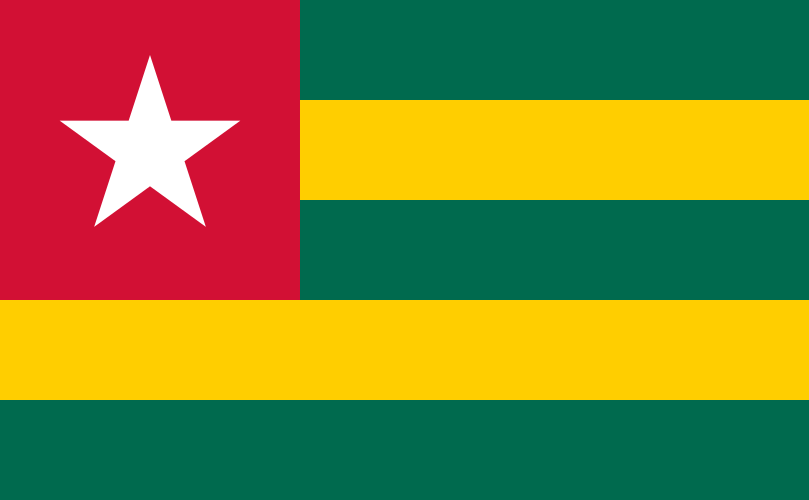
In Togo, the traditional Voodoo festival of Evala in July features timed wrestling matches that symbolize the agricultural calendar, where young Kabye men compete at dawn to honor fertility rites tied to the rainy season's onset. This event, drawing thousands to the northern town of Kara, highlights how time in Togo intertwines with cultural rhythms dating back centuries.
Togo, a vibrant West African nation with a population of around 8 million, spans a narrow strip along the Gulf of Guinea, bordered by Ghana, Benin, and Burkina Faso. Its capital, Lomé, serves as the bustling economic hub and primary entry point for visitors exploring this culturally rich country, known for its beaches, markets, and diverse ethnic groups. With just one time zone, understanding the time in Togo is straightforward, making it easy for travelers and businesses to coordinate with this ISO TG-coded destination in Africa.
Togo operates on a single time zone, Greenwich Mean Time (GMT), which corresponds to the IANA identifier Africa/Lome and a fixed UTC offset of +00:00 year-round. This places the entire country, including the capital Lomé, in sync with Coordinated Universal Time without any variations, simplifying scheduling for international interactions. Lomé, home to over 1.8 million residents, follows this zone precisely, where clocks tick steadily from the coastal ports to the northern savannas, reflecting Togo's compact geography of about 57,000 square kilometers.
Unlike many European or North American countries, Togo does not observe daylight saving time (DST), a policy unchanged since its independence in 1960. There are no switchover dates or seasonal adjustments; the clocks remain constant, avoiding the biannual disruptions that affect DST regions. This consistency is a boon for global trade partners, as Togo's time stays predictable, aligning with its role as a key player in West African commerce through Lomé's deep-water port.
When comparing to London, the time difference is minimal and straightforward. In winter (from late October to late March), when London is on GMT (UTC+00:00), Togo shares the exact same time—no offset at all. During London's summer months (late March to late October), when it switches to British Summer Time (BST, UTC+01:00), Togo falls one hour behind. For instance, if it's 2 PM in London during BST, it's 1 PM in Lomé. This setup means calls or meetings from the UK are seamless outside summer, but a slight adjustment is needed then. For those planning trips or virtual connections, tools like world clock apps can confirm real-time alignments, ensuring smooth coordination with Togo's always-steady Africa/Lome zone. Overall, the absence of DST underscores Togo's practical approach to time management in a tropical climate where daylight hours vary little seasonally.
Life in Togo pulses with a blend of traditional rhythms and modern influences, shaped by its tropical climate and multicultural fabric of over 40 ethnic groups. Meals anchor the day: breakfast is typically light and early, around 6:30 to 8 AM, often featuring staples like akassa (fermented cornmeal) or fresh fruit with coffee or tea, enjoyed before the heat intensifies. Lunch, the main meal, occurs between 12 PM and 2 PM, with families gathering for hearty dishes such as fufu (pounded yam) served with peanut stew or grilled fish, reflecting the country's coastal bounty. Dinner is lighter and later, from 7 PM to 9 PM, winding down the day with communal sharing under the stars.
Office and administrative hours generally run from 8 AM to 5 PM, Monday through Friday, though government offices in Lomé may close for a siesta-like break around midday in hotter months. Private businesses and banks often extend to 6 PM, while markets like the Grand Marché in Lomé buzz from dawn until dusk, with peak activity in the mornings when vendors sell everything from vibrant kente cloth to spices. Shops and informal street commerce adapt to the rhythm, opening as early as 7 AM and tapering off by 8 PM, influenced by the reliable equatorial daylight of about 12 hours year-round.
Sundays serve as the primary weekly rest day, with churches filling the air with gospel music from 8 AM onward, followed by family gatherings and relaxation. Local specifics add flavor: in rural areas, morning rituals include communal palm wine tapping at sunrise, while urban nightlife in Lomé stirs after 10 PM with beach bars and live music venues staying open until 2 AM or later on weekends. Festivals like the Evala wrestling ceremony in the north punctuate the calendar in July-August, syncing with harvest rhythms. Sunrise and sunset times are remarkably consistent due to Togo's proximity to the equator (around 8°N latitude); at the summer solstice (June 21), the sun rises about 5:50 AM and sets around 6:35 PM in Lomé, while winter solstice (December 21) sees rise at 6:25 AM and set at 6:05 PM—minimal variation that keeps daily life evenly paced without the long twilights of higher latitudes. This steady cadence fosters a resilient, community-oriented lifestyle, where time in Togo feels unhurried yet vibrant.