Tunis
Tunisia
--:--
Tunis 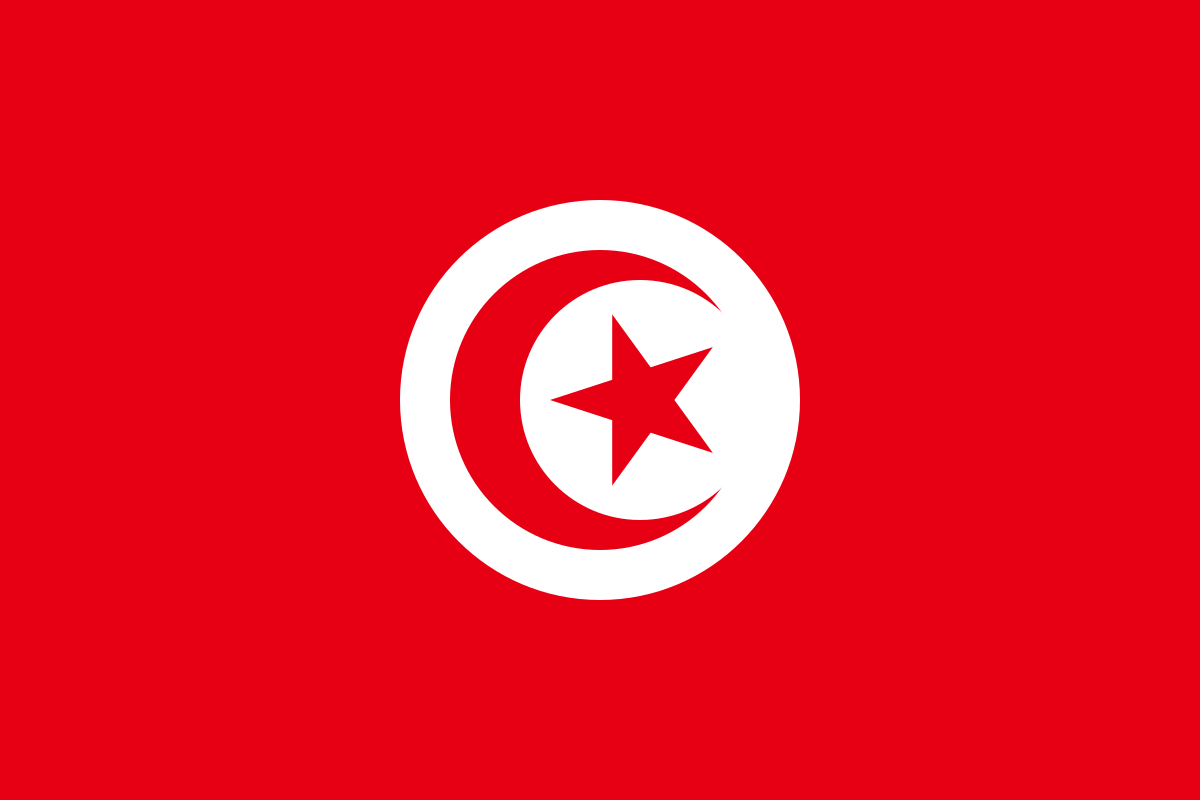
Liberté, Ordre, Justice
In 1881, during French colonial times, Tunisia became one of the first African regions to adopt standardized time zones, setting clocks to UTC+1 to facilitate railway operations from Tunis to the interior, a move that predated many European nations' full implementation. This early synchronization highlighted the country's strategic role in Mediterranean trade routes.
La Tunisie utilise CET (UTC+1) toute l'année.
Tunisia, a North African gem on the Mediterranean coast, blends ancient history with modern vibrancy, drawing over 12 million residents into its cultural tapestry. Known officially as the Republic of Tunisia (ISO code: TN), the country spans diverse landscapes from the Sahara Desert to bustling coastal cities, with Tunis as its lively capital. Time in Tunisia follows a single, straightforward time zone, ensuring seamless coordination across its 163,610 square kilometers. This unified system reflects the nation's compact geography and historical ties to European influences, making it easy for travelers and businesses to sync with the local rhythm without the complications of multiple zones.
Tunisia operates under a single time zone, the Africa/Tunis IANA identifier, which maintains a consistent UTC+1 offset year-round. This places the entire country, from the northern beaches of Bizerte to the southern oases of Tozeur, on Central European Time (CET), aligning it with much of Southern Europe and the Mediterranean basin. The capital, Tunis, exemplifies this uniformity, where clocks tick at UTC+1, as do those in key cities like Sfax, a major port on the eastern coast, and Sousse, a popular tourist hub known for its medina and beaches. Even remote areas, such as the desert town of Douz, adhere to the same standard, facilitated by Tunisia's relatively small size—about the length of California—spanning just 10 degrees of longitude.
This single-zone approach stems from both geographic and political logic. Positioned at 33–37°N latitude and 7–11°E longitude, Tunisia's position naturally fits within the UTC+1 band, avoiding the fragmentation seen in larger African nations like Nigeria or South Africa. Historically, the zone was formalized in the early 20th century under French colonial rule, which synchronized it with Paris to streamline administration and trade. Post-independence in 1956, Tunisia retained this setup for economic efficiency, supporting its role as a gateway between Africa and Europe. For visitors planning trips to sites like the Roman ruins of Carthage near Tunis or the Star Wars filming locations in Matmata, this means no need to adjust watches mid-journey—time in Tunisia remains predictably constant, enhancing logistics for flights into Tunis-Carthage International Airport or ferries to Sicily. In a continent with over 40 time zones, Tunisia's streamlined system underscores its pro-business ethos, with the Tunisian government promoting it as a stable environment for international investments in tourism and olive oil exports.
Tunisia does not observe daylight saving time (DST), sticking to its UTC+1 offset throughout the year without any clock adjustments. This policy has been in place since 2008, when the government abolished DST to simplify daily life and reduce administrative burdens. Previously, Tunisia experimented with DST from 1942 to 2007, shifting clocks forward by one hour in spring and back in fall, primarily to conserve energy during wartime and align with European partners. However, studies showed minimal energy savings—often less than 0.5%—and it caused disruptions in agriculture, where farmers preferred consistent sunlight for olive and date harvests, key to the economy.
The decision to forgo DST reflects Tunisia's Mediterranean climate, where summers are long and sunny but winters mild, making artificial extensions unnecessary. Politically, it avoids the confusion that DST can bring to a Muslim-majority nation, where prayer times (salat) are tied to solar positions and could shift awkwardly. Practically, this constancy benefits residents and visitors alike: no biannual clock changes mean fewer errors in scheduling flights, meetings, or Ramadan observances, which follow the lunar Hijri calendar. For businesses in Tunis or Sfax, it ensures steady operations without the "spring forward" fatigue common elsewhere. Travelers from DST-observing countries appreciate the predictability—arriving in summer still feels aligned, without the disorientation of mismatched local time. Overall, Tunisia's no-DST stance promotes a stable national rhythm, emphasizing reliability in a region prone to seasonal flux.
In Tunisia, the daily rhythm pulses with a blend of Mediterranean leisure and North African warmth, shaped by Islamic traditions and coastal influences. Breakfast, often light with bread, olives, and harissa-spiced eggs, kicks off around 7–8 AM, fueling the morning commute in cities like Tunis. Lunch, the main meal, typically unfolds between 1–3 PM, featuring couscous, grilled fish, or lamb tagines shared family-style; many offices pause for this, reflecting a cultural emphasis on communal dining over rushed bites. Dinner follows later, around 8–10 PM, especially in summer when evenings stretch into lively souk strolls, allowing time for the day's heat to fade.
Office hours generally run from 8:30 AM to 4:30 PM, Monday through Friday, with a siesta-like break in hotter months—though air-conditioned workspaces in the capital keep productivity steady. Government buildings and banks in Tunis close by 3 PM, while private firms in tech or tourism might extend to 6 PM. Shops and markets adapt flexibly: traditional medinas in Sousse buzz from 9 AM to 9 PM, with tea breaks honoring the five daily prayers, which subtly punctuate the day—Fajr at dawn, Dhuhr post-noon, and so on. During Ramadan, the holy month of fasting, everything shifts: days shorten to 8 AM–2 PM, and nightlife awakens after sunset Iftar meals around 7 PM, turning streets into feasts of sweets and music.
Nightlife in major cities adds vibrancy to Tunisia's tempo. Tunis's La Marsa district throbs with rooftop bars and clubs open until 2 AM, offering belly dancing and live chaâbi tunes, while Sfax's corniche hosts seaside cafes into the wee hours. Hammamet, a resort town, caters to tourists with all-night beach parties in peak season. These patterns highlight local specifics: the influence of French legacy in café culture, where lingering over coffee defies Western haste, and Berber roots in rural areas, where siestas align with sirocco winds. For expats or visitors, syncing with this rhythm—embracing late dinners and prayer pauses—unlocks authentic experiences, from haggling in Carthage markets to joining evening volleyball on Grombalia beaches.
Time in Tunisia, at UTC+1 year-round, creates straightforward differences with global hubs, unaffected by DST shifts elsewhere. Compared to London (GMT/UTC+0 in winter, BST/UTC+1 in summer), Tunisia is one hour ahead in winter and synchronized during British summer time from late March to late October. This means a 9 AM London meeting aligns with 10 AM in Tunis during winter, easing early calls for UK businesses coordinating with Tunisian partners in olive trade or IT outsourcing. With New York (Eastern Standard Time, UTC-5, or EDT UTC-4 in summer), the gap is six hours in winter and five in summer—Tunisia leads, so midday EST (12 PM) hits 6 PM locally, ideal for evening wrap-ups. Paris, sharing CET/UTC+1, matches Tunisia exactly, fostering seamless Franco-Tunisian ties in tourism and aviation.
For the best windows to call from the UK or US, aim for overlapping business hours: from London, dial between 10 AM and 5 PM UK time (11 AM–6 PM Tunisia) to catch the post-lunch productivity peak, avoiding Maghreb prayer around 6 PM. US callers from New York should target 11 AM–4 PM EST (5 PM–10 PM Tunisia), aligning with dinner prep but before late-night socializing. Tools like world clocks on apps such as Time Buddy help visualize this, especially for virtual meetings with Tunisia's growing remote workforce.
Jet-lag recommendations for travelers emphasize gradual adjustment due to the modest shifts. Flying east from New York (5–6 hour difference) to Tunis, combat fatigue by advancing your watch upon boarding and exposing yourself to morning light at destination—hydrate with mint tea and nap briefly post-arrival. From London, the one-hour nudge is minimal, but westward returns might warrant a light evening walk in Hyde Park to reset. For longer stays, adopt local cues: early mornings for El Jem amphitheater visits (open 8 AM) and late afternoons for Sidi Bou Said's blue-white alleys. Pharmacies in Tunis stock melatonin, but natural syncing via Tunisia's consistent time zone—plus fresh seafood lunches—accelerates recovery, letting you dive into the rhythm without delay.
**
Tunisia uses the Africa/Tunis time zone, which is UTC+1 year-round. The current time in cities like Tunis, Sfax, and Sousse is always one hour ahead of Coordinated Universal Time. To check the exact current time, use a reliable world clock tool, as it remains consistent without seasonal changes.
Tunisia is one hour ahead of London in winter (when London is on GMT/UTC+0) and matches it during British Summer Time (UTC+1). Tunisia does not observe daylight saving time, so its UTC+1 offset stays fixed, avoiding any clock changes that could affect the difference. This stability simplifies planning for UK-Tunisia interactions year-round.
From the UK, the best time to call is between 9 AM and 4 PM London time, which corresponds to 10 AM–5 PM in Tunisia, overlapping prime business hours. For US callers (Eastern Time), aim for 10 AM–3 PM EST to hit 4 PM–9 PM local time, catching the afternoon to early evening. For travel, spring (April–June) or fall (September–October) offer mild weather (20–25°C) and fewer crowds, aligning with Europe's vacations for easier flights.
Business hours in Tunisia typically run from 8:30 AM to 4:30 PM, Monday to Friday, with shops often open later until 8 PM; many pause briefly for prayers. Daily rhythms include lunch around 1–3 PM and dinner post-8 PM, influenced by Islamic schedules. The Bardo National Museum in Tunis operates 9:30 AM–4:30 PM (closed Mondays), best visited in the morning to avoid heat and crowds.
During Ramadan, which shifts annually per the lunar calendar (e.g., March–April in 2024), daily schedules compress: offices and shops often close by 2–3 PM, resuming after sunset Iftar around 6–7 PM. Prayer times gain prominence, and public life slows during daylight fasting hours. Non-Muslims should respect this by scheduling calls or visits post-Iftar for smoother interactions.