Harare
Zimbabwe
--:--
Harare 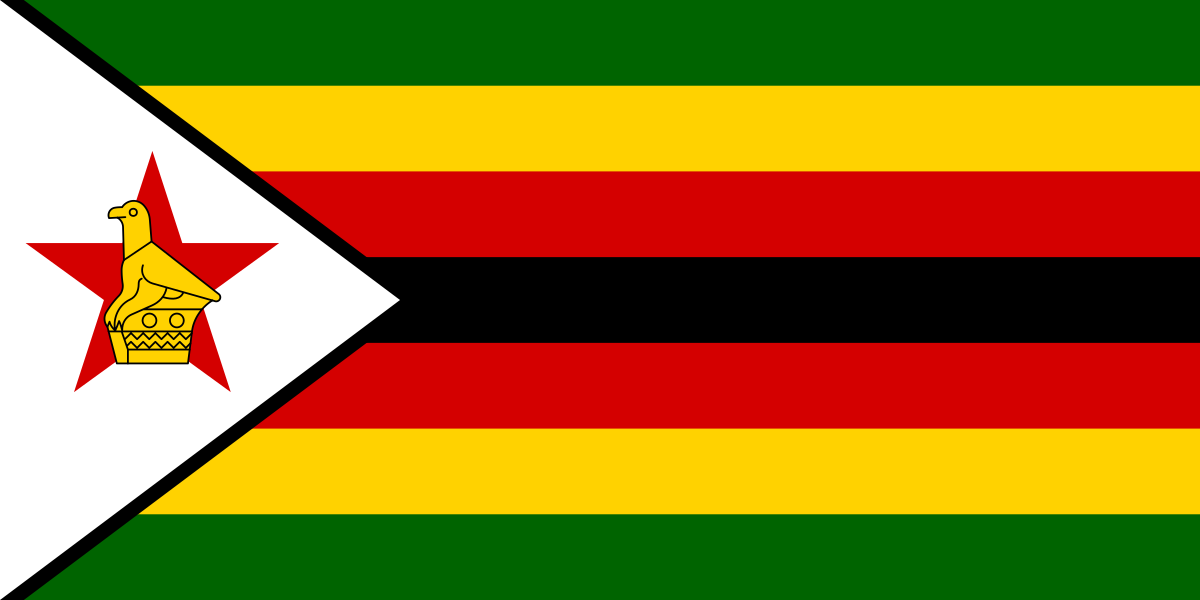
Zimbabwe's adoption of a single time zone at independence in 1980 was influenced by its role as a regional hub, aligning clocks with neighbors to streamline the 1979 Lancaster House Agreement timelines that ended minority rule. This unification helped synchronize the midnight celebrations of April 18, 1980, when the new flag was raised precisely at 00:00 CAT across the nation.
Zimbabwe, a landlocked nation in southern Africa with a population of around 16 million, is renowned for its stunning Victoria Falls, ancient Great Zimbabwe ruins, and vibrant wildlife reserves. As a country in the Southern Hemisphere, it experiences a subtropical climate that influences its daily and seasonal rhythms. Zimbabwe operates on a single time zone, Central Africa Time (CAT), which is UTC+2, providing a consistent temporal framework across its diverse landscapes from the Highveld plateaus to the Zambezi River valley. This unified time organization supports the nation's economic activities, cultural events, and international connections, ensuring that whether you're planning a safari in Hwange National Park or business in the capital, Harare, the clock ticks reliably year-round.
Zimbabwe adheres to a straightforward time zone structure, utilizing just one official zone throughout its 390,757 square kilometers. The designated IANA time zone identifier is Africa/Harare, corresponding to Central Africa Time (CAT) with a fixed UTC offset of +2 hours. This zone encompasses the entire country, from the bustling capital Harare in the north-central Mashonaland region to the industrial hub of Bulawayo in the southwest Matabeleland, and eastern border cities like Mutare near the Mozambique frontier. Harare, home to over 1.5 million residents and the political and economic heart of Zimbabwe, exemplifies this zone's application, where government offices, markets, and international airports synchronize to CAT.
The geographic and political logic behind this single-zone approach stems from Zimbabwe's relatively compact size and longitudinal span, which falls mostly between 25°E and 33°E—well within the 15-degree bandwidth that typically justifies one time zone without significant discrepancies. Politically, adopting a uniform time zone post-independence in 1980 fostered national unity in a country with 16 official languages and diverse ethnic groups, including the Shona and Ndebele peoples. This decision aligns with neighboring nations like South Africa, Botswana, and Zambia, all on UTC+2, facilitating seamless cross-border trade, tourism, and communication in the Southern African Development Community (SADC). For travelers, this means no internal time adjustments are needed when journeying from the Eastern Highlands' tea plantations in Nyanga to the Lowveld's game reserves in Gonarezhou National Park. In practice, the Africa/Harare zone ensures that events like the Harare International Festival of the Arts or Bulawayo's Umhlanga Reed Dance occur on a shared schedule, promoting cultural cohesion. Economically, it supports mining operations in Kwekwe and agricultural cycles in the fertile Mashonaland plains, where farmers rely on predictable daylight for maize and tobacco harvests. Overall, this singular time zone reflects Zimbabwe's commitment to simplicity and integration in a region where time zones could otherwise fragment daily life.
Zimbabwe does not observe Daylight Saving Time (DST), maintaining Central Africa Time (CAT) at UTC+2 consistently throughout the year. This policy has been in place since the country's independence, with no switchover dates or clock adjustments required. The primary reason for forgoing DST lies in Zimbabwe's tropical to subtropical climate, where seasonal daylight variations are minimal compared to temperate zones; the country lies near the Tropic of Capricorn, experiencing roughly 12 hours of daylight year-round, with wet summers from November to March and dry winters from May to October. Introducing DST would disrupt agricultural routines, energy consumption patterns, and public health without yielding benefits like extended evening light for urban activities, as historical trials in colonial Rhodesia proved inefficient.
The practical consequences of no DST are overwhelmingly positive for daily operations. Businesses, schools, and transportation systems benefit from unchanging schedules, reducing confusion and errors in a nation where electricity reliability can already be challenged. For instance, Victoria Falls tours and safaris in Mana Pools National Park run on fixed timetables, allowing visitors to plan without worrying about time shifts. Internationally, it simplifies coordination with DST-observing partners, though travelers must account for offsets elsewhere. Locally, this stability supports the informal economy, where street vendors in Harare's markets operate from dawn without seasonal disruptions. Health-wise, consistent sleep patterns help mitigate fatigue in a population facing economic pressures. In essence, Zimbabwe's rejection of DST underscores a pragmatic approach tailored to its equatorial influences, prioritizing reliability over artificial time manipulations.
In Zimbabwe, the daily rhythm blends traditional African communalism with modern urban influences, shaped by the consistent UTC+2 time zone and a climate that encourages outdoor living. Typical meal times reflect this balance: breakfast is often light and early, around 6:30–8:00 AM, featuring sadza (maize porridge) with milk or tea for workers heading to fields or offices. Lunch, the main meal, occurs between 12:30–2:00 PM, commonly including relishes like muriwo (greens) or meat stews shared in family or workplace settings, aligning with the midday heat when productivity dips. Dinner is served later, from 7:00–9:00 PM, with heartier portions of nyama (grilled meat) during social gatherings, allowing time for the sun to set around 6:30 PM year-round.
Office hours in cities like Harare and Bulawayo generally run from 8:00 AM to 5:00 PM, Monday through Friday, with a one-hour lunch break; government ministries and banks close promptly at 4:30 PM to accommodate traffic. Shops and markets, such as Harare's vibrant Copy Cat Market or Bulawayo's bustling flea markets, open around 8:00–9:00 AM and stay active until 6:00–7:00 PM, extending into evenings on weekends. In rural areas, the rhythm ties closely to sunrise (about 5:30–6:00 AM) for farming, with evenings dedicated to community braais (barbecues).
Nightlife pulses in major cities, particularly Harare's First Street district, where bars and clubs like House of Ghetto or Jazzy Club open from 9:00 PM onward, drawing crowds for live mbira music or Afrobeat until 2:00–4:00 AM on weekends. Bulawayo offers a more laid-back scene with shebeen pubs serving chikoro (local brew) into the night. Documented local specifics include the Shona concept of "Zimbabwe time," a cultural nod to flexible punctuality in social contexts, though formal events like weddings adhere strictly to schedules. Religious observances, with over 80% Christian population, often start services at 8:00 AM Sundays, influencing the weekend rhythm. This lifestyle fosters resilience, as seen in how economic challenges have led to adaptive routines, like early market trading to beat the heat.
Zimbabwe's Central Africa Time (CAT, UTC+2) creates straightforward yet variable offsets with global cities, aiding travelers and remote workers. Compared to London, which follows Greenwich Mean Time (GMT, UTC+0) in winter (late October to late March) and British Summer Time (BST, UTC+1) from late March to late October, the offset is +2 hours during London's winter and +1 hour during summer. For New York, on Eastern Standard Time (EST, UTC-5) from November to March and Eastern Daylight Time (EDT, UTC-4) from March to November, Zimbabwe is +7 hours ahead in winter and +6 hours in summer. Paris mirrors London's pattern, with Central European Time (CET, UTC+1) in winter and CEST (UTC+2) in summer, resulting in a +1-hour difference year-round since both shift simultaneously relative to UTC.
For the best windows to call from the UK or US, aim for Zimbabwe's morning hours to align with European or American afternoons. From London, dial between 9:00 AM and 5:00 PM UK time during winter (11:00 AM–7:00 PM in Harare) or summer (10:00 AM–6:00 PM in Harare) to catch business hours without encroaching on evenings. US callers from New York should target 8:00 AM–12:00 PM EST/EDT (3:00 PM–7:00 PM CAT), ideal for morning meetings in Harare when it's still reasonable there. Tools like world clocks on sites such as Timeanddate.com can confirm real-time differences, especially for video calls via Zoom.
Jet-lag recommendations for travelers emphasize gradual adjustment due to the 5–8-hour shifts from Western hubs. Flying east from London or New York, arrive in Harare and expose yourself to natural light immediately—start with morning walks in Harare Gardens to reset your circadian rhythm. Hydrate well en route, as Zimbabwe's dry season (May–October) exacerbates dehydration, and avoid caffeine post-arrival. For westbound returns, shift sleep earlier pre-flight. Business travelers might schedule arrivals mid-week to acclimate before Monday commitments, while tourists to Victoria Falls should plan rest days. Apps like Timeshifter provide personalized plans based on flight paths, helping mitigate the 1–2 days of fatigue common on these routes. Overall, Zimbabwe's stable time zone makes adaptation smoother than in DST-variable destinations.
**
Zimbabwe operates in the Central Africa Time zone (CAT), which is UTC+2, and this applies uniformly across the country including the capital Harare. There is no Daylight Saving Time, so the offset remains constant year-round. To check the exact current time, use reliable sources like world clock apps or websites such as Timeanddate.com, which factor in your local time for instant conversion.
Zimbabwe does not observe Daylight Saving Time, sticking to UTC+2 throughout the year for consistency in its tropical climate. The time offset with London varies seasonally: it's +2 hours when London is on GMT (UTC+0) from late October to late March, and +1 hour during British Summer Time (BST, UTC+1) from late March to late October. This makes scheduling calls straightforward, with no unexpected shifts on the Zimbabwean side.
The best time to call from the UK is between 9:00 AM and 4:00 PM local time, which corresponds to 10:00 AM–5:00 PM (summer) or 11:00 AM–6:00 PM (winter) in Zimbabwe, overlapping business hours. From the US East Coast, aim for 7:00 AM–12:00 PM EST/EDT, hitting 2:00 PM–7:00 PM CAT for productive conversations. For travel, the dry season from May to October offers mild weather (15–25°C) and optimal wildlife viewing, though avoid peak holiday crowds in July–August; flights from London or New York typically take 10–14 hours, so plan for jet lag recovery.
Daily life in Zimbabwe follows a rhythm synced to natural light, with offices and shops opening around 8:00 AM and closing by 5:00–6:00 PM. Major sites like Victoria Falls National Park welcome visitors from 6:00 AM to 6:00 PM daily, with guided tours starting as early as 7:00 AM to catch the mist at dawn. In Harare, the National Gallery operates 10:00 AM–5:00 PM Tuesday–Sunday, while markets buzz from 7:00 AM until dusk, reflecting the cultural emphasis on communal morning activities.
Zimbabwe's uniform Central Africa Time (UTC+2) promotes national unity by eliminating internal time barriers, allowing seamless coordination for events like the annual Big 7 Marathon in Victoria Falls or cultural festivals in Bulawayo. This consistency supports diverse ethnic groups, from Shona farmers in the east to Ndebele artisans in the west, in sharing calendars for holidays like Independence Day on April 18. It also aids tourism, as travelers don't adjust clocks when moving between regions.